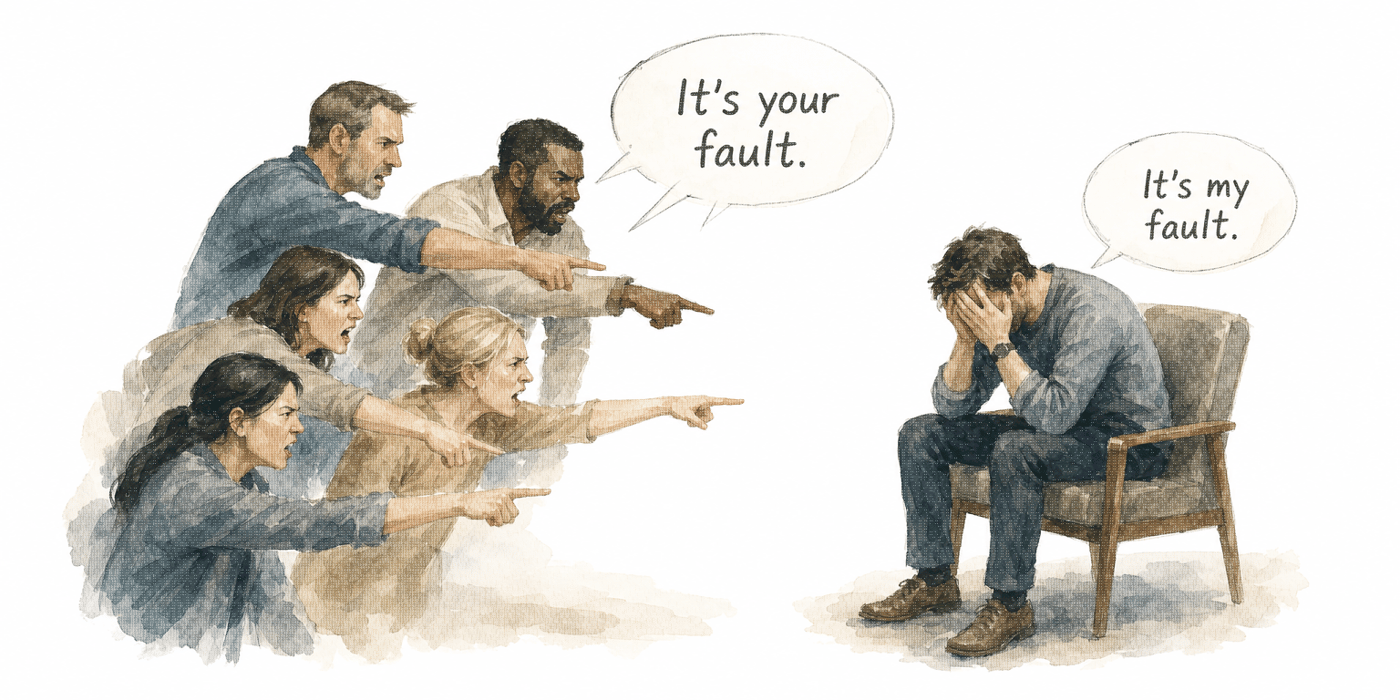

There seem to be three broad kinds of people in the modern Western world, distinguished less by politics or class than by where they locate the causes of what happens to them and others.
The first internalizes nearly everything — these are the chronic internalizers. Success is earned, failure is personal, and when something goes wrong, the first question is, What did I do? There is something admirable about this instinct because it preserves agency and responsibility. Taken too far, however, it becomes irrational. Sometimes the tornado really does hit your house. Sometimes you get cancer. Sometimes someone cheats you. Not everything that happens to us is our doing.
The second type has the opposite problem — these folks are the chronic externalizers. Success may be his accomplishment, but failure belongs to someone else: society, capitalism, racism, sexism, government, his parents, his employer, bad luck, or simply “the system.” Another actor somewhere in the causal chain can always be assigned responsibility. This worldview has an obvious psychological advantage. If nothing bad is your fault, there is little reason to examine yourself.
Psychology has names for much of this. Julian Rotter, an American psychologist known for developing social learning theory, called the general tendency locus of control, distinguishing between people who tend to see outcomes as resulting from their own actions and those who see them as largely controlled by outside forces. Later, Bernard Weiner, a well-known American psychologist and currently the Distinguished Research Professor of Social Psychology at UCLA, developed what he called attribution theory that both complicated and clarified the picture by recognizing that causes can be internal or external, stable or temporary, controllable or uncontrollable.
That brings us to the third type, the “discriminating attributors,” and probably the hardest one to be.
The rational person understands that life is an untidy mixture of personal agency and external circumstance. He asks what actually caused the outcome. What was within my control? What wasn’t? What did someone else do to me? What did I do to myself? Most importantly, what can I change the next time?
That requires considerably more intellectual discipline than either extreme because both extremes offer simple answers. Internalize everything and the world is entirely your responsibility. Externalize everything and the world is entirely someone else’s. Reality is rarely so accommodating.
Bernard Weiner’s take on attribution theory gets considerably closer to what I am thinking. Weiner argued that when something happens, people attempt to determine why. They tend to classify causes along at least three dimensions:
Locus (internal or external), Stability (stable or unstable), and Controllability (controllable or uncontrollable).
Here’s how that might appear — let’s say the triggering event is the loss of a job:
The internalizer might conclude that “I lost my job because I’m incompetent,” while an externalizer might conclude that “I lost my job because management is corrupt,” while the reality might be: “The company lost a major customer, my division was shrinking, I wasn’t performing particularly well, and management chose me rather than somebody else.”
That last explanation requires something beyond merely having an “internal locus of control.” It requires asking those rational questions.
It might seem that the extremes of internalization and externalization are finite and opposite categories, but I have observed an interesting, and potentially malevolent, nexus between those two.
The most pernicious example is how white individuals internalize white guilt. It plays into the perception that none of the problems of black Americans are their problem; it is due to white supremacy and racism.
The malevolent part is how political forces can manipulate the internalizers and externalizers to coalesce into one group that would seem from the outside to be completely contradictory — but it is currently being done with the idea that crime is not the responsibility of the criminal; it is society that makes the laws that is the problem.
And it can turn personally destructive.
There are cases where crimes were committed by a member of a “protected” minority class, and the victim refuses to participate in prosecution for externalization reasons. In January, Anna Krauthamer, a Columbia PhD candidate, revealed in a published essay that she chose not to report her 2021 gang rape in Las Vegas because of her rigid prison abolitionist views. She actually wrote, “I don’t want to ruin the lives of my rapists, and I don’t know if they have children. The only thing I want is for them to never have done what they did to me, and nothing, including sending them to prison, will ever change that reality.”
In a case of life imitating art, there was a 2024 “Law & Order: SVU” episode that featured a white woman resisting testifying against her black rapist because she didn’t want to perpetuate “systemic” inequality.
It certainly appears to me that Western culture has increasingly institutionalized the second explanation. We have developed an enormous vocabulary for external causation: systems, structures, privilege, oppression, trauma, social determinants, and institutional forces. Some of these describe very real things. The problem begins when they become universal explanations that progressively squeeze individual agency out of the equation.
It’s hard to explain — take the curious situation of white progressives: they externalize when they believe blacks are not to blame for their situations and whites always are, but they are also white internalizers, so they must be part of the problem. Nothing is more soothing than having that internal guilt transferred to a larger group. That’s a significant reason why communism seems so seductive to the left. It not only redistributes wealth, but also makes responsibility and causation characteristics of the collective rather than the individual.
Everybody is to blame, so no one is to blame.
Our problems seem to begin and end with the internalizers and externalizers. America was designed for discriminating attributors, and none other.
A society that internalizes everything can become cruel because it refuses to recognize misfortune and injustice. On the flip side, a society that externalizes everything becomes helpless because nobody is responsible for anything. A functioning civilization requires something more difficult: people capable of looking honestly at both the world and themselves and figuring out which one really needs fixing.