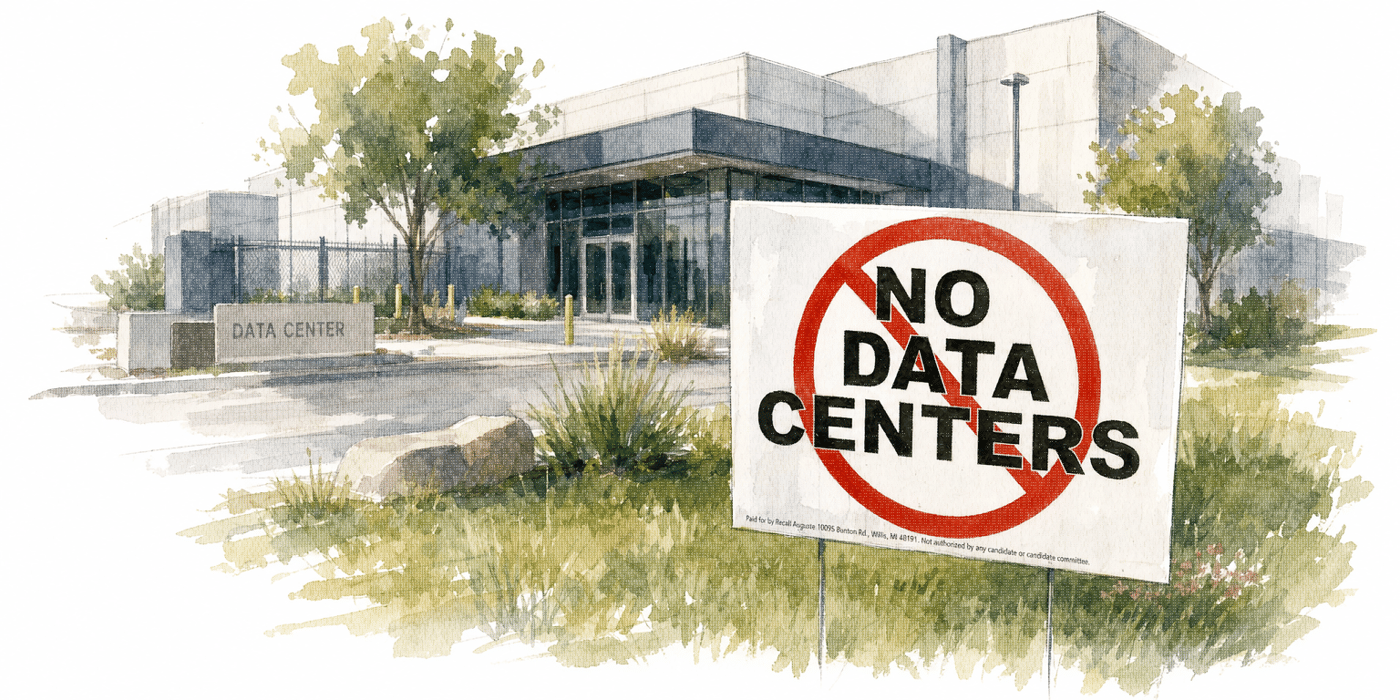

“They basically dug their own grave,” said Texas Republican Governor Greg Abbott of the tech companies building data centers.
Backing up a moment, Abbott was explaining the rationale behind his recent moratorium blocking new data centers in the Lone Star State until regulators and legislators can get their footing and establish a better system. Previously, Texas had offered tax breaks for data centers. Last year, Abbott proudly announced a $40 billion investment by Google to make Texas the “epicenter of AI development.” Indeed, The Texas Tribune reported in June that “the state has a total of 335 existing data centers, with at least 248 more in the works.”
But amid public complaints about electricity, water, noise, and so on, Abbott is hitting the pause button. He now says it’s all about technology companies failing to pursue and win public support before barreling headlong into construction.
“Gaining the support of people in local communities is essential,” Abbott asserted. “Because they did not do that, that’s why I am now coming in as governor, saying, ‘Listen, if you’re a data center and you want to operate in Texas, you have to first get the approval of those in local communities.’”
“They pop up in places that nobody ever heard of before until they started the construction,” the governor added. “And so they had not been working in collaboration with the state. They had not been in collaboration with local governments, and so they basically dug their own grave for the problem that’s been caused for them, and that’s why they got the backlash they deserve. And that’s why these new standards are in place to make sure they’re not going to be able to operate until they come into compliance with the standards that I have set.”
Abbott’s about-face is a concession to political reality. Public opinion has quickly and decidedly turned against data centers. Whereas most Americans didn’t have much of an opinion a year ago, a growing majority now opposes them. Depending on the poll, roughly 60-75% of Americans oppose the construction of new data centers anywhere remotely near their backyards. Democrat Gina Hinojosa is challenging Abbott this November, and one of her major planks is a moratorium on data centers.
Similarly, Ken Paxton, the baggage-ridden Republican running in a tight race against James Talarico for U.S. Senate in Texas, has staked out a position of stringent guidelines for data centers. “Texans deserve a fighter to lead and represent them as we address the growing presence of data centers in Texas and stop their negative impact on our neighborhoods,” Paxton said in a statement. “This plan will ensure that happens while putting Texas first, protecting our culture and land, and safeguarding our families and communities.”
Texas is hardly alone. New York Democrat Governor Kathy Hochul recently signed a moratorium on data center construction in her state, and Pennsylvania Democrat Governor Josh Shapiro is working to restrict the “bullies” and “speculators” who build them. More politicians in more states are vying to tap into (and fuel) voters’ anti-data-center sentiment.
Well, except President Donald Trump. “If I were the mayor of a town or the governor of a state, and I had a chance to get a big plant in, an AI plant or a data center, I would absolutely want it because the jobs are enormous, and the money paid, the taxes paid, are just enormous,” Trump said. “It’s going to create success. It’s going to create tremendous innovation medically.”
He’s not wrong. In fact, America faces a tech race with China. The Communist Chinese won’t be handicapped by a few “No Data Center” signs in their neighborhoods. They have ways of dealing with people with inconvenient opinions, for one thing, and for another, the Chinese state does whatever it wants. Thank God that’s not true here.
Nevertheless, America must compete, and that means building data centers. The editors of National Review boldly state, “In America, built by Americans, for Americans, with the jobs, economic benefits, and tax revenues benefiting Americans.”
Of course, I wouldn’t want one in my backyard, either. But as National Review’s Rich Lowry not-so-subtly put it, “We never would have become the country we are now if the response to the physical assets necessary for economic growth and good blue-collar work had been, ‘Not in my backyard.’”
Moreover, most of the reasons Americans oppose data centers aren’t as problematic if they’re built in the right areas with the best guardrails and features. For example, centers now use closed-loop water systems, mitigating concerns about local supply by recycling their water. New plants are also often built with their own power supply, addressing concerns about the grid. Unfortunately, many of those problems still plague older centers, and Americans simply noticed.
That doesn’t mean Senator Bernie Sanders was correct to warn that data centers and AI will have a “catastrophic impact” on Americans. He and his fellow communists in China are doing more to stoke outrage about data centers than anyone. There are real problems to address, but let’s solve them without unilaterally disarming and losing the technology war to China. After all, rising to meet challenges is what America is all about.
---
The Federalist’s John Daniel Davidson offers some intriguing food for thought:
Put simply, the reason so many people are skeptical of the next phase of the digital revolution is because they don’t believe the first phase has made their lives better. They know that an AI-dominated society — powered by massive data centers scattered across the land — means more of what the internet age has already brought us, in increasingly powerful and irresistible forms.
So if you want to make the case for data centers, don’t talk about how they will reduce electricity bills or increasing local tax revenue, or how they don’t actually use that much water. That is not why people really object to them. They object because they know that the promises of the digital revolution were empty, and that the internet and social media and hyper-connectivity has not made life better. Life is not better because you can use an app to get toilet paper delivered to your house or because you can place bets in real time on everything imaginable. Actually, life is worse because of those things, in ways that are hard to quantify, unlike GDP or utility rates.
If the pro-data center people make a persuasive case, they will have to address the actual fears that people harbor about being left naked before the rapacious forces of the AI revolution — a revolution that no one understands and no one can control.