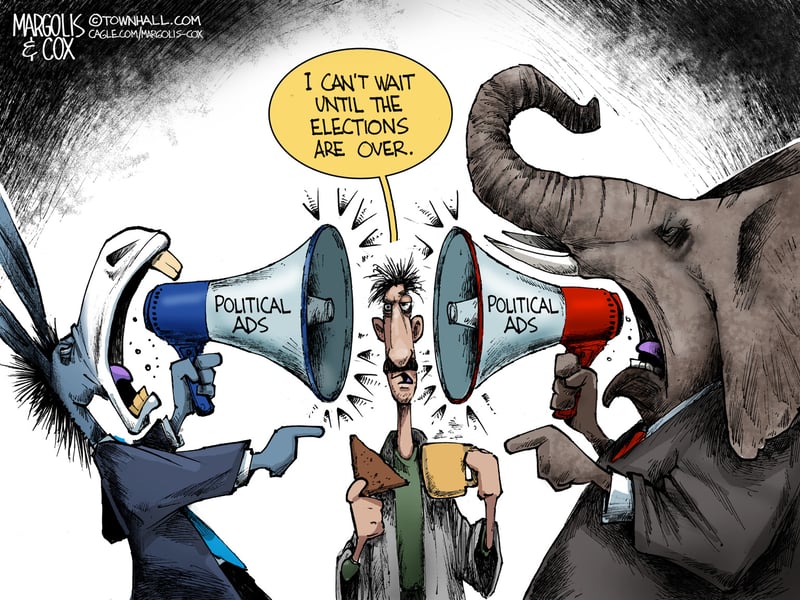

With the 2026 midterms just days away, frustration is growing among some conservative voters. Some are disappointed with President Donald Trump, others feel Republicans in Congress haven’t delivered on their promises, and others have grown disillusioned with the political process altogether. That frustration has led them to believe that the solution is to sit out the 2026 midterms.
That’ll show Trump! That’ll really teach Republicans a lesson! And what better way to send a message than to hand Democrats a victory? Brilliant strategy.
Except there’s one glaring problem with that logic: Elections aren’t just about rewarding politicians who keep their promises or punishing those who don’t.
Free speech, the right to life, and constitutional freedoms are directly under threat. Your vote isn’t just about which politicians deserve your support — but what kind of country you want to preserve. The Right’s vision for America’s future stands in stark contrast to the dangerous shift in values being pushed by the Left. Sitting out is not an option.
Political violence and the normalization of hatred
The assassination of Charlie Kirk in September 2025 exposed something deeply disturbing about America’s political climate. A husband and father was killed while engaging in the very kind of open debate that makes a free society possible: exchanging ideas with people who disagree.
Civil debate has long been a cornerstone of American progress. It’s how we challenge ideas, find common ground, and maintain unity despite our differences.
Kirk himself once warned, “When people stop talking, really bad stuff starts.”
The reaction from leftists made it disturbingly clear that they viewed Charlie Kirk’s murder not only as justified, but as the kind of retaliation people should expect for challenging their beliefs.
It’s precisely this normalization of political violence that makes the warning from National Review editor Mark Antonio Wright, following Kirk’s murder, so important.
Wright emphasized that constitutional government, elections, and free debate exist precisely because the alternative is settling political disagreements through violence. He also issued a sobering warning to Americans who might allow such a heinous act to intimidate them into withdrawing from politics, elections, or public debate.
“We are staring into the abyss,” Wright writes. “The moment when Americans of goodwill abstain from entering the public arena — as politicians, as activists, as citizens — will be the moment we refuse our God-given right to govern ourselves. If we are cowed by violence and the threat of violence into staying silent and avoiding political discourse, we are no longer free.”
This should alarm every American, regardless of political affiliation. When expressing an unpopular opinion invites threats, intimidation, or even murder, free speech becomes a right people are afraid to exercise. And when political violence is excused, fear replaces debate. A nation where people are afraid to speak freely is a nation that has lost its freedom entirely.
“Free Speech” is for those with the approved views
Increasingly hostile political rhetoric has created an environment where far too many Americans are afraid to express their beliefs publicly for fear of retaliation.
In January 2026, National Review reported on a Students for Life of America poll finding that 92% of surveyed voters ages 18 to 45 were concerned about violence targeting people for exercising free speech.
That concern is hardly unfounded. The media’s repeated comparisons of Trump to Hitler, his supporters to Nazis, his allies to the Gestapo, and his base to fascists have created a narrative that portrays the right as comparable to regimes responsible for torture, brutality, and the extermination of millions of innocent people. That rhetoric has convinced left-wing voters that they’re confronting an evil so extreme that violent retaliation is not only justified, but something their political opponents should expect.
But the encouragement of violence extends beyond media rhetoric.
Conservative commentator Ben Shapiro has warned that specific ideologies combined with inflammatory political rhetoric have created “permission structures for violence.” When people frame ideological disagreements as threats to their very existence, they foster an “either me or them” mentality that makes violence seem necessary.
Using radical transgender ideology as an example, Shapiro wrote, “When Charlie Kirk was assassinated, it was obvious almost immediately that the ideology that was driving the shooting was a left-wing, radical trans ideology.” He argues that, by labeling the statement that a man is not a woman as “trans genocide,” the Left makes disagreement seem like a deadly threat.
That is precisely where free speech is most at risk: expressing views that differ from the Left can provoke retaliation of any kind.
Abortion and the value of human life
Abortion is no longer simply a moral disagreement. It has become a gateway for government to decide who deserves to live, reducing human life to a political calculation.
Even more troubling, the arguments have evolved beyond “safe, legal, and rare” and “a woman’s right to choose.” Abortion was once defended as necessary in difficult circumstances involving rape, incest, or threats to the mother’s life. But abortion advocates have since embraced a far more troubling position: openly acknowledging that the unborn child is a human being, yet arguing that its humanity is irrelevant if a woman chooses to end her pregnancy for any reason.
And that’s the point. For the Left, humanity has become irrelevant.
TPUSA representative Shane Winnings and a college student clashed over this very issue. Winnings argued that human beings have inherent value simply because they are human. The student rejected that biblical standard, arguing that human life has no inherent value and that people can justify deciding who lives and dies under a wide range of circumstances.
This is exactly where we feared the abortion debate would lead, and the potential implications for society — and the laws designed to protect human life, or lack thereof — are terrifying.
These opposing views on human life’s inherent value reveal the kind of society we risk becoming if those in power decide that an innocent person’s right to life depends on their development, circumstances, or convenience to others, then write laws to justify taking that life.
Constitutional rights and accountable government
Beyond individual controversies lies a broader question about the government’s relationship with its citizens.
Conservatives prioritize limited government, constitutional freedoms, and preserving the values that have allowed generations of Americans to prosper, overcome adversity, and build better lives through hard work and personal responsibility.
By contrast, the Left advocates bigger government and increasingly restrictive policies that threaten individual freedoms, replacing personal liberty and traditional values with a system of government control that demands compliance under threat of retaliation.
The importance of participation
Political disappointment is inevitable. No president or party will deliver everything its supporters expect. But the stakes of sitting out go beyond individual policies. We’re now deciding whether America remains grounded in the principles of free speech, the right to life, and liberty under the Constitution — or moves toward a society where dissent is silenced, human life is treated as conditional, and political violence is excused.
Ultimately, what’s at stake is not just who governs, but the values that define our nation. Our rights are either God-given and protected by government or privileges that those in power can grant and revoke. The Founders established the Constitution to prevent the latter.