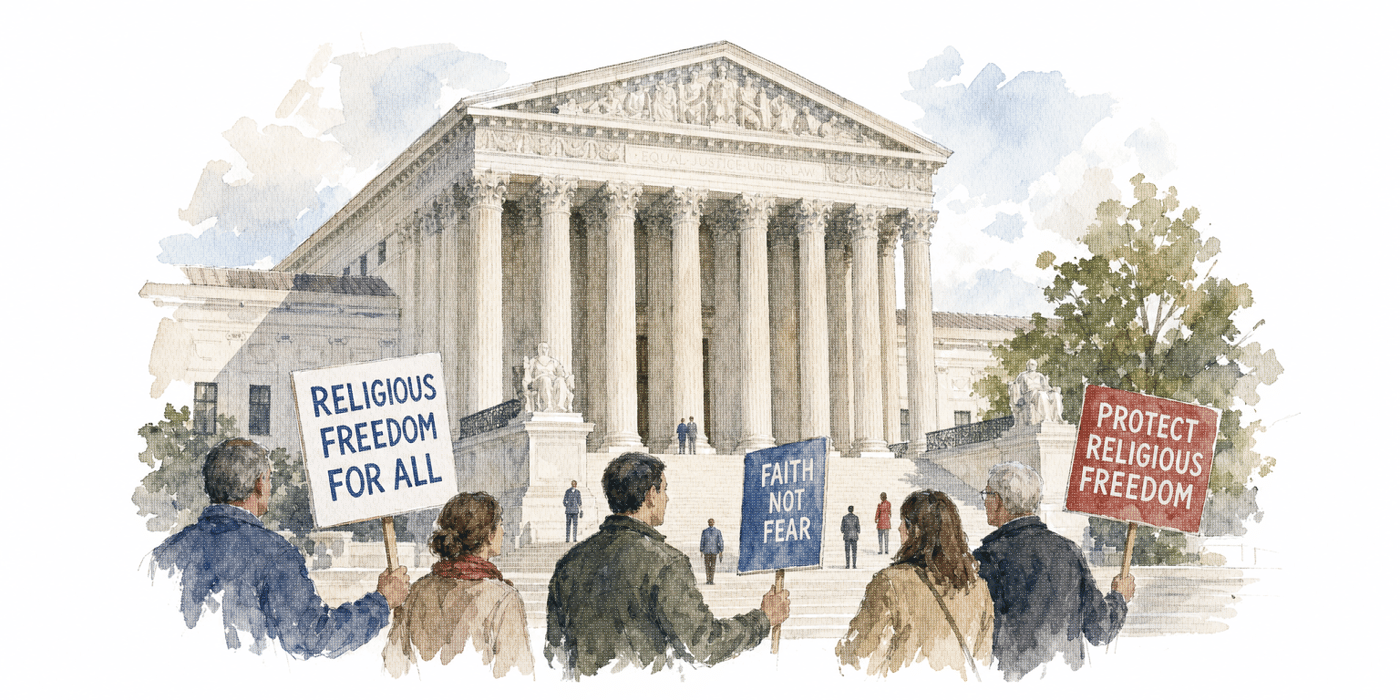

Can a state mandate social views onto the community regardless of people’s religious and moral beliefs, so long as the state couches it under “nondiscrimination”? The U.S. Supreme Court will effectively answer this question in another religious discrimination case out of Colorado.
The high court heard oral arguments on St. Mary Catholic Parish v. Roy on Tuesday. Colorado’s “universal” preschool program grants up to $6,500 per student to “qualifying” schools. The state has excluded 34 Catholic schools from participating in the program because these religious schools refuse to sign the state’s “nondiscrimination” agreement that requires the affirmation of LGBTQ ideology and same-sex marriage.
Colorado argues that excluding Catholic schools from the program does not constitute religious discrimination but enforces a “generally applicable” nondiscrimination requirement for all state residents.
Colorado further notes that it hasn’t prevented parents from sending their children to these schools and contends that Catholic schools, not the state, have engaged in discrimination by requiring the parents of preschoolers to sign an agreement that they will support the church’s teachings on sexuality and marriage.
The attorney representing the Catholic schools, Nicholas Reaves, explained that the schools “exist to pass on the faith to the next generation,” and therefore “to do this, they ask all families who enroll to be open to and supportive of the church’s teachings.” Furthermore, Reaves pointed out that the state has been inconsistent in the application of its nondiscrimination requirement, noting that Colorado “has flexibly interpreted the [nondiscrimination] mandate to accommodate important secular interests, but it’s called the same law a hard limit when petitioners sought a religious accommodation.”
Reaves also observed, “Letting families use universal preschool funding at Catholic schools won’t take away a single seat from the over 2,000 preschools already participating in the program. In fact, letting Catholic schools in will create more seats for everyone, even for families who disagree with Catholic teachings.”
The justices’ comments and questions suggest the conservative-leaning Court sympathizes with the Catholic schools’ position.
For example, Justice Brett Kavanaugh pointedly challenged the state’s position, noting, “I notice one preference that’s allowed: schools are allowed to have preference for parents who will be more involved in the school. ... That almost inherently discriminates against single-parent families, inherently discriminates against families with two-income parents in the real world.” He then asked, “You can have a vegetarian school, but you can’t have a Catholic school; you can’t have a Jewish school. ... How do you respond to those concerns?”
The Roberts Court has a positive track record of upholding the First Amendment and defending religious freedom.
Hopefully, that trend continues, as this case, while on the surface relatively minor and localized to Colorado, actually highlights the secular Left’s very real efforts to discriminate against Biblically committed Christians’ religious liberty, all under the guise of “inclusiveness” and “nondiscrimination.”
Should the justices side with Colorado, that could open the floodgates to the passage of so-called “nondiscrimination” laws that would discriminate against and limit conservative Christians from freely engaging and applying their religious views in the public square. For example, states could create a litmus test to force people to accept their radical views on gender, sexuality, and marriage. The implications should seriously trouble conservatives.
This case also shows just how committed the Rainbow Mafia is to forcing its views onto all Americans. Oh, you can believe what you want, as long as you don’t let your beliefs shape how you view and engage with society.