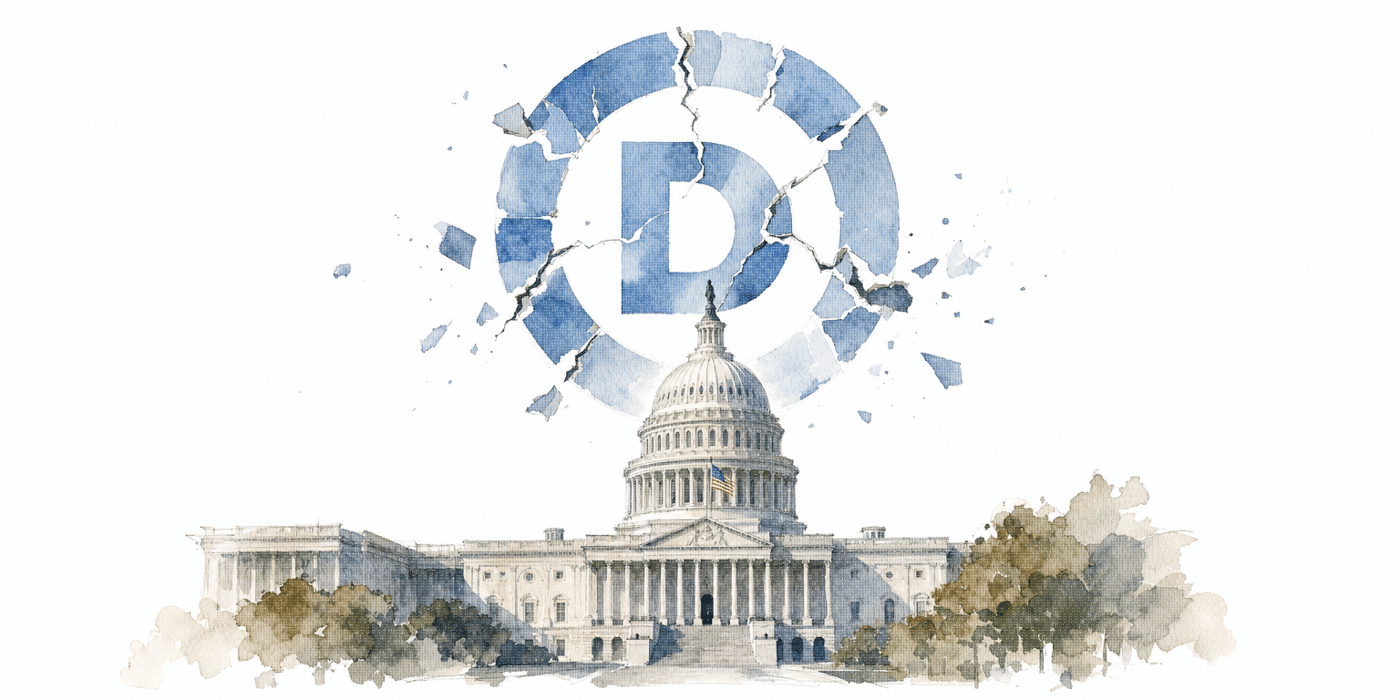

The blue tsunami could cause party disagreements in the new Democrat congressional majority. Some even wonder whether those divisions could fuel an inner-party civil war for control of the party.
The most prominent victory of the night for Democrats came in Michigan, where Senate candidate Abdul El-Sayed easily overcame Republican Mike Rogers in a race many had considered a toss-up.
Following his victory, El-Sayed gloated, “JD [Vance], there is this delicious irony in the fact that you’re constitutionally obligated to swear me in, in January.”
While El-Sayed is not technically a member of the Democratic Socialists of America (DSA), for all intents and purposes he is one, and, apologies to Bernie Sanders, he may arguably be the most radical leftist ever to hold the office of U.S. senator.
Also celebrating was the co-chair of the DSA’s national political committee, Ashik Siddique, who heralded the victories of eight DSA candidates in House races as just the latest evidence of the Marxist-committed group’s continued rise to party power.
“Democratic Socialists of America are building an enduring organization that can lead an enduring movement,” Siddique crowed. “We’re now seeing DSA candidates win reelection to second or third terms across the country. We ran more candidates in this cycle than ever before. I think there were at least 200 candidates at many levels of government, from local up to Congress. So we’re really leading the conversation and helping to shift public opinion on a wide range of issues.”
He further noted how a number of the DSA’s platform issues, like abolishing ICE, an anti-Israel agenda, and Medicare for All, have seemingly become mainstream issues for Democrats.
Siddique expressed confidence that this hard-left ideology would only continue in Washington, even if there is some pushback from establishment Democrats. He pointed to the staying power of Alexandria Ocasio-Cortez and the increasing numbers of DSA-aligned representatives to bolster his conviction.
And in many ways, he is not wrong. DSA candidates have certainly been punching above their weight in recent elections. A party that numbered just 6,000 members in 2016 now boasts over 130,000 today, and with these recent election victories, is likely to grow even more. The DSA will boast eight representatives in the new Congress, doubling its current number.
The DSA has also made it clear it has its own ideas for Democrat leadership, namely pushing out the current leaders, House Minority Leader Hakeem Jeffries and Senate Minority Leader Chuck Schumer, in favor of younger, more radically driven leadership.
Jeffries’s comments on the Democrats’ victory seemed to signal that not all Democrats embrace a radical socialist agenda. “Enough of the extremism,” he said. Of course, his warning was aimed at President Donald Trump, but it also put the DSA on notice that Jeffries has no intention of giving up his leadership position.
In fact, despite the DSA’s strong showing, the Democrats’ tsunami of a victory may ironically lessen the power of the radical socialists. With more mainstream Democrats elected, especially from red parts of the nation, where they ran as moderates and focused primarily on economic issues, Jeffries can lose the eight DSA votes and still have little problem securing the speakership. Democrats will likely enjoy their largest House majority since 2009-2010, meaning Jeffries can essentially ignore the noisy DSA faction.
The faction of Democrats that has grown most over the last couple of election cycles has been the more moderate so-called New Democrat Coalition, which has risen from 43 members to 114, with a strong chance of adding 22 or 23 more in the new Congress after all the votes are finally counted.
So, while the prospect of a civil war within the Democrat Party may seem plausible, given the noisy and radical nature of the DSA faction, it is unlikely. In reality, both Jeffries and Schumer will likely keep their leadership positions as establishment Democrats once again reassert their power.