
After two weeks of relatively upbeat post-midterm columns by yours truly, reality is creeping in. I’d naively visualized that mature adults — with policy and political differences, but a common love of country — might find ways to collaborate, both for the good of their respective political parties and for our country. But no such luck.
The unfortunate truth is that leadership and majority members of both chambers of the new Congress would be quite happy to see our elected President and his administration fail — hopefully in spectacular fashion — thus giving Democrats the inside track for the 2028 presidential election.
Their political zeal is understandable; their lack of concern about the enormous risks posed by two years of dysfunctional, internally combative leadership is not. But in any case, it’s safe to assume the Democrats have known all along what they would do if they won majorities in both chambers. Now they have to convince voters that they’re getting what they voted for.
But wait — whatever happened to affordability? In fact, didn’t they call it “the affordability crisis”? Until just two weeks ago, weren’t Democrat federal and state candidates everywhere claiming total focus on the issues that really matter to the American public, and assuring voters that number one on that list was affordability?
Suddenly, affordability is missing in action, swept aside and ignored as Democrats leap enthusiastically into matters such as impeaching a key member of the President’s cabinet. They’re issuing warnings to Republican officials to “lawyer up,” to expect a blizzard of subpoenas, and they openly identify other cabinet officers as potential impeachment targets. But nary a word about affordability and what they plan to do about it.
When pressed about their seeming amnesia about pre-election promises, Democrat spokespersons have adopted the curious practice of redefining otherwise well-understood words and claiming that they’re doing exactly what they’d promised. For example, Congressman Jamie Raskin (D-MD) has opined that accountability and affordability are not two competing priorities but the same issue — and that corruption is the reason people can’t afford things. House Minority Leader Hakeem Jeffries (D-NY), Senate Minority Leader Chuck Schumer (D-NY), and incoming House Oversight Chair Robert Garcia (D-CA) have made similar assertions on numerous occasions.
In essence, the Democrats’ new affordability message is “Don’t worry, America — a few more subpoenas, maybe another impeachment or two, and the price of eggs will be dropping like a rock.” But does anyone actually believe it?
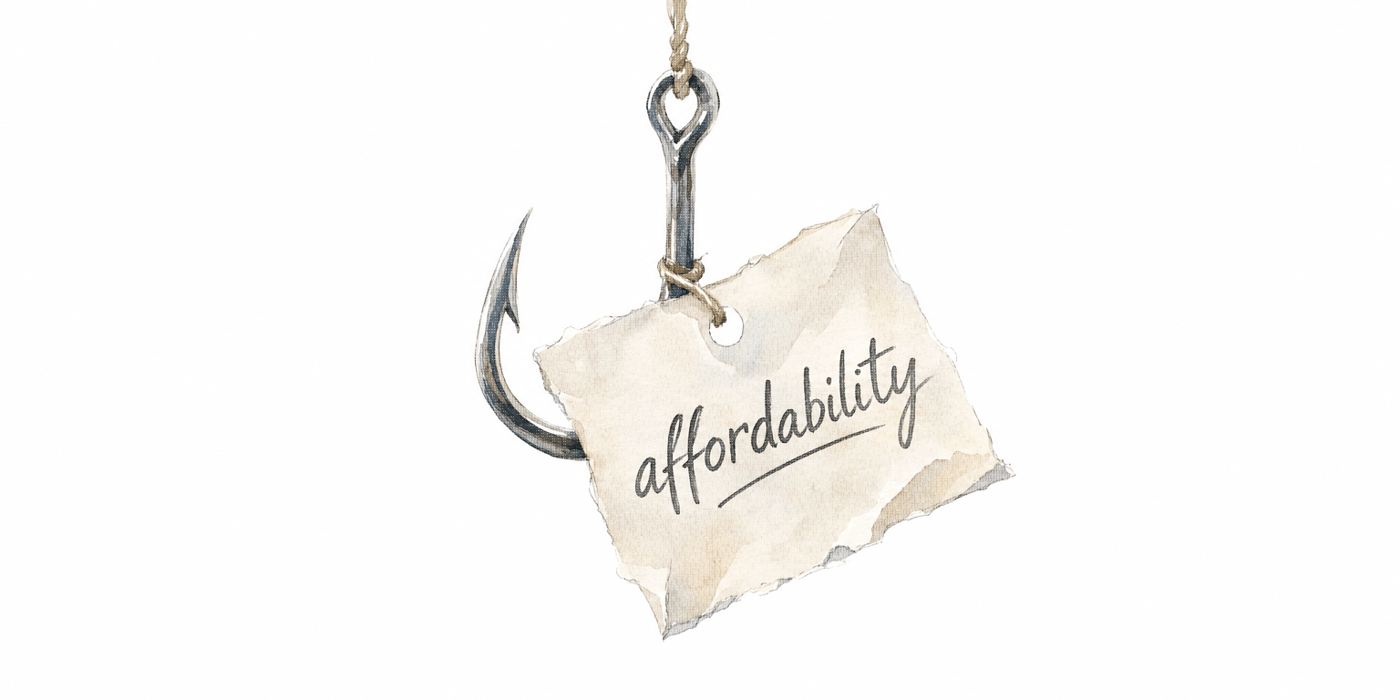
It’s the old bait and switch, the time-honored skill of slippery salesmen everywhere — the unreadable fine print under the enticing ad or the smooth assurance that the item in the box that you just paid for is “exactly the same” as the one in the store window.
It’s a good time for a quick refresher for Messrs. Jeffries, Schumer, Garcia, and anyone else lost in word salad.
Affordability is the ultimate result of a sound economy and all of its elements: solid productivity growth, high employment, good wages, low taxes, and low inflation — all of which translate to lower prices and more money in people’s pockets.
Despite the pre-election hand-wringing and opinion polls showing widespread dissatisfaction with President Donald Trump’s handling of the economy, the underlying economic indicators are quite strong — with the notable exception of prices for gasoline, diesel, and attendant grocery prices. Also, beating back persistent inflation (particularly the massive 21% composite inflation inherited from the previous administration) always takes time. But these are transient and well-understood issues, and all are clearly headed in the right direction.
The bottom line on affordability here in the U.S.: It’s steadily improving — and aside from complaining about it, the incoming Democrats have revealed no plan for accelerating its improvement. In fact, their stated priorities of universal healthcare, substantial tax increases (supposedly targeting only the wealthy, although we know that tax consequences ripple through the entire economy), and an increased minimum wage are guaranteed to worsen affordability.
Accountability means that individuals in any healthy organization, and particularly the leaders, stand behind their actions, always strive to do the right thing, and, as a matter of course, acknowledge and correct their missteps. Ask anyone with a U.S. military background, and they will tell you how central accountability is to unit performance.
Unfortunately, Democrat politicians confuse accountability with blame and retribution — as if the most important action, in any situation or outcome they don’t like, is to find someone to blame (preferably a political opponent) and to punish that person severely, whether or not doing so will have any bearing on the underlying problem.
Thirst for retribution and revenge for past injustices, real or imagined, is a dead end that infects politicians on both sides of the political divide. Upon his return to the White House in 2024, Trump insisted that the best way for him to exact retribution for the outrageous actions taken by his political opponents (i.e., lawfare, federal indictments, civil lawsuits, efforts to block his reelection efforts, and a hate-barrage that may well have triggered two assassination attempts) would be to succeed as president. He was absolutely correct on that score, but too many times he has failed to follow his own advice.
And so the tit-for-tat continues, unabated, with each change of leadership. Somehow we must find a way to break that ugly cycle. But for now, the incoming Democrats’ drive for accountability via endless investigations, impeachments, and ongoing hate-mongering is a counterproductive sideshow and has nothing whatsoever to do with affordability.
Corruption. Post-election polling indicates that concern about rampant corruption in government was a very significant contributor to midterm voters’ choices on federal and state midterm candidates. They were right.
The corruption issue that received the most attention before the election was the cryptocurrency enterprises conducted by the Trump family, with Trump himself as a major beneficiary. In my view, despite Trump’s personal business acumen, his active engagement in such family business matters is unseemly, inadvisable, and arguably improper — but not illegal. Perhaps it should be illegal. If Democrats think so, I’m sure they will push the matter.
However, the Trump family’s cryptocurrency enterprise isn’t corrupt in the traditional sense: It’s neither clandestine nor hidden. It contrasts sharply with the “Biden Family Business,” whose dealings, detailed in the infamous and now-validated Hunter Biden’s laptop, involved selling access to foreign entities, including U.S. adversaries. The Trump family businesses are licensed and visible.
Moreover, there is the great unspoken mystery: If voters were so concerned about corruption, how could they ignore the rampant fraud exposed over the past two years, particularly in Democrat-run states, where organized fraudsters stole billions in taxpayer dollars by posing as providers of elder care, preschool, daycare, and other nonexistent services while elected officials looked the other way?
The Trump administration, with Vice President JD Vance leading, has successfully pursued, exposed, and prosecuted corrupt operations coast to coast. But somehow, despite the undeniable stench of real corruption in their own state, Minnesota voters reelected Attorney General Keith Ellison and appointed Lieutenant Governor Peggy Flanagan as their new U.S. senator. Go figure.
All in all, the Democrats’ high-profile approach to achieving accountability and eliminating corruption, just like their enthusiasm to impeach members of the President’s team, is deeply problematic. However unlikely in today’s political environment, both should be revisited and treated as collaborative rather than partisan efforts. And as currently advertised, they will do nothing whatsoever to help Democrats in their supposed quest for affordability.
Don’t take the bait. They switched it.