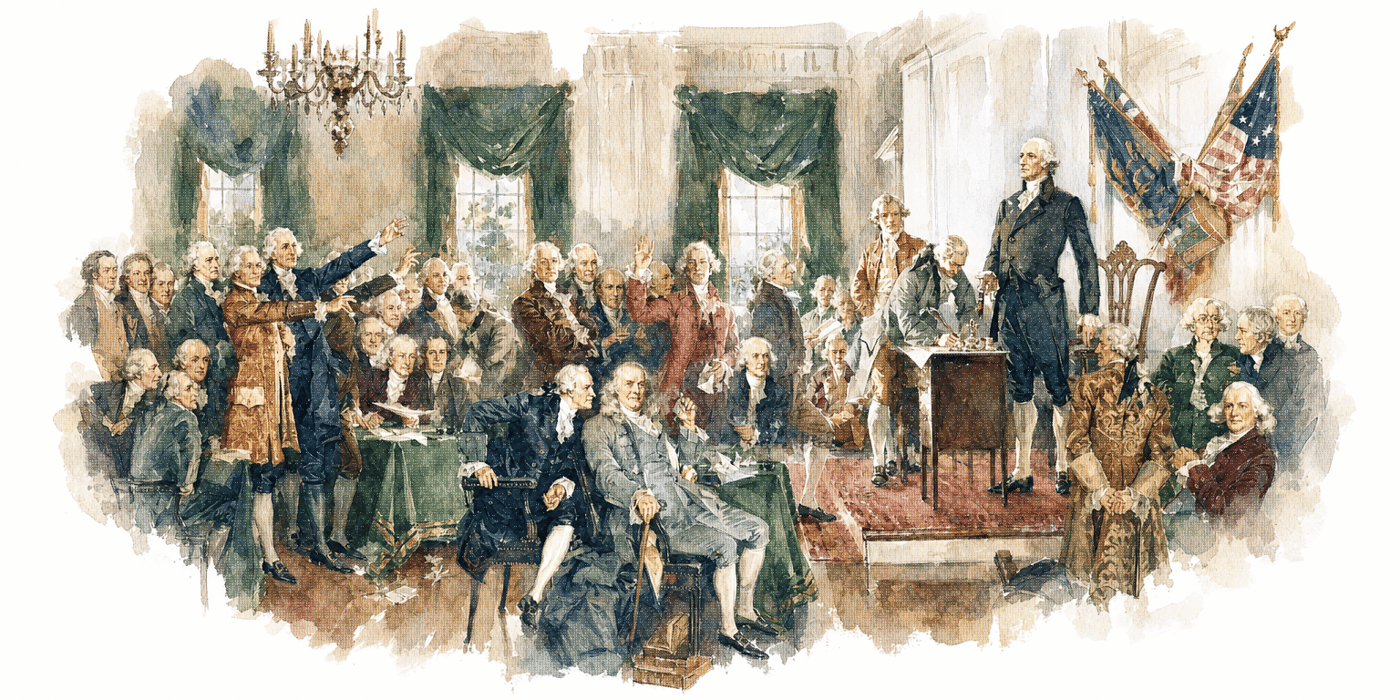

As we roll into Thanksgiving and the holidays, we begin the season of considering our blessings.
I’m undyingly thankful for America, warts and all. My career has taken me around the world, and I can say without hesitation that no place beats America. She is the crown jewel of nations.
That’s the good and bad news rolled into one.
We should be glad to have her and scared as hell we might lose her.
Americans have developed a remarkable inability to appreciate just how revolutionary the founding of their own country actually was.
We celebrated our 250th birthday this year, and although flags were waved, fireworks launched, and copious hot dogs consumed, it seemed muted at best and full of partisan rancor at worst compared to the 1976 Bicentennial celebrations. We congratulated ourselves on making it this far without giving much thought to our remarkable birth in 1776.
We treat the founding as another historical event, a change in government brought about by disgruntled colonists objecting to taxes on their tea, when in reality, it represented a tectonic shift in the relationship between human beings and political authority, one that helped accelerate the transformation of Western civilization.
For most of recorded history, government was imposed upon people rather than created by them. Kings ruled, political power flowed downward, and subjects were expected to obey. There were exceptions, of course. The Greeks experimented with democracy, the Romans developed republican institutions, and the English spent centuries wrestling power away from monarchs. Western philosophers debated natural rights and political legitimacy long before Thomas Jefferson picked up his quill. Nevertheless, government remained the authority, and the people were governed.
The American Founders stood that proposition on its head.
Their achievement was not inventing liberty, natural rights, or representative government. Those ideas had developed through centuries of Western civilization, from classical philosophy and Roman jurisprudence through Christianity, English common law, and the Enlightenment. Locke and Montesquieu provided the intellectual foundation. The Americans took those ideas from the philosophical salons and built a nation around them, challenging the premise on which political authority traditionally rested.
Consider Jefferson’s assertion that human beings possess unalienable rights endowed by their Creator, not granted by kings or potentates, and that governments derive their just powers from the consent of the governed. Government did not grant rights, own the people, or serve as the source of liberty. Individuals possessed rights before government existed, and government derived its legitimacy from protecting them.
More than simply a change in political management, it reversed the relationship between citizen and state, creating a nation where free people could place faith in God, their country, and themselves as they determined their futures.
The Constitution translated that philosophy into an operating system for a republic. Power was divided, constrained, and distributed among competing institutions. Government received enumerated powers, and the Bill of Rights protected fundamental liberties. The Founders understood human nature well enough to recognize that political authority attracts people who want more of it. Rather than search for unusually virtuous rulers, they constructed institutions to restrain the ambitions of ordinary, fallible human beings.
The experiment was hardly perfect. Slavery persisted, women lacked political equality, and the treatment of Native Americans exposed enormous contradictions between the nation’s principles and its conduct. Yet those principles exposed the nation’s failures and provided a means to correct them.
The consequences extended far beyond North America. The American Revolution demonstrated that Enlightenment philosophy could become more than intellectual debate. The French Revolution followed in 1789, influenced partly by the American example, although it took a considerably bloodier path. Republicanism, constitutionalism, and popular sovereignty subsequently influenced movements throughout Europe and Latin America.
The American experiment had become an example that could no longer be ignored.
Perhaps more consequential, ordinary people’s expectations changed. While the old world was organized around inherited status and rigid hierarchies, the emerging American ideal emphasized individual achievement, economic opportunity, and private property. America did not invent capitalism or social mobility, but it demonstrated the potential of this new society.
Once liberty became an inherent right rather than a granted privilege, the burden of justification shifted. People expected government to explain why it should possess power rather than citizens having to explain why they deserved freedom. The individual became the philosophical foundation of legitimate government rather than merely an object of political administration.
We underestimate this transformation because we take its legacy — constitutional protections, free expression, religious liberty, and political participation — for granted. We judge the 18th century by 21st-century expectations.
It’s ironic to watch modern Americans dismiss the Founders as antiquated and deeply flawed while also demanding liberties whose political legitimacy owes so much to their principles. We have become so accustomed to the fruits of the American experiment that we scarcely recognize the revolutionary nature of the tree that produced them.
The founding did not create Western civilization but culminated centuries of philosophical, religious, legal, and political development. It turned natural rights and limited government into a nation’s governing principles.
And the American Revolution not only created the United States but also created a permission structure for people throughout the Western world to reconsider what government ought to be, what individuals could expect from it, and who possessed the authority to decide.
In my opinion, it accelerated the changes of the past 250 years. With Americans leading the way, we won World Wars, conquered the atom, and landed humans on the Moon. People understood they did not need permission to explore, innovate, or change how we see the universe.
We should spend less time arguing about whether the Founders measured up to our modern expectations and more time considering how much of our modern world exists because they dared to challenge their expectations.