
By Kimberley Strassel
Columnist, The Wall Street Journal
Of the many alarming statements uttered this past year by America’s rising tide of “democratic” socialists, pay closest attention to the one that landed in early August, via the godfather of this modern movement, Vermont Senator Bernie Sanders.
Democratic political strategist James Carville had criticized Hasan Piker, the socialist provocateur who claims that “America deserved 9/11,” that the terrorist group Hamas is “a thousand times better” than Israel, that communist Mao Zedong (whose policies killed 65 million Chinese) is “one of the great leaders of this world,” and that his critics are “rabid, ultra-Zionist pigs.” Carville made clear: “I have no intention of ever being in the same political party with [Piker],” adding that he believed “an overwhelming majority of Democrats agree with me.”
Sanders shot back: “If Mr. Carville doesn’t want to be in my party, the party I belong to, that Piker, that [Michigan’s socialist-aligned Democratic Senate candidate] El-Sayed belongs to, he can start his own party.”
The “my party” construction is striking, given that Sanders has long expressed contempt for both our major political parties, disparaging them as captured interests. Since his first successful election in 1981, he has styled himself a “democratic socialist” and run as an Independent on the Vermont ballot. He’s endured the Democratic Party only to the extent that it allowed him to leverage its resources to his advantage—caucusing with it in the Senate to gain seniority and using it as a platform for his presidential runs. Always while holding his nose.
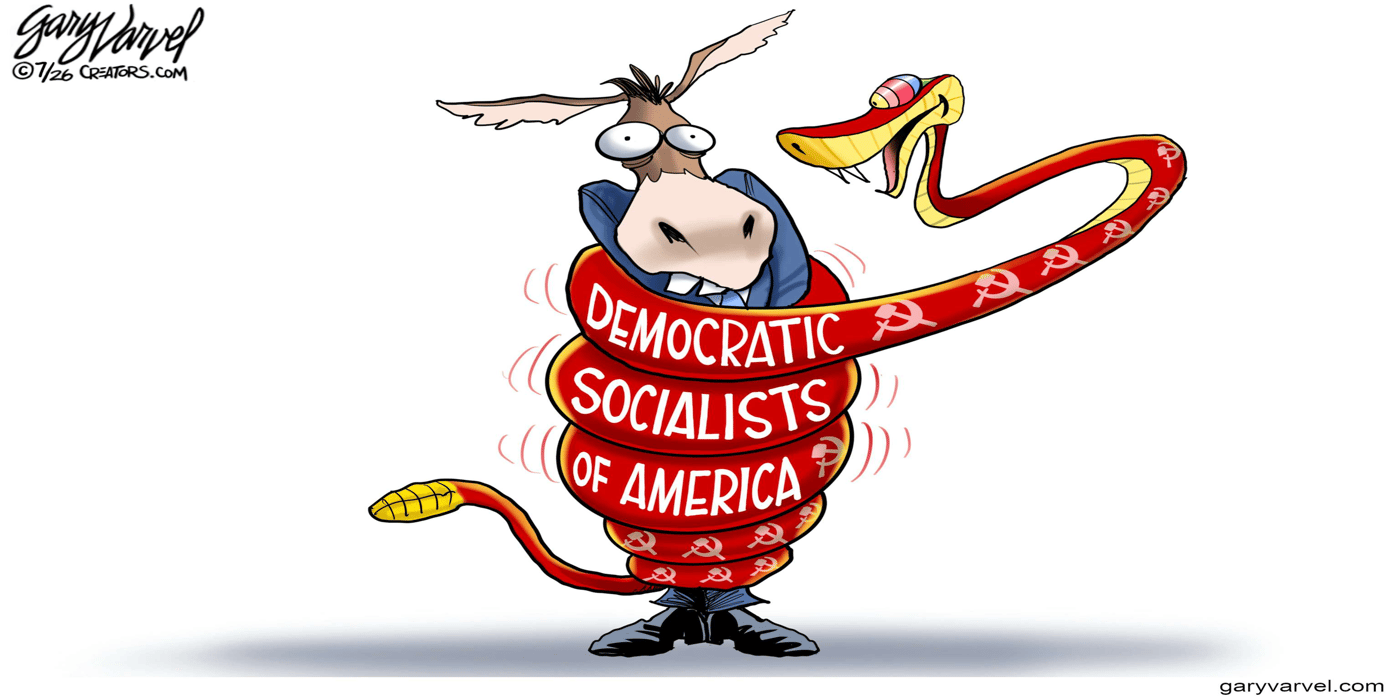
But things have clearly changed. Sanders is done raging against the machines. His goal now is to own and operate one of them. His growing army of democratic socialists are working to capture the Democratic Party from within, replace its agenda with their own, and purge it of dissenters. It’s a time-worn tactic: if you can’t beat them, infiltrate them. And the elected leadership of the Democratic Party is doing nothing to stop the takeover.
***
Before we can address the rise of the democratic socialists, we need to clarify what it is that is rising. That’s made harder by an education system that has left generations of Americans poorly equipped to recognize socialism, and by a liberal media and left-wing political establishment that are determined to play down today’s threat.
Socialism has come in many forms through history and has seemingly infinite definitions. But simply put, it’s a system based on collective or government ownership of goods and services, as opposed to private ownership or markets. It’s animated by class warfare, the claim that the “workers” in a society are kept down and exploited by wealthy, powerful forces, and that only the forced seizure and redistribution of capital will produce a more egalitarian and just society.
Its other defining feature? It always fails, usually horrifically. Historians generally agree there have been more than two dozen major national attempts at socialism, all of which ended in tyranny and economic collapse. This dismal history has inspired advocates over the ages to produce new “versions” of socialism, ones they insist will finally produce magic. Karl Marx wrote off the earliest, failed communes as “utopian socialism” and contrasted it with his own “scientific socialism.” The world has also seen “anarcho-socialism,” “market socialism,” “ujamaa socialism,” and “goulash communism.” And untold deaths.
The modern twist is democratic socialism. Its proponents chose that descriptor with care. They know socialism’s authoritarian history, and they know how deeply Americans still hold to the Constitution. Their goal with that adjective is to fool us into believing that this version of socialism really is different, that it is no threat, that it can in fact be achieved through democratic means.
Sanders is a master at cloaking his ideology in soothing geographical or historical comparisons. He has a decades-long track record of refusing to provide a precise definition of his ideology, preferring to suggest that democratic socialism is some vague version of European “social democracy,” or nothing more than “completing the vision” of FDR’s New Deal. Similarly, New York City’s socialist Mayor Zohran Mamdani argues that Democrats are just “going back to what the party used to be.” And New York Representative Alexandria Ocasio-Cortez is quoted in The New York Times as saying that she thinks it is totally “possible”—somehow—for capitalism and socialism to coexist.
These assurances are hard to square with the socialists’ proposals. Sanders, when he was active in the Liberty Union Party in the 1970s, argued for government ownership of the energy, banking, telephone, electricity, and drug industries—to name a few. After failing spectacularly to get elected four times in a row, he toned down his rhetoric. But there’s no reason to believe he’s changed his stripes, especially as he continues to demand the nationalization of select sectors, including health care and artificial intelligence. He has also called for a 100 percent marginal income tax on higher earners in order to fund cradle-to-grave government services, including medical care, housing, childcare, education, Internet, and meals.
This is government seizure and ownership of wealth and industry to facilitate government redistribution of goods and services. In a word, socialism.
Better yet, read the DSA’s 2026 manifesto, which has no time for Sanders’ nuance in laying out its overriding ambition: for the “working class” to rise up and create “a future without capitalism.” No one will have “bills,” because “food, education, energy, medicine, and transportation” will be “common goods and utilities.” The future it foresees will also include “fully abolishing the police and prison system”; “queer liberation”; enacting “reparations”; abolishing the Department of War; ending “all military and economic aid to Israel”; and legalizing “migration.”
What about the claim to be democratic? The DSA platform explains that the glorious uprising will require a few tweaks to the U.S. democratic system. First up is abolishing the Electoral College and the Senate. Second the DSA would “replace the President and Supreme Court with an executive and judiciary chosen by and subordinate to” one supreme people’s (soviet?) congress. That congress would be dominated by blue states under strict proportional representation—a form of representation, seen in parts of Europe, that is foreign to America’s constitutional tradition. No more checks and balances. No more federalism. No more republic.
Released in August, this platform caused a number of DSA-aligned candidates to scurry away, saying they didn’t agree with all its provisions. But its publication had the merit of clearing things up. Regardless of the “democratic” spin, the U.S. is facing its largest resurgence of socialism since the early twentieth century. Only this time, it isn’t labor leader Eugene Debs making his 1912 run as a member of an outsider third party. This is a socialist movement that is well on its way to capturing one of our major parties.
***
Democratic socialists were elected as mayors of New York City and Seattle last year, and Washington, D.C. voters are all but certain to elect a DSA-endorsed mayor this year. Socialist insurgents have won U.S. House of Representative primaries in New York, Pennsylvania, Colorado, and Michigan. In November, socialist-aligned candidates will be running as Democrats for the U.S. Senate in Michigan, Minnesota, and Maine.
The DSA points to dozens more 2026 primary victories in state legislative races, as well as city council and school board contests, from Vermont to California. Its goal is to swell the number of DSA members who serve in elected offices—more than 250 across 40 states in 2025. Fifteen years ago, the party had about 6,000 dues-paying members. The DSA today boasts more than 120,000 dues-paying members, via some 220 chapters nationally. That means the DSA can claim an even greater following than that of Debs, who led the Socialist Party of America to its peak of about 113,000 dues-paying members a century ago.
None of this is sudden. It’s the work of many years. Sanders’ 2016 presidential run thrust democratic socialism into the mainstream. The Vermonter was open and unapologetic about his decision to run as a Democrat. He didn’t want to be marginalized as a third-party candidate, and so he used the Democratic Party ticket to legitimize his socialist approach. Although Sanders lost to Hillary Clinton, he accomplished his aim of attracting a new, impressionable generation to his cause—and encouraging them by example to seize power from within.
This isn’t a new strategy. Stand-alone socialist parties have always found it difficult to go mainstream. (Debs finished fourth in 1912, with six percent of the popular vote.) Russian revolutionary Leon Trotsky’s prescribed solution was a tactic he called “entryism,” which meant infiltrating larger movements, converting followers, taking charge of power centers, and then altering policies to the left. A famous example was the group Militant Tendency, which operated for a long time within Britain’s Labour Party before being thwarted by Labour Leader Neil Kinnock.
Ocasio-Cortez and Michigan Representative Rashida Tlaib were elected to Congress as Democrats in 2018, though both call themselves democratic socialists. They were followed by Representatives Cori Bush of Missouri, Jamaal Bowman of New York, Shri Thanedar of Michigan, Summer Lee of Pennsylvania, and Greg Casar of Texas. But these were just the highly public positions. Behind the scenes, the DSA began to grow its ranks within the Democratic National Committee and has swelled its members in state political parties. This coincided with a sharp leftward jump in the Democratic Party caucus as a whole.
Sanders further turbocharged the movement by running again as a Democrat in 2020, putting enormous leftward pressure on the entire primary field. When Joe Biden ultimately won, it was thanks to a comeback at the hands of more moderate voters. But his first act was to adopt most of Sanders’ agenda. His ensuing term as president was defined by an effort to pass $6 trillion in tax hikes and spending, “equity” policies, a disastrous withdrawal from Afghanistan, an intentional collapse of border security, censorship of opposition views, and an unconstitutional effort to erase student debt. An agenda the DSA could fully endorse.
***
Following their party’s drubbing in the 2024 election, Democratic leaders seemed to understand that they needed to ditch far-left politics. Humbled politicians worried openly about spending-caused inflation, “cultural disconnect,” and the party’s new antisemitic streak.
Yet that same leadership remained terrified of the radical base, and the DSA crowd took full and cynical advantage. Sanders and his team began recruiting socialist candidates to run in primaries, intending to pick off sitting members of Congress in the 2026 season. Ocasio-Cortez dropped not-so-subtle hints that she’d challenge Democratic Senate leader Chuck Schumer in a primary if he didn’t back their agenda. Far left and socialist members used their influence within the Democratic National Committee to undermine any effort to moderate the party’s platform. Outside groups mobilized to pressure existing Democrats to stay true to DSA policies.
Today, the Democratic Party establishment stands in paralysis. Centrist Democratic groups continue to produce new ideas that the party might use to win back average voters. But leaders won’t touch them for fear of upsetting the socialists. The party center has retreated to a “resist Trump” agenda, the only cry it still feels is safe to float across all constituencies.
The DSA is aware that Americans as a whole are in an anti-incumbent mood and that the Democratic electorate is fed up with an ancient party apparatus. The DSA has endorsed more than 170 candidates this primary season, most of them young and energetic. While their ideas might be socialist, damaging, and crazy, they are at least ideas—for free, free, free everything. That’s more than a stupefied Democratic establishment is offering.
Republicans take comfort in evidence that DSA-aligned members still face rough waters in swing states. Which is true. But no one who understands the danger of socialism should be much comforted. There are an estimated 192 solidly Democratic districts in this country. And the DSA strategy is clear. Primaries are low turnout—often involving just 10 to 30 percent of the party. But they feature the most dedicated (and radical) voters. The DSA will continue to nominate candidates of the Mamdani type. Once those candidates win a primary, they are shoo-ins to win a general election since these are heavily gerrymandered Democratic districts. This is the method by which the DSA will take control of the House and grow its ranks in the Senate. And it means socialists will be calling the shots when Democrats next take the White House or Congress.
***
Which raises two final questions: Why are Americans voting for socialism, and why now? The answer to both questions has to do with education.
For all the DSA’s tripe about “working” Americans, it’s a movement comprised almost entirely of young, white, privileged Americans. Statewide socialist candidates in Michigan and Wisconsin had their highest margins in college towns. A Fox News survey in Michigan found that only 75 percent of black Democratic voters intend to vote for the socialist-aligned U.S. Senate candidate, who is also underperforming among women, independents, and suburban and older voters. Socialism is largely a youth movement.
Economist Friedrich Hayek once quipped: “If socialists understood economics, they wouldn’t be socialists.” And indeed, as business professor Kimberlee Josephson wrote recently in The Wall Street Journal, a poor economy doesn’t explain the fascination of young Americans today with socialism. What explains it is that on today’s campuses—especially those of the “wealthiest and most selective” universities—students are living in (fake) socialist utopias: “climbing walls and lazy rivers,” “lofts with expansive lounges,” “campus coffee bars with national brands.” Kids ride buses without paying fares; they “attend concerts, meet career coaches, reserve study rooms, download software, join student organizations, and participate in countless campus activities without ever reaching for a wallet.” Others are paying the bills, of course; the students just don’t know it. And why should real life be any different?
Too few of our K-12 schools, colleges, and universities teach real history or civics any longer. We fret constantly about our falling math and reading scores, and we should. But a nation that does not teach successive generations about the differences between capitalism, socialism, and fascism, or about the horrifying carnage of Lenin, Stalin, Mao, Pol Pot, Ho Chi Minh, Hoxha, Ceausescu, and Tito, or about the basics of personal finance and business, is a nation defenseless against the pull of fantasy ideologies.
We can do better. Go online, right now, and look up the “1912 Eighth-Grade Examination for Bullitt County [Kentucky] Schools,” which is maintained online by the Bullitt County History Museum. This is the knowledge we once expected of our 13- and 14-year-olds—most of whom were, with this exam, finishing their education and embarking on adulthood. Look at the questions these young Americans were able to answer—especially those in geography, civil government, and history.
That exam is a one-document explanation for why our country faces a socialist threat today—and a one-document roadmap for what we need to do to fix it.
Kimberley A. Strassel is a columnist and a member of the editorial board at The Wall Street Journal, where she has worked since 1994. She received her B.A. from the Princeton School of Public and International Affairs. In 2014, she received the Bradley Prize from the Lynde and Harry Bradley Foundation. She is the author of four books, including The Biden Malaise: How America Bounces Back from Joe Biden’s Dismal Repeat of the Jimmy Carter Years.
Reprinted with permission from Imprimis, a publication of Hillsdale College. The opinions expressed in Imprimis are not necessarily the views of Hillsdale College.