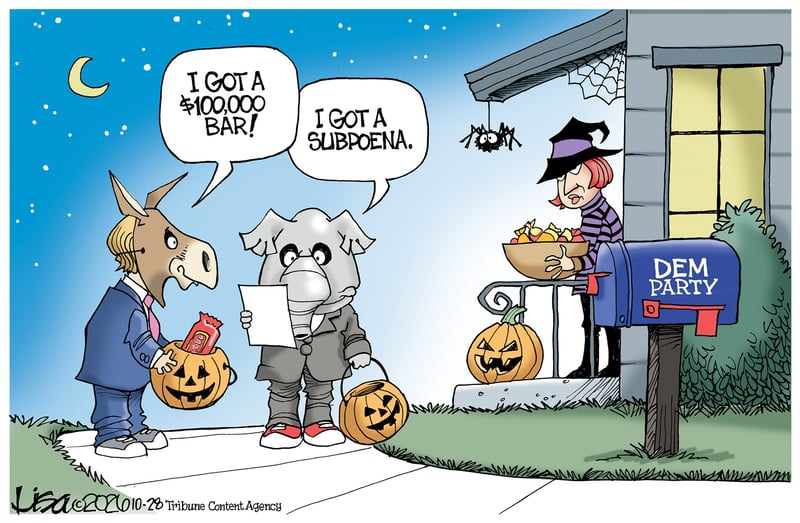
If the midterms give us the Democratic sweep that the media is promising, at least we can look forward to a renewed trust in government. Like when the FBI manipulated social media companies into censoring The New York Post’s exposé of Hunter Biden’s laptop by insinuating it was “Russian disinformation” — soon followed by 51 former senior intelligence officials signing a letter saying the same thing.
It was one of the most baldfaced deceptions ever perpetrated on the American people (not counting the one about Michelle Obama being the pinnacle of feminine beauty). Now, two FBI agents have been charged with lying to Congress to hide the agency’s role in the chicanery. Unless the prosecution is making up its facts, they look pretty guilty to me.
As we later found out, the FBI had known the laptop was genuine nearly a year before the Post published its scoop on October 14, 2020. Surprisingly careless for a crack addict, Hunter had left his computer at a repair store, but never picked it up. The shop contacted the FBI, which took possession of the computer and confirmed its authenticity back in 2019. Nearly a year later, the same place gave the computer to the Post.
Perhaps anticipating that the public would eventually get wind of the laptop, the FBI had been grooming social media companies throughout 2020, warning them about a coming Russian dump of misinformation before the election. Naturally, when intelligence specialists labeled the laptop “Russian disinformation,” the companies cried “EUREKA!” and shut down any mention of the laptop across their platforms.
Not taking any chances, the day the Post‘s bombshell report came out, FBI officials called top executives at social media companies to discuss the story. Whatever they say they said (there are no tape recordings), the G-men sure didn’t make clear that the laptop was not Russian disinformation. As a result, we got unprecedented, sweeping censorship across the digital public square.
Twitter, for example, immediately suspended the accounts of the Post and White House Press Secretary Kayleigh McEnany. The next day, it suspended the Official Trump Campaign account. Anyone who tried to tweet the Post‘s story was blocked and informed: “We can’t complete this request because this link has been identified by Twitter or our partners as being potentially harmful.” (This was done at the direction of Twitter “Safety” exec Vijaya Gadde — one of our highly skilled, very talented Indian immigrants.)
Facebook fiddled with its algorithm so that users could post stories about the laptop to their heart’s content — but no one would see those posts. It also announced that the story would be investigated by the company’s “third-party fact-checking partners” (Rachel Maddow and Hunter’s crack dealer).
Even after the muzzling of speech about a laptop that the FBI knew was authentic, the agency sat on its hands, calmly allowing this egregious violation of Americans’ free-speech rights to proceed.
The semi-happy ending to the story is that Elon Musk bought Twitter, fired Gadde, and restored free speech on the platform. Mark Zuckerberg later apologized for Facebook’s suppressing posts about the laptop.
But absolutely nothing was done about the FBI’s sleazy maneuvering — until recently. Last Friday, two FBI agents, Nikki Floris and Bradley Benavides, were charged with lying to Congress about the laptop. According to the complaint, Floris and Benavides were actively involved in the FBI’s investigation of Hunter Biden and knew the computer was not Russian disinformation.
But when called before Congress and asked about the laptop, Floris said, for example:
“I don’t know what laptop the [Post] article was referring to.”
“I don’t have any details about the laptop.”
“You know, I don’t have any knowledge of said laptop.”
Benavides claimed that everything he knew about the laptop he learned from Wikipedia.
Somehow, they neglected to mention their participation in “briefings, emails, instant messages, and meetings” concerning the laptop, as alleged in the complaint.
The inescapable fact is that the FBI conspired to censor damaging information about a presidential candidate weeks before the election. (Maybe no one has “standing” to sue, as the Supreme Court found, but that’s what happened.) These two agents, the government says, lied to Congress to cover up the whole sleazy operation.
Big story, right? Let’s see how the much-celebrated publisher of the Pentagon Papers reported it.
New York Times Headline: “Two Former F.B.I. Officials Charged With False Statements About Biden’s Son.”
What were the “false statements,” New York Times? Did they falsely state that Hunter has never traded on his name? That he ever held a real job? That he’s a world-renowned artist?
Maybe the Times will get to the key point in the subhead...
Times Subhead: “The charges intensified the administration’s efforts to go after the law enforcement and intelligence personnel who cast doubt on unsubstantiated claims that Joseph R. Biden Jr. engaged in corrupt dealings in Ukraine.”
Whenever the Times uses long, densely nested sentences like this, with a series of stacked modifiers, vague references, and pejoratives such as “unsubstantiated,” I feel like the paper is going the extra mile to make things crystal clear to readers. They must really want people to understand the story.
Other examples of the Times’ straightforward reporting from the same article:
“allegations, which have long obsessed President Trump and his supporters”;
“after Russia interfered in the 2016 election”;
“a narrative that Republicans seized on to strengthen Mr. Trump’s prospects in 2020.”
Remember, kids: it’s “book burning” when the local PTA removes Johnny’s First Blowjob from the school library, but when the FBI incinerates an entire news story, it’s just an unsubstantiated claim that has long obsessed President Trump.
COPYRIGHT 2026 ANN COULTER