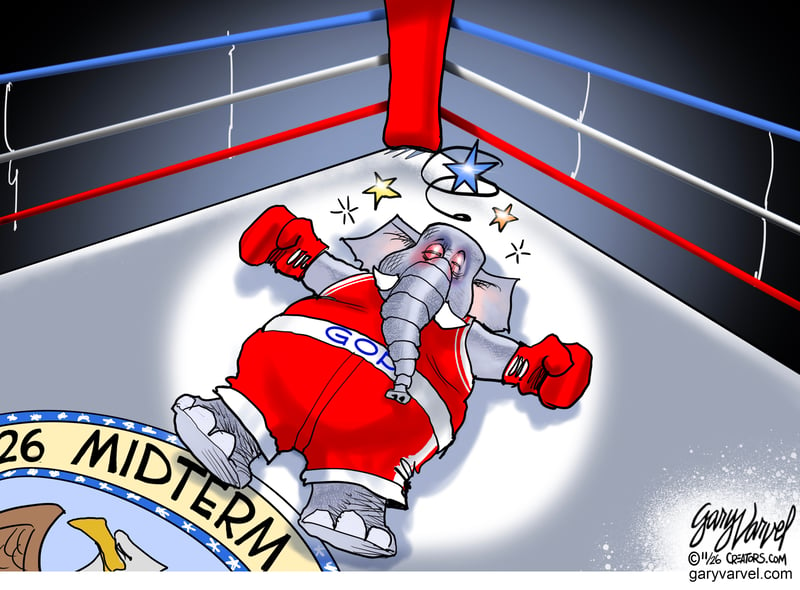
Right before the midterm elections, President Donald Trump announced that the United States would stop providing military aid to Israel, forcing the most dedicated Israel-obsessed antisemites to declare that this, too, was evidence of nothing more than Prime Minister Benjamin Netanyahu’s latest scheme.
However, as debate swirls over what this means for America and one of its most consequential foreign policy relationships in the world, it’s worth pushing back on the underlying premise of all military aid: that America has been manipulated into giving up the goods.
Nothing could be further from the truth. When it comes to Israel, America was never forced to hand over a single penny, and the real history of American assistance to Israel tells a completely different story from those who portray the Jewish state as international puppet masters coercing Washington into doing its bidding.
When Israel declared independence in 1948, the United States was far from its military benefactor. Even though President Harry Truman recognized the fledgling Jewish state, his administration continued to restrict weapons shipments to both sides before and after war broke out. American assistance came in the form of economic support, leaving Israel to look to the Eastern Bloc for military supplies.
This started to change under President John F. Kennedy, who authorized the sale of antiaircraft missiles to Israel in the early 1960s. But he was motivated by American assessments of Israel’s vulnerability to Egyptian air attacks, particularly as Cairo was now backed and supplied by the Soviet Union. In this case, Israel requested defensive weapons, and after careful strategic evaluation, Kennedy’s administration decided that providing these weapons served American interests.
The relationship between Israel and the United States developed following the approval of the sale of fighter jets, which established an important precedent for American support of Israel’s military superiority over potential adversaries. But the real transformation came under President Richard Nixon when Egypt and Syria launched their surprise attack against Israel on Yom Kippur in October 1973, after which Nixon authorized a massive American airlift to replenish Israel’s military supplies. Soon after, Israel was granted its first substantial assistance grant.
But again, this was no act of Israeli coercion, but a strategic decision made in the environment of the Cold War in the face of Soviet-backed Arab states who were looking to annihilate an increasingly important American partner. From this point onward, the relationship developed into a long-term and mutually beneficial security arrangement, reinforced by consecutive administrations and legislatures.
This is not to mention the fact that despite the protestations of those who pretend that American military aid simply disappears into mysterious Israeli bank accounts, much of these funds were then immediately spent on American-made military equipment, thereby supporting American defense manufacturers and their workers.
Of course, none of this means military assistance should continue indefinitely, or that the United States does not have every right to adjust its spending priorities, strategic commitments or its relationships with foreign governments. But that does not change the fact that this was never a situation in which America was bent over a barrel by Israel.
For decades, American presidents and lawmakers chose to support Israel because they believed doing so advanced American interests, with these decisions made in Washington, D.C., and not Jerusalem. Regardless of what happens next, this distinction matters, especially for those who think that Israel manipulated America into coughing up billions of dollars and are now manipulating America into not coughing up billions of dollars.
Heads I win, tails you lose!
COPYRIGHT 2026 CREATORS.COM