By Suzanne Bowdey
There’ve been a lot of fake polls out there, and it’s a shame that Gallup’s isn’t one of them. But unfortunately, the organization’s new survey on the country’s “shared values” is a terrifying picture of how far apart the two parties are on the basics — like loving and supporting America. Turns out, not everyone on the Left who says they care about their nation actually does. Only 6% of Democrats believe patriotism is important — a figure that should startle everyone.
The survey ranked a dozen values: freedom, patriotism, service, kindness, respect, equality, fairness, responsibility, integrity, courage, honesty, and humility. In one of the clearest snapshots of the chasm between the two sides, Republicans ranked patriotism first in their priorities (46%), while Democrats, amazingly, ranked it last. At a 40-point spread, this wasn’t a margin-of-error issue. This is a profound statement on how little half the country thinks of a nation that’s given them unlimited freedom, opportunity, and influence.
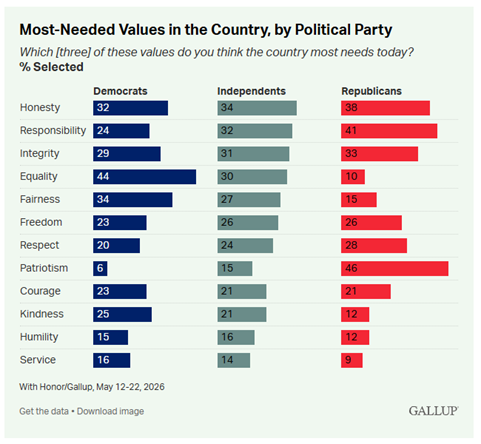
As the survey’s analysis points out, “Democrats are far more likely to say the country needs equality, fairness and kindness, while Republicans are far more likely to say the country needs responsibility and patriotism,” a nod to their overall ideologies. The Left’s entire foundation of identity politics, sexual radicalism, and critical theory rests on this misguided notion of “equality.” The GOP, on the other hand, prizes self-sufficiency, industriousness, and American exceptionalism. Two very disparate visions that we’re seeing play out on the national stage quite dramatically.
This gravitational pull toward socialism and communism in the Democratic Party has all been cloaked in the notion of “fairness” and “equality.” “Government is supposed to supply everything to everyone,” House Speaker Mike Johnson (R-La.) underscored to Family Research Council President Tony Perkins on Saturday’s “This Week on Capitol Hill.” But, he underscores, “Government has no money of its own. This is Econ 101. Poly-Sci 101. Government has to take a dollar out of someone’s pocket to give it to someone else. … The idea is that the state controls everything, governs everything, takes away private property ownership,” he emphasized.
“It’s anti-American,” the speaker warned. “It is exactly the inverse of what America’s founding principles are about: individual freedom, limited government, the rule of law, peace through strength, fiscal responsibility, free markets, human dignity.”
That’s one of the biggest complaints conservatives have about the leftward lurch we’re witnessing — it’s antithetical to what our country is and stands for. No matter what challenges or disagreements America has faced — and there’ve been plenty — the one thing that we could always come back to is our common identity as members of this great nation. But somewhere along the way, the Democrats’ love of country became conditional on who’s in power. And that’s tragic, because America has never been about who’s in charge. It’s about a set of ideals that transcend any single moment in time.
Fortunately, there are still some people on the other side who understand the dangerous implications of this shift. “We need to confront the fact that anti-Americanism has become the default stance of the Democratic voter base,” left-leaning commentator Noah Smith warned.
“The gap is so severe,” The Daily Signal’s Jarrett Stepman laments, “that it calls into question how America moves forward without devolving into two distinct regimes angrily living under one hopelessly divided government.” Patriotism, he observes, “was something we could fall back on, even when we disagreed over the extent to which we believed in this idea or that. When you throw in the dramatic increase in religious, ethnic, and racial diversity that has occurred over the last half-century it’s easy to see why America and so many other Western countries are powder kegs. People fall into pure tribal identitarianism or ideological solidarity. Trust disintegrates. Cynicism prevails.”
On the bright side, the survey pointed out, “Americans view honesty (34%), responsibility (32%) and integrity (31%) as the values most urgently needed. Beneath that surface, though, the parties see starkly different remedies for what is most needed in the nation.” Perhaps, Gallup concluded, “the ultimate shared value is that Americans agree to disagree.”
But if that disagreement isn’t predicated on a shared appreciation and respect for the country that already exists, where does that leave us? Nowhere but two warring sides, one of which wants to completely dismantle the America we know and replace it with the failed experiments of poorer, less secure, and less free nations.
That’s not to say our nation is perfect — far from it. But, as the Brookings Institution’s William Galston once wrote, “I can believe that my country has made serious mistakes that must be acknowledged and corrected without ceasing to be a patriot. I can believe that my country’s political institutions are evil and need wholesale replacement without ceasing to be a patriot. I can believe that other objects of regard (my conscience, or God) on occasion outrank my country without ceasing to be a patriot. The fact that zealous patriotism can have terrible consequences does not mean that reasonable and moderate patriotism does.”
Obviously, some of this is a failure of education, which for years has taught our children that America is something to be ashamed of — a place of rank injustice. And while we have plenty of shortcomings, this thinking has done a major disservice to generations of young people, who wrongly believe there’s a better system of government out there or a nation without moral evil. A utopia. But no such place exists.
“[C]onsidering the fallen world in which we live and the tremendous effects of sin on it … God has shed immense grace on America,” Andrew Dionne insists in Christ Over All. “This grace is experienced every day by both the righteous and the unrighteous. Millions of Americans wake up to working infrastructures, reliable modes of transportation, a surplus of food, the availability of emergency personnel, the many attractions we can afford, free commerce, freedom to move and travel without fear of political imprisonment, freedom to dissent, to believe as our consciences dictate, to fight, to not fight, to pursue social and economic mobility, for the benefit of ourselves, our neighbors, and the nation to which we belong.”
That’s where the gratitude and unity come in — not because America is perfect, but because together we can strive for the virtues that make it great.
“We should remain fiercely proud of the American system,” Rep. Tom Suozzi (D-N.Y.) insisted before the Fourth of July. That doesn’t mean agreeing with every policy or administration. But it does mean having faith “that our country is worth improving and confidence that our ideals are worth defending. … I love America,” he stressed. “Unfortunately, as we celebrate our nation’s 250th birthday, too many Americans associate those three words only with Republicans. Democrats need to change that.”
And for the sake of our country, soon.
Suzanne Bowdey serves as editorial director and senior writer at The Washington Stand.
This article originally appeared here.