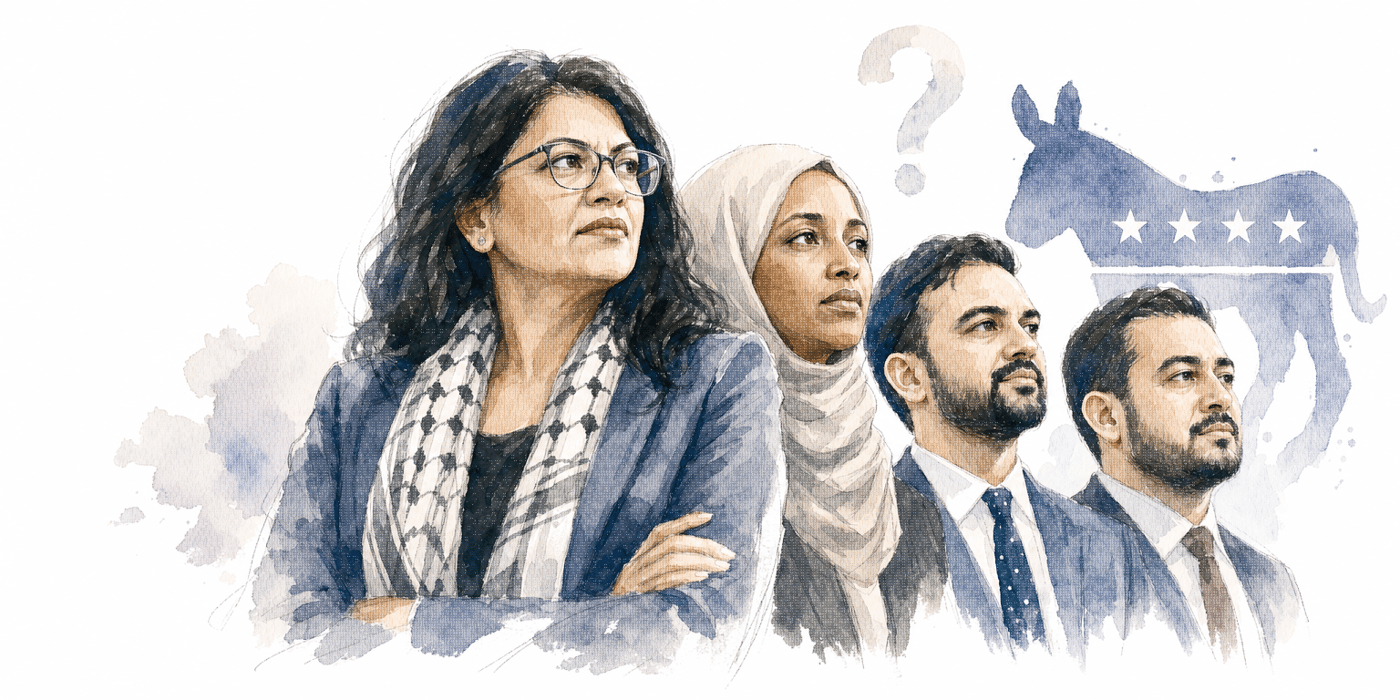

Muslim Americans are increasingly getting involved in American politics.
Most prominent are members of Congress Rashida Tlaib (D-Mich.), Ilhan Omar (D-Minn.), Andre Carson (D-Ind.), and Lateefah Simon (D-Calif.).
Most prominent among several mayors is Democrat Zohran Mamdani in New York City.
Democrat Abdul El-Sayed, now running for the Senate seat in Michigan, could become the first Muslim in the U.S. Senate.
A question that comes to mind is: Why are these Muslim American politicians uniformly Democrats?
They generally hold up their Muslim religion as a prominent part of their political identity, which presents somewhat of a conundrum.
The principles and values of Islam, as far as I can tell, are in total contrast to the values and principles that define today’s Democratic Party.
Per Gallup polling, 66% of Democrats have a “positive view of socialism” compared to 14% of Republicans. The politics of Muslim American politicians fit right into the socialist sympathies of Democrats. But do they fit into the values of Islam?
Islam values private property and ownership, forbids theft and forbids confiscation of property toward political ends.
Of the roughly 50 Muslim countries in the world, there is not one that can be called socialist. Although countries such as Iran have little economic freedom, Iran is not a socialist country. There is no pretense of government redistributing wealth toward any alleged social benefit. It is a country run by despots who control the country’s wealth in the name of their own ideological agenda.
The wealthiest Muslim countries, natural-resource-rich countries such as Bahrain, United Arab Emirates, Saudi Arabia and Qatar, are among the most economically free countries in the Middle East.
How about religious/social values such as abortion and the LGBTQ agenda? The Democratic Party is uniformly on board with all of this, all of which are generally forbidden and rejected by Islam.
Religion itself does not have a particularly welcome home in the Democratic Party. Per Gallup, 37% of Democrats say religion is “very important” in their own life compared to 47% of all Americans and 64% of Republicans. However, according to a Pew Research survey, 60% of Muslims say religion is “very important in their lives.”
So, Muslims in general are very serious about their religion. But Muslim politicians uniformly join the party that is defined by secularism and antipathy to religion.
What is there to make of this?
Two other prominent contrasts between Democrats and Republicans are American patriotism and sympathy for Israel.
Per Gallup polling in 2024, 59% of Republicans, 41% of all Americans and 34% of Democrats said they are “extremely proud” to be American.
And per Gallup polling this year, 65% of Democrats said their sympathies are more with Palestinians and 17% said more with Israelis.
In contrast, 70% of Republicans said their sympathies are more with Israelis and 13% more with Palestinians.
The only apparent conclusion is that Muslim American politicians wear their Muslim identity not as an indication of religious principles but as indication of a political agenda.
That agenda points to transformation of our country, moving away from our founding principles of freedom, capitalism and traditional Christian pro-life family values.
The other main element is opposition to Israel. In this, Muslim American politicians are also at home in the Democratic Party.
We circle back and note that opposition to Israel corresponds strongly with anti-religious sentiments of the Democratic Party.
Per Gallup, among those with no religion, 34% are more sympathetic to Israel and 43% are more sympathetic to the Palestinians.
Muslim American politicians, along with their Democratic colleagues, want a Palestinian state.
So in closing, we must ask: What are the chances that a Palestinian state would embody the socialist, pro-abortion, LGBTQ agenda of the Democratic Party?
Should we laugh or cry?
COPYRIGHT 2026 CREATORS.COM