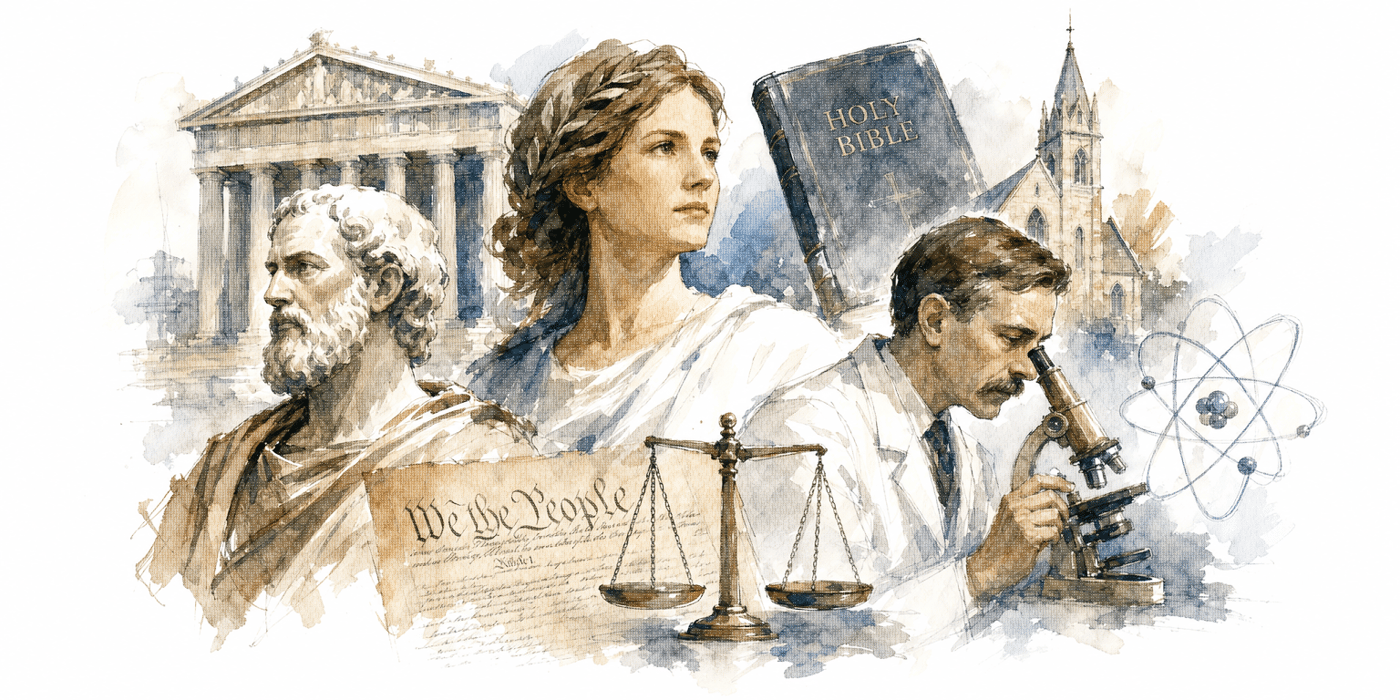

Western civilization is often defined by its accomplishments. Democracy, individual rights, religious liberty, and scientific advancement are all commonly associated with the West. But simply listing these achievements misses the more important question: What actually makes Western civilization different?
The answer cannot simply be that the West has been morally superior to every civilization that came before it. Western history includes slavery, war, persecution, and countless other injustices. But none of these things are uniquely Western either. Nearly every major civilization throughout human history has experienced slavery and other forms of oppression.
What distinguishes the West is not the absence of injustice, but the development of principles that allow injustice to be recognized and challenged.
We can see the beginnings of this idea long before modern Western civilization. The Code of Hammurabi, written nearly 4,000 years ago, begins with an extraordinary purpose: to prevent the strong from oppressing the weak.
Hammurabi’s laws were certainly harsh by modern standards. The famous principle of “an eye for an eye,” also found in the Old Testament, hardly resembles our modern criminal justice system. Yet behind it was an important idea: punishment should be proportional and predictable. Justice could not simply depend on the arbitrary desires of whoever happened to possess power.
The code even attempted to protect people from false accusations and to establish responsibilities that extend beyond individual citizens. In certain circumstances, communities could be required to compensate victims of robbery or the families of those who had been killed.
But Western civilization eventually went considerably further.
Its development emerged from the interaction of two traditions, commonly represented by the cities of Jerusalem and Athens.
Athens gave the West reason. The Greeks developed traditions of logic and philosophy based on the idea that human beings could examine the world and discover truths about it. Reality was not simply whatever a ruler declared it to be. Through reason, people could investigate nature, politics, morality, and ultimately the proper purpose of human life.
Jerusalem offered something different but equally important: revelation.
The Judeo-Christian tradition taught that God exists independently of human beings and that man is created in the image of God. If human dignity comes from God, it does not come from government. A king cannot grant it, and a majority cannot take it away. The weakest person therefore possesses a dignity that even the strongest ruler is obligated to recognize.
Western civilization developed through the tension — and ultimately the combination — of these two ideas. Athens taught that human beings can discover truth through reason. Jerusalem taught that truth exists beyond human power and that every individual possesses inherent worth.
Religious tolerance, abolitionism, the scientific method, and eventually the expansion of legal and political rights to women and minorities did not emerge because Western societies were always tolerant or just. Clearly, they were not. They emerged because Western civilization contained principles through which its own failures could be judged.
One of the greatest threats to this tradition is the tendency to abandon either reason or religion. History shows what can happen when one is cast aside. Communist regimes such as the Soviet Union and China tried to build societies without religion, reducing morality to ideology and the authority of the state. The result was not liberation, but repression and death on an enormous scale.
The opposite extreme is no better. Iran shows what can happen when religious authority is allowed to operate without enough room for reason or individual judgment. And the history of the Muslim world itself shows that Islam is not inherently incompatible with reason. During periods when faith and reason worked together, Muslim societies produced major advances in mathematics, medicine, philosophy, and education.
But today, the West faces a different danger: politics increasingly governed by emotion rather than reason or religion.
We see it in debates over race, immigration, abortion, and economic inequality, where emotional stories are often treated as arguments in themselves. A society cannot decide what is just simply by asking which side produces the most sympathy or outrage.
The Soviet Union itself began with emotionally powerful grievances about inequality and resentment toward the ruling class, along with the promise that everyone could be made equal. Those concerns were not entirely irrational. But once emotion and ideology became more important than moral limits and reason, there was little left to restrain power.
Western civilization is imperfect because human beings are imperfect. But its greatest principles provide something extraordinarily valuable: a standard by which even the most powerful can be told they are wrong. If the progressive movement continues to radicalize across the Western world, however, those foundations risk being eroded by a wave of emotional politics — a system fundamentally incompatible with the principles that made Western civilization possible.