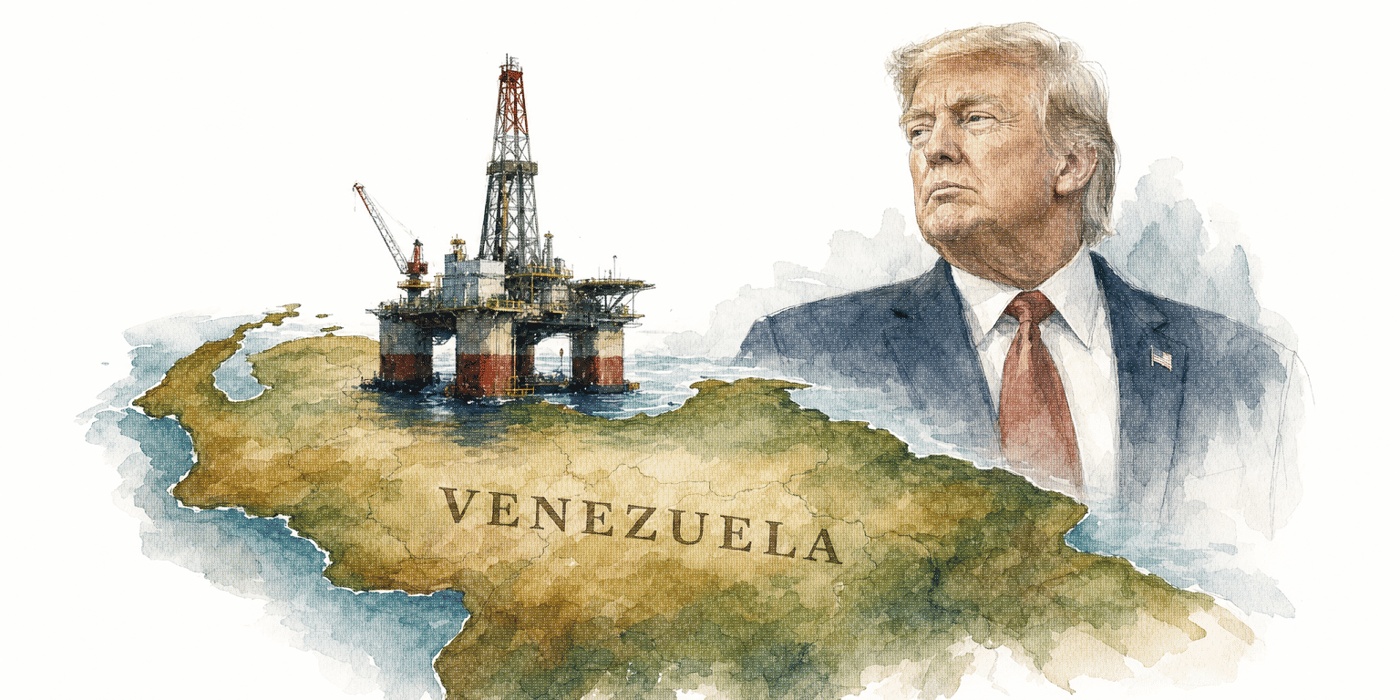

On Friday evening, President Donald Trump announced on Truth Social that his administration had entered “THE BIGGEST OIL DEAL IN WORLD HISTORY!”
Under the deal, the United States would take a 35% passive stake in North American Blue Energy Partners, a private company led by Venezuelan businessman Alejandro Betancourt. The company would receive the opportunity to develop 17 Venezuelan oil fields reportedly containing as much as 65 billion barrels of oil, roughly one-fifth of the country’s enormous reserves — the largest proven reserves in the world.
U.S. proven reserves are less than 50 billion barrels.
The United States would also secure preferential rights to purchase 20% of the project’s production at cost, while the Pentagon would help finance the venture and potentially benefit from its future output.
Here’s how President Trump described it:
At my direction, Secretary of State Marco Rubio, and Secretary of War Pete Hegseth, working closely with Highly Respected Interim President of Venezuela, Delcy Rodriguez, and, through a partnership with private business, have secured majority U.S. control of more than 65 BILLION BARRELS of proven Oil Reserves in Venezuela, at no cost to the American Taxpayer. This Historic Transaction MORE THAN DOUBLES American Oil Reserves, greatly increases our Oil Supply, and will substantially lower Gas Prices for all Americans, long into the future, while helping to continue to set Venezuela on a course toward Tremendous Success and Great Prosperity.
For free-market conservatives, there is an obvious problem with this arrangement: Why is the federal government buying a stake in a private company — especially one that competes with numerous American companies?
It is a legitimate concern.
The same criticism emerged earlier in Trump’s term when the federal government acquired a stake in Intel. Government ownership of private companies creates the possibility of favoritism, distorts competition, and risks putting taxpayers in the business of picking winners and losers.
As a free-market capitalist, I generally oppose it.
But Venezuela is not a normal market, and this is not a normal investment.
There are two primary criticisms of the agreement. First, critics argue that negotiating with Venezuela’s current government legitimizes an unelected regime that remains closely connected to the system created under Nicolás Maduro. They also argue that government backing for one private oil developer could discourage competitors from entering Venezuela, as they would effectively be competing against a company supported by Washington.
Both concerns are warranted. But they miss the extraordinary circumstances surrounding Venezuela.
The country has spent decades destroying its energy sector through socialism, nationalization, corruption, and political instability. Despite possessing the world’s largest proven oil reserves, Venezuela has repeatedly demonstrated that contracts and property rights cannot be taken for granted. That is precisely why Trump needed an arrangement involving a private company with significant operations inside Venezuela.
A simple agreement between Washington and Caracas would be only as valuable as the Venezuelan government’s willingness to honor it. In a country with Venezuela’s history, that is hardly reassuring. Building the agreement around a major private enterprise with an enormous economic interest in its success provides another layer of stability and makes abandoning the deal significantly more difficult.
The charge that the agreement legitimizes Venezuela’s current government also requires perspective. An economic agreement is not the same as an endorsement of a regime. The Trump administration’s broader posture toward Venezuela has hardly suggested that Washington suddenly considers its political system legitimate or admirable.
More importantly, the greatest value of this agreement may not be the first 17 oil fields. It may be what happens afterward.
Venezuela possesses more than 300 billion barrels of proven oil reserves, but those reserves mean little if companies are unwilling to invest the billions of dollars necessary to extract them. No major developer wants to enter a country where contracts can disappear, assets can be seized, or political conditions can change overnight.
The Trump administration tried to get ExxonMobil and ConocoPhillips to invest; they wouldn’t for the aforementioned reasons. “We’ve had our assets seized there twice,” ExxonMobil CEO Darren Woods said in January. “To reenter a third time would require some pretty significant changes from what we’ve historically seen here and what is currently the state.”
Someone has to go first.
If this initial project succeeds, it could demonstrate that large-scale private investment in Venezuelan energy is once again possible. That could encourage other American and international companies to enter the market, bringing capital, technology, competition, and production with them.
It also happens to come at a time when President Trump is struggling against the “affordability” charge, thanks in large part to war with Iran and the resulting spike in gas prices. Part of Trump’s goal is to replenish the Strategic Petroleum Reserve, which is currently at record lows because of vain efforts to reduce prices.
The economic benefits of his Venezuelan deal will not arrive tomorrow. Developing these fields will take years; Venezuelan oil production has fallen to just 1.1 million barrels a day. But the potential payoff is enormous, both in billions of dollars of economic activity and in greater access to one of the world’s largest sources of energy. It’s worth noting that U.S. refineries are better equipped to handle Venezuelan crude than our own shale oil.
Government ownership of private companies should never become the norm. If Venezuela becomes stable enough for genuine competition, Washington should step aside and allow the market to work. But there first has to be a market to compete in.
If temporary government backing is what it takes to convince the first major developer to take that risk and reopen Venezuela to private investment, it is an exception worth making.