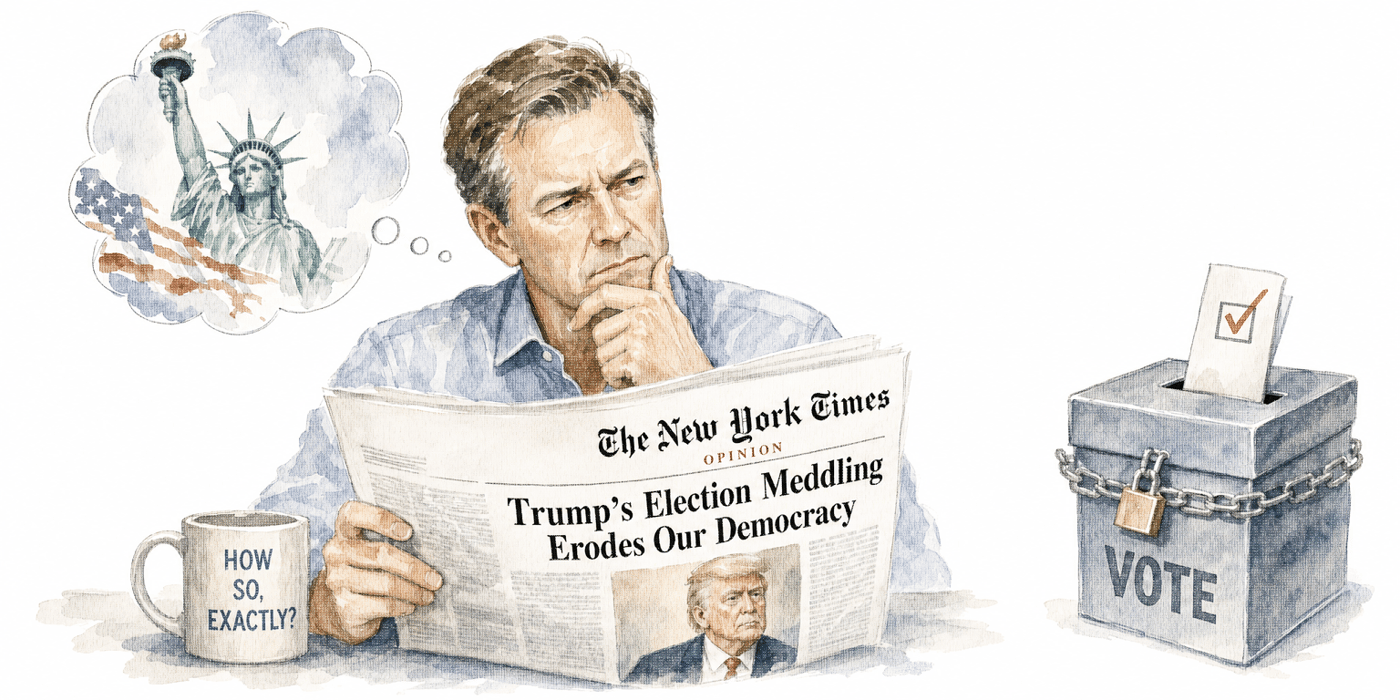

When there’s a lull in conversation about the supposed evils of President Donald Trump, the haters instinctively fall back on the same old standbys, such as “well, he’s a threat to American democracy — nothing’s more important than that!”
And when we ask, “How so? In what way, exactly, is he a threat to democracy?” there is rarely anything specific — just a reminder of the day-to-day nightmare of life under the iron grip of the totalitarian King Trump.
The professional Trump critics at The New York Times recently rose to the challenge with an editorial titled “Trump’s Election Meddling Erodes Our Democracy,” offering examples of Trump-incited democratic erosion to back up their headline assertion.
First, notice the obvious. Although this is an opinion piece with no pretense of being straight news, its boldly assertive headline conveys that the Times fully embraces the Trump-is-a-democracy-thief talking point — and perhaps the editors also recognize that, absent some level of objective underpinning, it’s a toothless accusation. And so they’ve waded in, as if to say, In case anyone ever asks, let’s break it down, piece by piece.
The editorial is actually very helpful in that respect. At its heart are 12 specific “markers,” each a key indicator of “democracy erosion.” That list provides a reasonable framework for methodical assessment and debate about the civic health of our nation.
But from that point, the Times assessment flunks its own logic test. It purports to examine current U.S. trends for each of the 12 indicators, using a scale of zero to 10, with 10 representing full-on autocracy, as in Russia, China, and Iran. But the Times analysts start the trend clock on January 20, 2025, the day Trump took office in his second term; they assign zeros for each marker on that date, thus willfully ignoring any and all prior antidemocratic actions by previous administrations.
Their approach exposes the inconvenient truth that the Times analysis is not a meaningful examination of the safety or the trajectory of American democracy; it’s a vehicle to support the standard left-wing claim (and the Times’s own oft-published allegations) about Donald Trump. In fact, the editors are quite upfront about the ruse, justifying it on the basis that while America’s grip on democracy in prior years was admittedly “not perfect,” Trump’s second-term actions are particularly “worrisome” to their “democracy experts” (whomever they are), thus demanding rigorous new assessment.
No surprise there; New York Times hacks find President Trump worrisome on every score, and they say so daily.
But rather than accepting the Times’s premise that, under Trump, we are experiencing an unprecedented erosion of democracy, let’s take a more holistic look at the longer-term situation using their own indicators.
Manipulating the law to stay in power (marker #1)
The Times analysis levels its guns at gerrymandering, the tactic of defining voting district boundaries in ways that unfairly benefit one political party. That’s correct, but let’s be clear: Democrats have been the superstars of gerrymandering for decades.
For example, today there is still not a single GOP congressional representative in the entirety of New England’s six states. Furthermore, Democrats in California currently hold a 43-9 (87%) advantage over Republicans in the U.S. House of Representatives, and following last year’s Prop. 50, that advantage will probably increase to 48-4 (92%) — both vastly disproportionate to the roughly 2-1 ratio of Democrat-to-Republican voters in the Golden State.
Recent, highly publicized redistricting in several states will level the playing field to some degree, but this clearly antidemocratic practice has favored Democrats as much or more than it has favored Republicans.
Also in this category of antidemocratic actions, the Times editorial assigns significant weight to Trump-era GOP-led legislation that “could” suppress minority votes in upcoming elections, despite the fact that there is neither statistical evidence nor logic supporting that premise. Similarly, the Left has been sharply critical of Trump’s recent executive order restricting mail-in voting. Both initiatives target election fraud, not the other political party.
Stifling speech and dissent (#2) and controlling information (#7)
It’s hard to find a more compelling example of government antidemocratic influence than the Biden administration’s 2020 actions to both prevent public disclosure and subsequently discredit legitimate information (namely, information related to Hunter Biden’s laptop) germane to that year’s presidential election — quite possibly affecting the election outcome.
Persecuting political opponents (#3)
The Biden administration’s multifaceted and unprecedented lawfare campaign targeting Trump wins this democracy-erosion competition hands down. Trump’s subsequent retribution has been similarly unhealthy and politically counterproductive, but trivial in comparison to the abuse he endured at the hands of Team Biden.
Bypassing the legislature (#4)
Trump’s prosecution of the Iran war without congressional approval is noted — but with the qualification that bypassing Congress in such circumstances is hardly unusual, and securing endorsement from today’s fractious and fiercely partisan legislature would probably not have been possible.
Defying the courts (#6)
Without question, Trump routinely challenges the courts and looks for legal ways to get around rulings he dislikes. But in my view, the single most egregious example of a president defying the courts is his predecessor continuing his student loan forgiveness policy despite an explicit SCOTUS ruling that doing so is unconstitutional.
Declaring false emergencies (#7) and vilifying marginalized groups (#8)
Although not addressed specifically in the Times editorial, Trump’s actions in these two categories garnered the highest (i.e., most critical) score in democracy erosion; presumably they relate to his administration’s aggressive treatment of illegal immigrants. These actions are controversial, but hardly antidemocratic, as they align directly with Trump’s preelection commitments.
Using the military at home (#5) and trying to take over universities (#10)
These are common issues raised by Trump critics, not scored highly by the Times, and relatively unimportant in this evaluation.
Creating a cult of personality (#11) and using power for personal profit (#12)
I’m guessing that “cult of personality” relates to the tiresome Trump-is-Hitler trope. If so, it’s not worth rebutting. And Trump’s continuing pursuit of business opportunities while in office (unlike most presidents, Trump is a businessman, not a career politician) may be unseemly but is neither clandestine nor illegal. In my view, these two are hardly antidemocratic categories and do not belong on the Times list.
In short, the Times editorial is loaded with anti-Trump pejoratives and conveys great concern about what Trump “might” do in the months ahead — but the scorecard on his actions to date versus those of his predecessors, as measured by the editors’ own scorecard, tells a very different story than their patent democracy-thief hype.
If their message is that staying true to our nation’s core principles is a never-ending job, one that we can never take for granted — terrific, we can all agree. And I’d go a step further and agree that the foundation of our great nation has taken some serious hits, particularly in recent years, and may be in much more serious trouble if the recent Democratic Socialists of America (DSA) craze takes root.
But to the notion that Donald Trump poses a unique threat to democracy, one far greater than his predecessors’, I say respectfully to The New York Times: baloney! The facts say otherwise. Your partisan bias is blinding you and your readers.