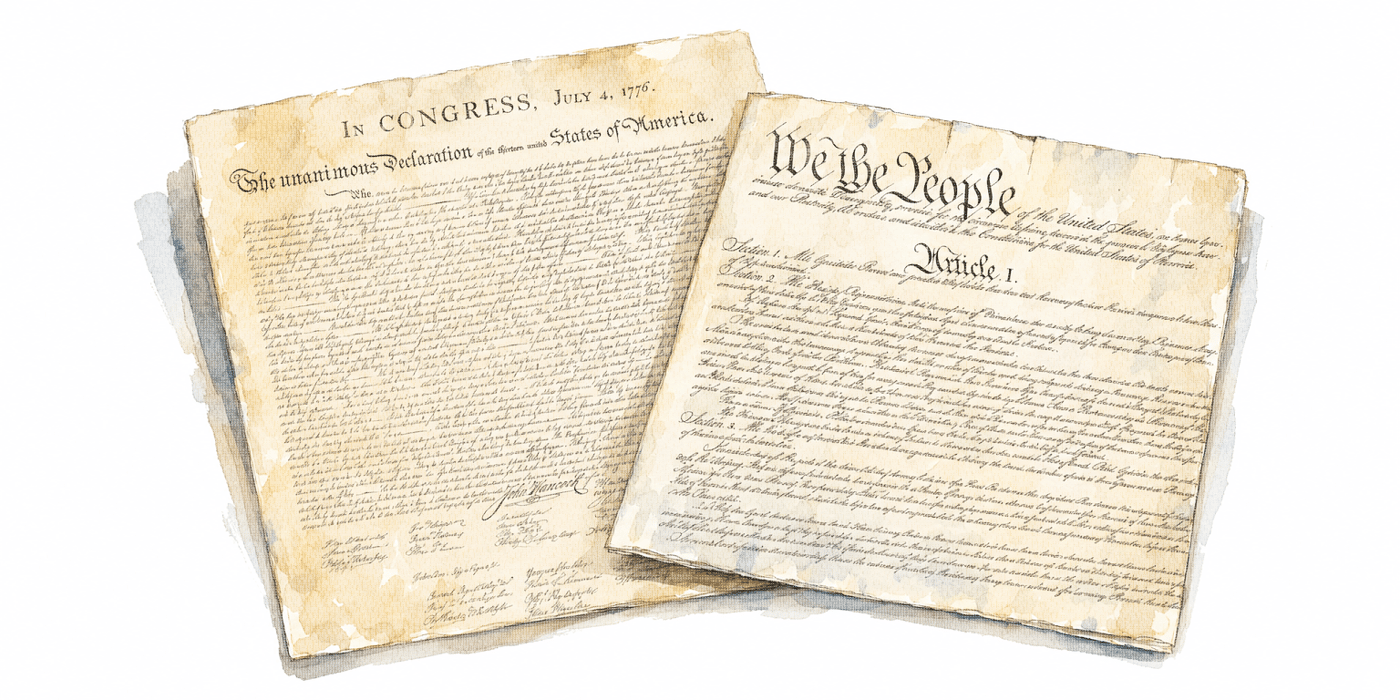

The Declaration of Independence is one of the most quoted documents in American history. But it is also one of the most misunderstood. The Declaration was not written as a detailed blueprint for government. It does not create a Congress, establish courts, or explain how a president should be elected. Instead, it states the principles upon which legitimate government must rest.
Men are created equal. Rights come not from government, but from nature and nature’s God. Government exists to secure those rights, and its legitimate power comes from the consent of the governed. These principles were not meant to create new rights. The entire point was that these rights already existed.
The Constitution came later because principles alone are not enough.
Abraham Lincoln explained this relationship better than anyone. In an 1861 fragment, Lincoln described the principle of liberty expressed in the Declaration as an “apple of gold.” The Constitution and the Union, he wrote, were the “picture of silver” constructed around it. The frame existed not to replace the apple, but “to adorn, and preserve it.”
That distinction is incredibly important. The Declaration tells us what America is supposed to protect. The Constitution tells us how America protects it.
The separation of powers, the Senate, the Electoral College, federalism, enumerated powers, and the other restraints placed on government were designed around a basic understanding of human nature: power tends to expand, and concentrated power eventually threatens liberty.
This is also why the Constitution can sometimes appear frustratingly undemocratic — it is intentionally so. The Senate gives Wyoming and California the same number of senators. Senators serve six-year terms. Federal judges are not elected. The president is elected through the Electoral College rather than a national popular vote. Legislation must pass through multiple institutions before becoming law.
But America was never designed as a system in which 50.1% of the population could simply do whatever it wanted.
The Founders understood that democracy does not guarantee liberty. A majority is perfectly capable of violating the rights of a minority. The Constitution therefore deliberately places obstacles between temporary political majorities and the unrestricted exercise of political power.
That is also why simply having a written constitution is not enough. Many countries throughout history have adopted constitutions filled with impressive guarantees of liberty, equality, and individual rights. Yet those promises often meant very little when governments ignored the institutions and limitations meant to protect them.
Constitutional government survives only when political leaders and citizens accept that certain institutions, procedures, and limits must be respected even when ignoring them might produce a political outcome they prefer. The real test of commitment to constitutional government comes when the Constitution stands in the way of getting what we want.
The safeguards built into the Constitution are not separate from our freedoms; they are what make those freedoms secure. When we begin treating constitutional restraints as obstacles to be weakened or discarded whenever they interfere with a political goal, we weaken the protections that preserve individual liberty as well.
A constitutional safeguard may be frustrating when it blocks a policy we support, but that same safeguard may someday be the only thing preventing a government we oppose from using its power against our rights.
Lincoln understood that the Constitution was not the ultimate purpose of America. Liberty was. The Constitution is valuable because it provides the structure necessary to preserve the principles announced in the Declaration.
Without the Declaration, the Constitution would lack its higher purpose. But without the Constitution, the Declaration’s promises would be little more than promises.