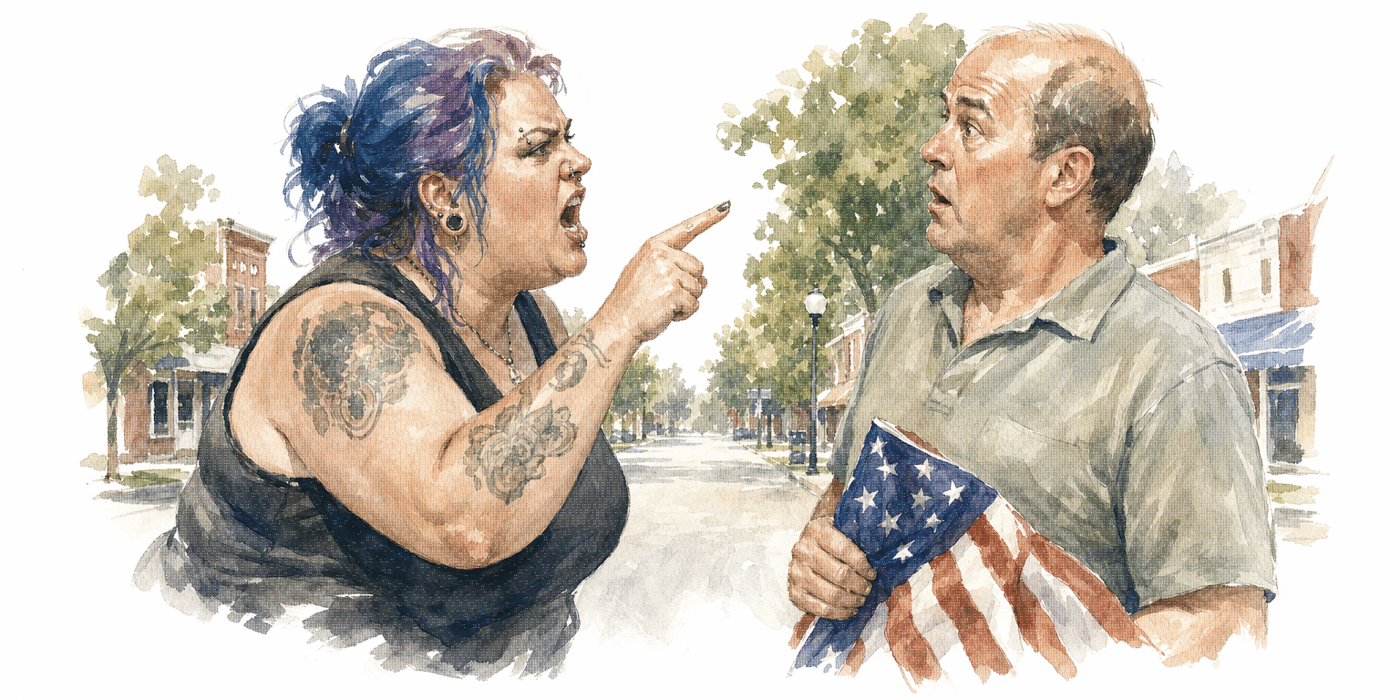

True, we’ve never really liked the folks on the other side of the political aisle. That’s usually the case with politics. The endless debates, both on matters of substance and silliness, wear us down until we just want to beat them at every opportunity. We’ve become instinctively, and perhaps permanently, partisan.
At some point over the years, we (at least some of us) have crossed the line, allowing political opposition to morph into abject hatred. In today’s political climate, I want to pin that ugly trend on the Democrat Party, but Republicans aren’t exempt — and we’ll find out after midterms just how tolerant we can be with the Democratic Socialists of America in the tent.
We know for sure that Donald Trump’s political enemies don’t just dislike or disagree with him; they despise him, and they encourage their followers — and any Americans who will listen — to despise him as well. Theirs is a seething, visceral, boiling-over hatred. No conventional English-language slur is derogatory enough for them. F-bombs fill the air.
Left vs. Right political head-knocking is par for the course; hatred of our political leaders is not. The Trump hatred is toxic. It spills over into the media, social media, and the public at large. In all likelihood, the Left’s feverish anti-Trump rhetoric has been a prime contributor to the steep increase in political violence of all kinds in this country over the past two years.
The Democrat Trump-hating is a curious political strategy for targeting a lame duck president. Trump will not compete in another U.S. election (his taunting red “Trump 2028” hats notwithstanding). But it’s working.
Although Trump’s name won’t appear on a single midterm ballot, his unique political influence remains loud and clear. His declining public approval, now in the mid-30s based on recent polling, is generating optimism among Democrats — and so their Trump-hating drumbeat continues unabated.
I cannot think of a single example of Republican animosity for a political opponent approaching that currently aimed by Democrats at Trump. Republicans were sharply critical of Joe Biden, considering him feeble, over his head, ineffective — but they didn’t hate him. They just wanted Biden and his policies gone. Ditto regarding GOP feelings about Barack Obama, Hillary Clinton, Bernie Sanders, Alexandria Ocasio-Cortez, Chuck Schumer, Hakeem Jeffries, and certainly the flash-in-the-pan DSA newcomers such as Abdul El Sayed — Republicans simply want to keep them as far away from the levers of power as possible.
But we’re obviously trending in that direction. In answer to the above question about the origin of truly serious political acrimony — of the kind that could reach the level of the hate leveled at our current president — I’d argue that the watershed moment was the unprecedented and abrupt public rejection of President Richard Nixon in 1974.
Nixon was hardly an inspirational leader (that became obvious when he ran against Jack Kennedy in 1960). He was an awkward, klutzy individual — but at the same time, viewed (accurately) by the electorate as smart and competent. Running for a second term as president in 1972, Nixon was widely seen as an effective executive, and he won every state except Massachusetts, racking up 520 of 538 Electoral College votes — at the time, the most lopsided presidential election victory in American history.
Yet within the next 18 months he plummeted from grace in spectacular fashion, enmeshed in scandal from an attempted, politically motivated pre-election break-in at the Democrat headquarters in the Watergate Hotel complex, compounded by a top-down effort to cover it up. Imagine that: a stupid, unnecessary, and unsuccessful political cover-up! How naive we were in 1974.
Compared to the political hijinks of today (as one example, the Obama administration’s elaborate “Russia collusion” bear-trap designed to derail the first Trump presidency), Nixon’s role in the ill-conceived and unsuccessful Watergate break-in was child’s play. But Democrats saw an opening, they jumped in enthusiastically, and many Republicans joined the fray.
Still, the huge boost came from the news media. Two young Washington Post investigative reporters, Bob Woodward and Carl Bernstein, broke the story and became instant folk heroes, subjects of books and movies, and winning a Pulitzer Prize for The Washington Post. It was a full-on PR rout. Under threat of impeachment and likely conviction, the president resigned in disgrace, a political pariah for his remaining years — an American tragedy.
Although I don’t recall the word “hate” being used openly, Nixon’s popularity nosedived from best to worst in U.S. political history. His epic collapse — and more importantly, the remarkably powerful political/media junta that pulled it off — serves as an object lesson for political operators everywhere and leads directly to today’s state of affairs.
Clearly, the wide sweep of American political history is too complex to characterize by two very different presidencies, half a century apart. But the comparison is instructive. Two key lessons come to mind.
First, over time we’ve learned, not just from Nixon’s spectacular fall from grace but also from the steady deterioration of civility in our political interactions since then, that political muscle supported by an enthusiastic and fully engaged media can topple a presidency.
Secondly — and particularly noteworthy on the eve of our 25th anniversary of 9/11 — is the reminder that we have more than enough serious enemies around the world. There’s no need to turn internal political opponents, on either side, into contrived public threats.
And how to arrest our current slide? As with every other threat in this contentious world, a bit more unity would certainly come in handy.