
While Republicans’ loss of congressional control has headlined the blue wave that hit them during the midterms, their losses in state houses across the country may prove even more consequential.
Six states have now come under complete Democrat control, adding to the 22 that already were. These states include Arizona, Michigan, Minnesota, Nevada, Pennsylvania, and Wisconsin. There will now be 28 states with Democrat governors and Democrat-controlled legislatures.
It’s not hard to imagine a long-term swing to the left in much of the country. Just look at California, Oregon, or New York, for example.
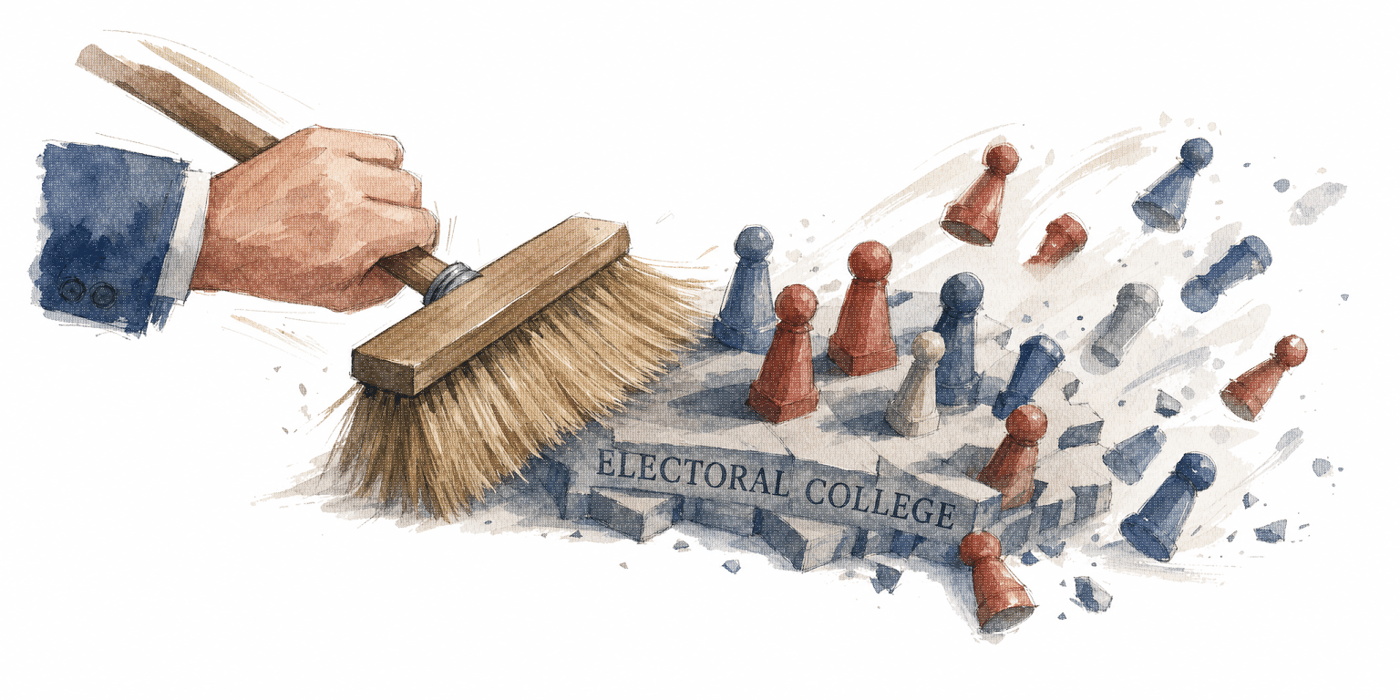
This shift in party control raises another major concern: the Democrats’ threat to the Electoral College.
Following Donald Trump’s 2016 election victory over Hillary Clinton, Democrats, including Clinton herself, blasted the Electoral College as problematic, as she falsely labeled it a relic of racism. “We shouldn’t be hanging on to an anachronism that was designed for slave-owning states, really,” Clinton whined. “This needs to go because it’s not reflective of one person, one vote.”
Clinton attacked the Electoral College because, for the second time in less than two decades, it handed the presidential victory to a Republican candidate who failed to win the national popular vote. The first instance was the 2000 election, when George W. Bush defeated Al Gore.
Clinton’s defeat spurred a concerted effort by Democrats to launch an end-run around the Constitution: the National Popular Vote Compact. Since the Electoral College is enshrined in the Constitution, it would take a constitutional amendment to eliminate it, a prospect Democrats know is a political impossibility. So instead, they created this unconstitutional pact.
Under the NPVC, states would give their EC votes to the candidate who wins the national popular vote, regardless of who wins the popular vote in each state.
The NPVC can only come into play, by design, once enough states sign on to meet the 270 Electoral College vote threshold needed to elect a president. The current number of states signed onto the NPVC totals 222 EC votes.
However, with six states soon to come under complete Democrat control, the NPVC could acquire the remaining EC votes needed for the pact to take effect.
Far from being a relic of slavery — Democrat Representative Alexandria Ocasio-Cortez smears it as a system that “weighs white voters over voters of color” — the actual intention of the EC protects the political voice of smaller, less populous states. And that is the great irony, which the Democrats, who love to claim they’re all about protecting the interests of the little guy, are so focused on eliminating.
Despite the fact that President Donald Trump won his 2024 election victory with the popular vote, Democrats still want to press forward with the NPVC. Wisconsin Governor-elect David Crowley recently expressed support for eliminating the EC, stating, “We should do away with it.” And Pennsylvania Governor Josh Shapiro said the NPVC “makes sense,” and he would “work with lawmakers to figure out what the right mechanism is for moving forward on that.”
Even if enough Democrat-controlled states adopt the NPVC, its constitutionality remains uncertain. A number of factors could derail it, chief among them the fact that each state handles its elections differently.
However, if enacted, it could easily backfire on Democrats. The many Republicans in states like California and New York have little say in who is elected president, since they are so outnumbered by Democrats. Yet the NPVC could serve as a significant push to get out the vote in these states, which could increase the Republican candidates’ vote tally nationally.
While in theory eliminating the EC would allow candidates to ignore smaller populated states, it could conceivably have the opposite effect. In other words, should the Democrats move forward on their anti-EC gambit, it’s far from a sure thing for their electoral chances.