
Criticism of the American public school system has hit a new high as new information shines a spotlight on how badly our education pipeline is failing our students.
I want to be clear before we dig in: this is not primarily a teacher problem. Many wonderful public school instructors are truly doing their best to guide our kids through their educational journeys. They are on the front lines of the issue, fighting in both directions. Nevertheless, enough bad public school teachers, administrators, teachers’ unions, parents, and curricula exist to create cracks in the pipeline with widespread negative effects.
First, the bad news.
A Gallup poll released on Labor Day detailed Americans’ dissatisfaction with K–12 education. Republicans are unhappy with the system because too many schools are not successfully teaching children basic skills like reading, writing, and math. Democrats likewise are unhappy with it, also citing a lack of basic skills as well as American students’ failure to be academically competitive when stacked up against other nations.
Overall dissatisfaction has reached an all-time high, with 67% of poll respondents saying they were completely or somewhat dissatisfied.
Speaking of our students not stacking up from a global perspective, The New York Times’s Sarah Mervosh reported Tuesday on the stark difference in academic achievement between American students and Chinese or Singaporean students. “By every measure,” she writes, “American students are being outperformed by students in Singapore and parts of China who had top scores on the Program for International Student Assessment, or PISA, taken by 15-year-olds around the world.”
In addition, American students hit record lows in math and are approaching record lows in every other subject. This trend started before the pandemic.
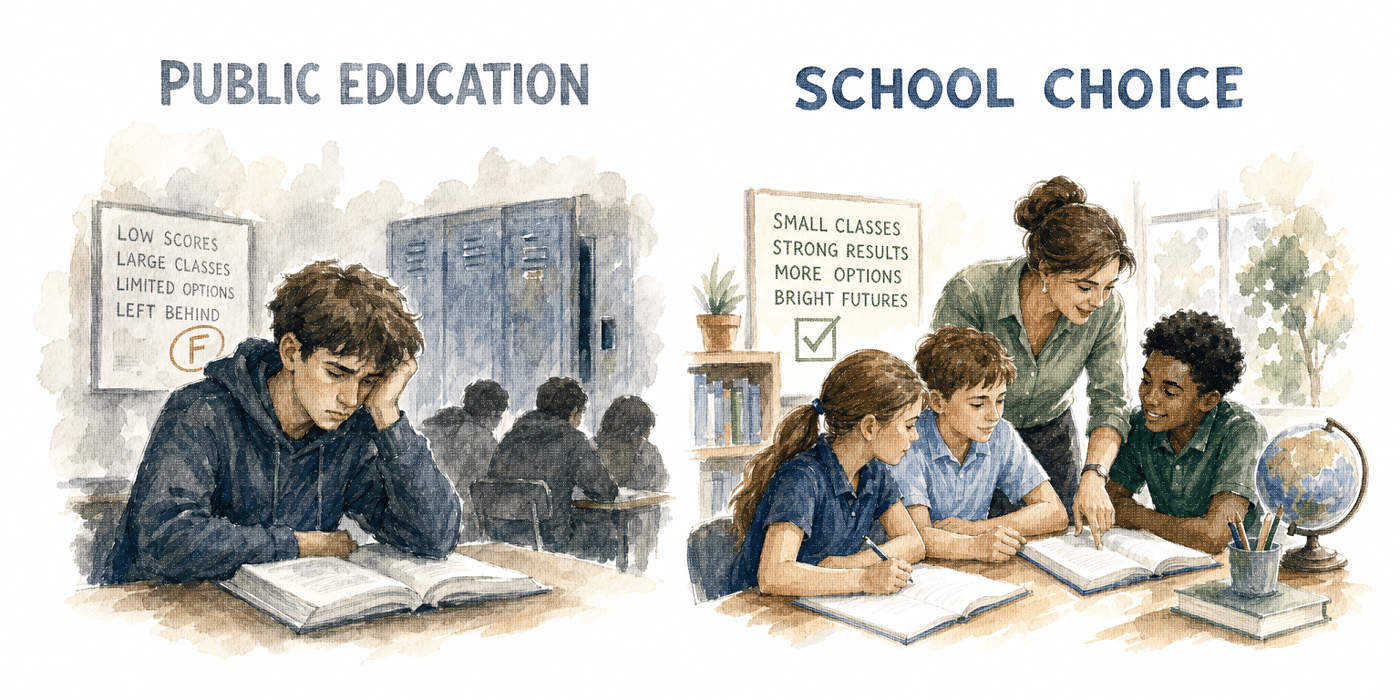
Bottom line: The way we have structured public education is failing. It’s failing students, and it’s ultimately failing the country.
However, hope is not lost.
States are helping out students by providing school choice options for parents. With 18 states now offering school choice, the money follows the student, and parents get to choose where their child attends school regardless of zip code or financial situation.
School choice not only benefits parents and children but also forces schools to become competitive and make changes to keep students rather than lose them.
At the end of the day, homeschool children whose parents provide a structured program to follow perform better than public school children. However, the biggest indicator of success in school might actually be a student’s ability to self-regulate. In other words, can they handle the strong emotions that come with challenges, or will they tear up a classroom over a perceived wrong?
If you can self-regulate, you can be disciplined. If you can be disciplined, you can learn. If you can learn, you can achieve.
Perhaps this is one of the biggest indictments of our culture yet. We have become so focused on protecting our children from every possible risk that we sometimes forget to teach them independence, resilience, and the ability to navigate reasonable challenges on their own. In trying to prevent every scrape, disappointment, and failure, we can inadvertently inhibit the very skills children need to become capable adults. It exhausts parents and limits children, yet we continue down this path.
Clearly, when it comes to education, we as a nation have to learn from our mistakes. That starts with parents teaching their children how to behave and how to be resilient, and is continued by school instructors teaching well and administrators focusing on education, not social justice and social-emotional learning.
Thankfully, the education deficit may solve itself as parents come to terms with what their children actually need and actively seek out solutions via school choice.