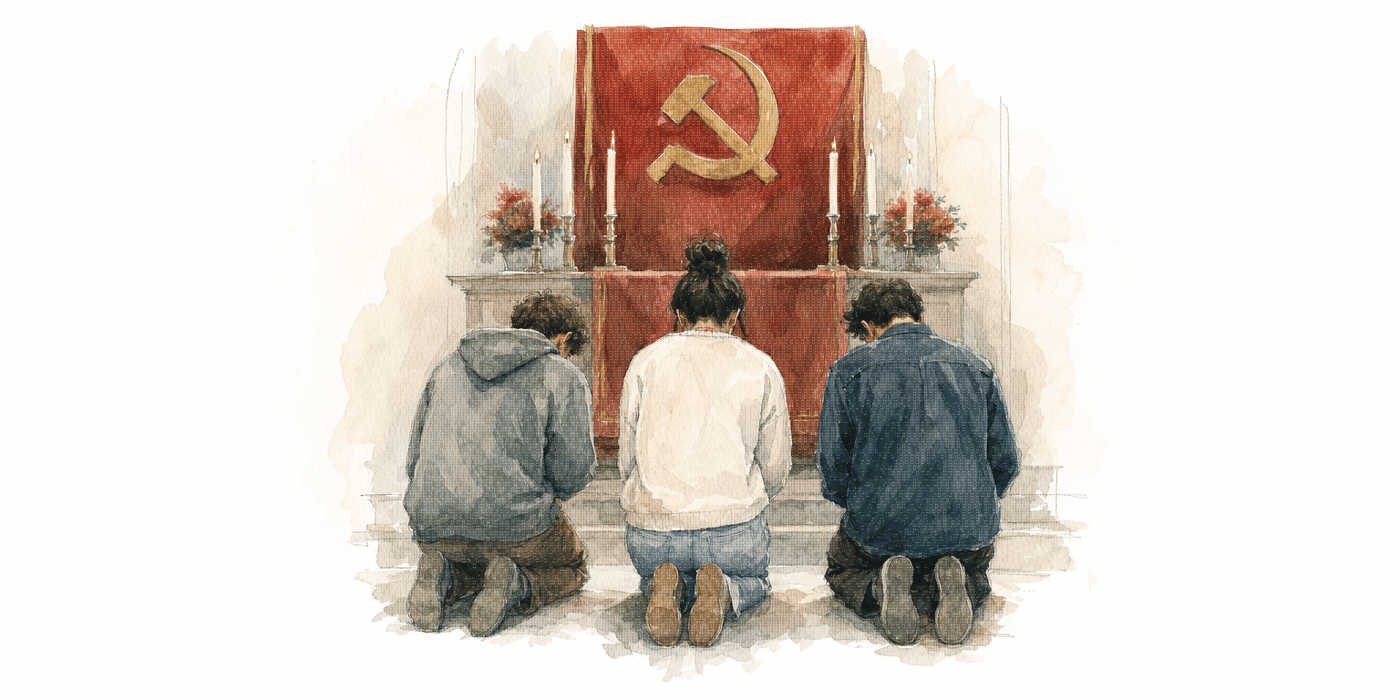

For much of American history, religious institutions did considerably more than provide a place to worship. Churches, synagogues, and other congregations created communities. People gathered every week, formed friendships, helped their neighbors, raised families together, and became part of something larger than themselves.
As religious participation has declined, especially among younger Americans, the desire for community has not disappeared.
The growing appeal of socialism among young people is often explained through education, economic frustration, or the belief that capitalism is inherently exploitative. Those explanations may account for part of the trend. But another possibility deserves more attention: political ideology can begin supplying the sense of belonging and purpose that religious institutions once provided.
Young Americans are surrounded by communication while often lacking community.
Social media lets people interact with hundreds of people every day without knowing the people who live next door. Someone can spend hours talking online while lacking a physical community where people know his name, expect him to show up, and notice when he is gone.
Political movements can enter that vacuum.
Religion traditionally answered many of the same human needs, although toward very different ends. A congregation provides community, but also something politics cannot provide: a moral framework grounded outside government itself. Religion asks questions about responsibility, purpose, suffering, and the meaning of human life that no political platform can fully answer.
The generational divide in American religious life is significant. Pew Research Center’s 2023-24 Religious Landscape Study found that just 46% of Americans ages 18 to 24 identified as Christian. Only 27% said they prayed daily, while 25% attended religious services at least monthly. Older Americans reported substantially higher levels on all three measures.
The institutions may weaken, but the human desires those institutions addressed do not disappear.
People still want somewhere to belong. They still search for explanations of injustice and morality. They still want to believe their lives contribute to something larger than themselves.
Political ideology can answer those desires. Socialism, like other comprehensive political ideologies, can present both an explanation for society’s problems and a community organized around solving them. For someone without another strong source of belonging, the combination can become especially powerful.
The danger begins when politics moves beyond governing and starts becoming a source of moral meaning.
Government has a limited but important role. Its responsibilities are few, even when their scope is vast: maintaining order, enforcing the law, and legislating only when necessary. But the government cannot answer the deepest questions about why human beings exist or what ultimately gives life meaning. Religion attempts to answer those questions from a source of authority outside the state.
Charlie Kirk understood the importance of maintaining a distinction between politics and faith. His work increasingly emphasized religion alongside conservative politics, and Turning Point USA describes the movement he built as centered not only on political principles but also on faith and family.
That message mattered beyond persuading young people to adopt a particular political position.
A person who has a religious community already possesses something politics cannot easily replicate. Faith provides a source of morality outside government. Congregations provide relationships that do not depend on agreement over every election. Religious belief can also remind people that political victories are not the highest purpose of human life.
Politics becomes dangerous when people begin expecting it to provide everything.
Families, congregations, civic organizations, and local communities have historically created relationships that neither government nor social media can easily reproduce. Strengthening those institutions would not guarantee any particular political outcome, nor should it. Their importance is deeper than electoral politics.
Unfortunately, much of Gen Z increasingly looks to government for the meaning, purpose, and moral direction that religion once provided. If government begins to replace God, the growing appeal of socialism should not surprise us. The answer is to rebuild the institutions that remind young Americans that politics cannot provide everything.