
Greta Gerwig is no stranger to controversial movies. The famed director is an interesting, passionate filmmaker with projects like “Little Women” and “Barbie” in her filmography. She likes to take cultural touchpoints and make them her own with a feminist twist.
Gerwig’s next project is a Netflix adaptation of C.S. Lewis’s beloved children’s book Narnia: The Magician’s Nephew — with a controversial casting decision to top it off.
For those unfamiliar with this seminal work and the chronological first tale in the Narnia series, the story follows two children, Digory and Polly, in England around the year 1900. Digory’s mother is dying, and to distract himself from the fear and sadness of that fact, he and the neighbor girl, Polly, decide to go exploring. They accidentally find themselves at the mercy of Digory’s wicked Uncle Andrew, who is a magician and a contemptible coward.
Andrew tricks Polly into touching a ring that transports her to the Wood Between Worlds, and then manipulates Digory into chasing her to get the return rings. Both children explore the Wood Between Worlds and unexpectedly unleash a great evil: a wicked witch-queen named Jadis.
First, Jadis follows them to London when they return, and then later into a new magical place called Narnia. The only thing that made the evil queen scream and become impotent was the song of creation sung by a lion named Aslan. He is her doom, and she cannot stand before him.
The Magician’s Nephew is an allegory for the creation story in the Bible. Narnia is sung into existence much like God’s Word commanded everything into existence. As the Gospel of John makes clear, the Word was Christ.
Aslan is the Jesus character in this and every story in the Narnia series. While God himself is outside of gender, Jesus was born, took on flesh, and was a male, so Aslan in the books is a male lion with a glorious mane. This is further appropriate because Jesus is called the Lion of Judah. Male lions also represent kingship.
The mane and maleness were critical in The Lion, the Witch and the Wardrobe — shaving Aslan’s mane was part of his humiliation before Jadis murdered him.
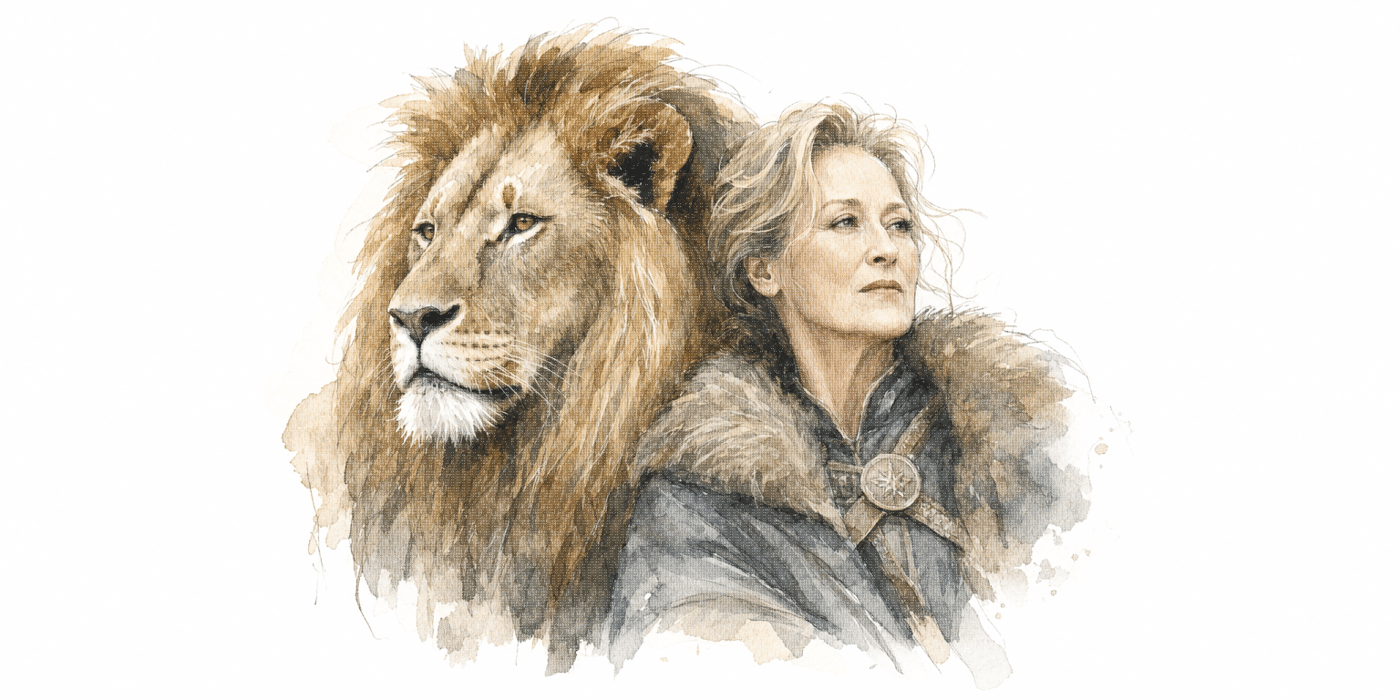
Gerwig, however, decided to cast Meryl Streep as the voice of Aslan — effectively shaving his mane to make a point.
“I wanted someone who was profound but not pretentious, who had gravitas but not morose self-seriousness,” she opined of the casting decision. “Someone who could communicate depth and pathos as well as joy and delight. I wanted someone who was older than 70, so there was a wisdom of experience, but who also had the capacity of fresh wonder, like a child. And also to be one of the greatest actors to ever do it. That list is not a long one.”
Gerwig is not wrong about Streep — she is one of the greatest actresses of our time — but casting her to voice Aslan is a fundamental misreading of the story and seems like an unnecessary nod to a feminist notion of God as a woman.
There is something to be said for artistic license. Theater people are a strange lot and like to play around with different ideas and even gender swaps. This tradition goes back to the Greeks, when women did not act on stage. Shakespeare, arguably the greatest playwright of all time, had an all-male company because women were not allowed on stage. Men played all the parts.
Literature also has precedent for taking such license with God as female. In the book The Shack, God the Father and God the Holy Spirit were portrayed as female characters. Notably, the book portrays Jesus as the Bible explicitly says he is: a Jewish carpenter from the first century.
However, Jesus, unlike God the Father or the Holy Spirit, was born and lived on Earth as a human man. Will Gerwig keep Streep’s voice as is, or alter it to sound more male? Will Aslan still be a male lion?
These are important questions to ask because Gerwig’s core audience for this sort of film (Christians) likely won’t be very interested in watching if she is perverting a story that is an allegory for the Biblical creation story.
This sort of artistic choice didn’t happen in a vacuum. We are living in the era of Texas Senate hopeful James Talarico deliberately manipulating the understanding of God as outside of gender and saying that God is “non-binary.”
We also live in an era of feminist dominance. Gerwig, if she read Genesis as background for her reading of The Magician’s Nephew, would have seen that the woman’s constant sin battle over eating the forbidden fruit is that she will always try to overthrow her husband’s authority. How is this casting choice not a direct thumb in the eye of this particular element of the Creation-Fall-Redemption arc in the Adam and Eve story?

The destruction is intentional. They don’t care if this loses money. This is not meant as an entertainment offering. This is a cultural and political project meant to destroy Christianity in the Western imagination, and they’ll happily lose money to do so.

Meryl Streep will officially voice Aslan in Greta Gerwig’s ‘NARNIA: THE MAGICIAN'S NEPHEW’. 🔗 empireonline.com/movies/news/na…

Joel Berry, formerly of The Babylon Bee, pointed out that this casting choice is intentional destruction. “They don’t care if this loses money,” he argued. “This is not meant as an entertainment offering. This is a cultural and political project meant to destroy Christianity in the Western imagination, and they’ll happily lose money to do so.”
You also have to consider which company Gerwig is making this film for. Netflix has a strong trans-the-kids agenda, as evidenced by the kid shows on its platform. The idea of gender-swapping Aslan would probably sound delightful and in line with the secular worldview. To make another C.S. Lewis reference, this idea is so diabolical it could only have come from Screwtape.
Gerwig has also decided to move the story’s setting up by 50 years, so Polly and Digory are in 1950s England. This doesn’t work well if she decides to continue the series because The Lion, the Witch and the Wardrobe very crucially takes place in the 1940s during the Blitz.
The Pevensie children in that story are sent to the country to keep them out of danger from the London bombings. Digory, a child in The Magician’s Nephew, is the elderly professor the Pevensie children stay with in the country manor. No other time in English history merited such a mass evacuation of London children. Story-wise, this makes it difficult to justify setting the Pevensie children in 2000s England, forced to the country to live with the elderly Digory.
Gerwig wanted to make her retelling “rock-n-roll” and therefore set it in the era of rock-n-roll, but in doing so, she made a follow-up movie more challenging, if not impossible. It is also another sign that Gerwig’s determination to take creative license trumps her genuine understanding and respect for the source material.
All available evidence indicates that Gerwig and Netflix are taking a lot of liberties and have most likely crossed a line in this Biblical Creation retelling of a beloved children’s book. We could be surprised by the resulting film, but this casting choice and storytelling chronology suggest a director who doesn’t understand the source material — or, worse, who aims to twist a piece of Christian literature.