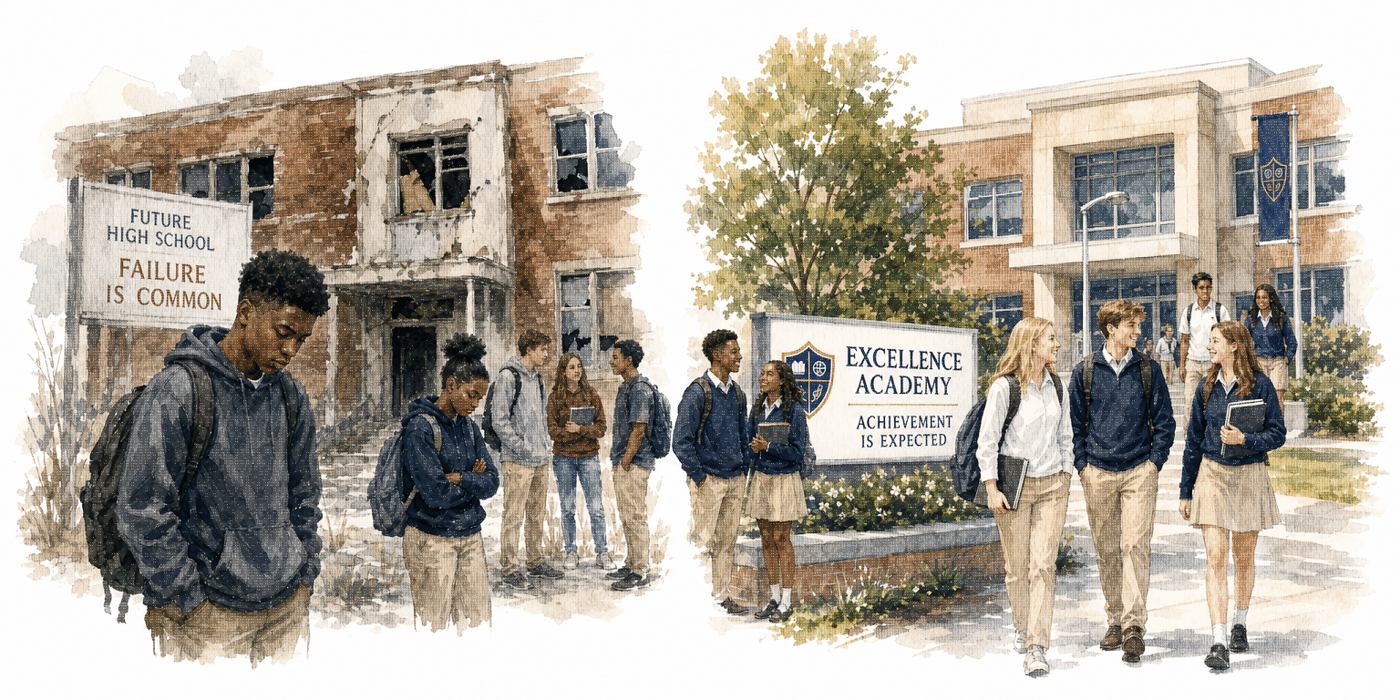

Children are the victims of left-wing social experiments. They are happily sacrificed for “the greater good” of individuals or society. Therefore, when it comes to abortion, children are murdered for “the greater good” of their mothers. When it comes to criminal justice, Lindsay Clancy killed her children because “society refused to help her” treat her mental illness. And in education, 1619 Project creator Nikole Hannah-Jones sacrificed her daughter’s well-being for the belief that one caring family could change a school.
Hannah-Jones has a theory about failing public schools: they are going under because of modern-day segregation. Her solution? More money.
The raison d’être for the 1619 Project was to make slavery both America’s original sin and the reason for America’s being. Serious historians across the board have denounced this retelling of U.S. history; nevertheless, schools across the country still use Hannah-Jones’s ideas, which were adapted into a curriculum.
Her work contributes to school failure. Students educated in the Hannah-Jones theory of life see the world through a downtrodden pair of glasses. She and her acolytes are so focused on their victimhood and denying that merit is a universal trait (not limited by race or sex) that they cannot see the forest for the trees.
In an article for The New York Times Magazine, Hannah-Jones explained over and over again that she believed black and Latino kids were disproportionately placed in public schools in low-income neighborhoods. They received uncommitted, exhausted teachers, few opportunities, and a subpar education. She attributed this to racism.
Here’s the thing about the gospel of victimhood: If you tell someone that they can’t succeed, that the system is stacked against them, they’ll believe you and stop trying.
Hannah-Jones even said something similar when describing her daughter taking a test to get into the best public schools in NYC. Her daughter believed there was no hope and almost refused to try.
However, Hannah-Jones also boldly proclaimed that she opposes school choice because it further depletes public schools. She also claims the screening exam — an entrance exam — is racist and that her kids wouldn’t have stood a chance anyway.
In her own words:
Under the city’s so-called school-choice system, most of the highest-performing public middle (and high) schools use what are called academic screens — a combination of grades, interviews, portfolios and standardized tests that determines admission — to allot access to public schools that most public-school children can’t get into.
This systemic sorting of worthy and unworthy children is justified by saying that our “brightest” students deserve and demand more rigor. While many of the city’s Asian students have benefited from these screens, in reality the screens are part of a tawdry bargain to keep a dwindling number of white and wealthier parents from exiting the public school system.
However, when her daughter finally confronted her about choosing other kids in the community over her own education and well-being, Hannah-Jones broke.
Her daughter, Najya, as an eighth-grader, advocated for herself and convinced Hannah-Jones to let her attend a public school of her choice with a better academic record. The damage to Najya’s education meant that her first semester at the more rigorous high school exposed massive gaps in her learning. The girl had to work extra hard. Hannah-Jones got her tutoring. By the end of her freshman year, Najya had caught up.
Hannah-Jones blames the failing of her child’s elementary and middle schools on a system that is segregated by race, income, and, most importantly, ability.
However, while she heavily dwells on the racism that antiracism inculcates (i.e., what George W. Bush once called “the soft bigotry of low expectations”), she neglects to also account for the very real problem that infects education: blind parental trust.
Like many other parents, Hannah-Jones entrusted her child to schools where she did not receive an education, and because of the convenient adherence to not giving homework, she had no idea where her daughter stood academically. The only thing she knew was that her daughter was not a racial minority and was an “honors” student in her school. She also knew that affluent white and Asian families either tested or paid their way out of failing public schools.
This author went through public school. We had a very diverse student population. What set us apart was invested parents, involved teachers, and high expectations. Merit was king.
In adhering to a vainglorious notion that she, Hannah-Jones, was going to use her daughter to bring about the kind of educational change in her failing public schools as Ruby Bridges did in integrating schools in the South, her daughter languished in mental doldrums. Children are the victims of leftist social experiments. In this case, at least, Hannah-Jones and her daughter found redemption.