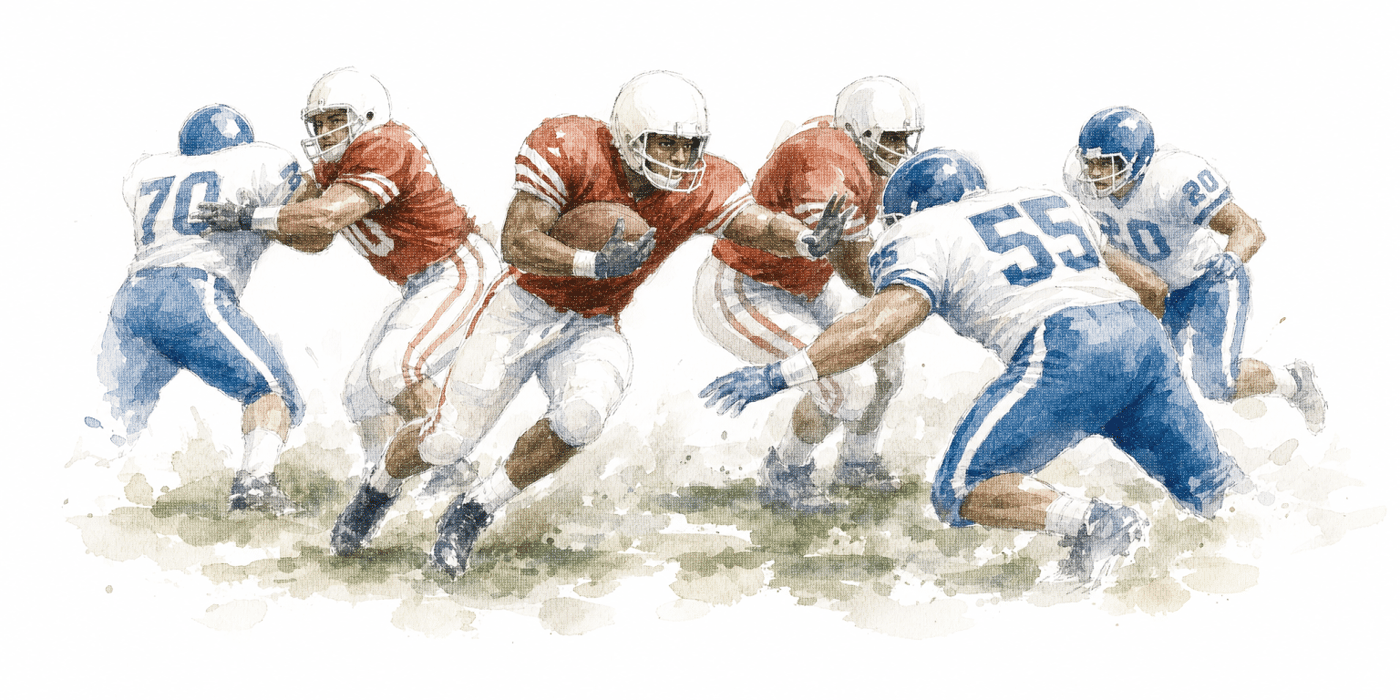

With football season in full swing, sports fans are now seeing, in all its gory detail, the mess in college sports that has been unfolding for the past several years. Big money has taken over. The all-too-familiar scenario: our team’s star quarterback from last year now plays for our arch rival — but we have a new one, a terrific player from the Big Ten. The new guy is costing us millions, so hats off to our Booster Club for once again coming up with the big bucks needed to buy a winning team.
Hmm…
By all accounts, it’s open economic warfare, governed by inconsistent (or no) rules and regulations. College football’s top players move freely from team to team, aided by a convenient transfer portal and relaxed NCAA eligibility requirements. Coaches are constantly hunting for the next superstar, armed with eye-popping compensation packages to convince the next prospect to jump ship.
And don’t look for the new star players on campus — they’re hired to play football, not go to class. As one example, the University of Miami has fielded new starting quarterbacks for each of the past four seasons. Their 2025 star QB, in a media interview just before the NCAA National Championship game, was asked how well he was enjoying his new school — he responded innocently, “Well, I actually haven’t been on campus yet.” (That was in January!)
The numbers tell the story. The poster child for today’s college football merry-go-round (albeit with others catching up fast) is Louisiana State University (LSU), a perennial football powerhouse. During last year’s football season, LSU lured away rival Ole Miss’s very successful coach with an offer of nearly a 50% salary increase. At LSU, he now takes in $13 million per year, and the excellent quarterback he brought with him will be paid $4.5 million this year. By comparison, the LSU chancellor’s annual salary is a paltry $750,000.
More and more, it seems that big-time college football has less to do with education and everything to do with the mammoth U.S. sports/entertainment complex. And surprisingly, that tectonic shift remains cloaked in the quaint fiction that college football is an extra-curricular activity — intercollegiate competition among student athletes representing their respective institutions, conducted under the auspices of the National Collegiate Athletic Association (NCAA).
Granted, that idyllic notion began disappearing years ago with high-powered programs, huge TV revenues, top-notch athletic facilities and dormitories, packed stadiums and fanatical fans. But that transition is becoming more pronounced than ever, and it’s doing more bad than good.
Right now, Congress is working on legislation to fix the problem. On Monday, the Senate passed the Protect College Sports Act with strong bipartisan support. At least our elected legislators are attempting to solve an obvious problem, and the promised legislation should bring some order and consistency to the current chaos. But it’s not at all clear that legislation is the best path forward.
The primary concern, in my view, is that the emerging Protect College Sports legislation will have the net effect of validating — and even expanding — the very problematic situation. It will normalize the mess.
By all indications, that’s where it’s headed. Our legislators on both sides of the aisle seem quite OK with the current trend. They argue about salient aspects, such as potential salary caps for coaches and staff. Evidently, however, they not only endorse paying huge sums of money to student athletes, but also propose increasing those payments. The bill the Senate approved would raise the cap on such payments from the current $21M per year (per college) to $49M per year.
I’m pretty sure that throwing more money into the arena won’t help.
So, in a fit of regressive, Neanderthal thinking, let me propose a fundamentally different approach — that we resurrect the previous practices and policies we hastily tossed out the window. Consider for a moment the key features of inter-collegiate athletic competition that made it so successful and popular, for so long:
- Competitors who are actual students of the colleges or universities they represent and who in most cases remain at the same school for their full period of eligibility.
- Student athletes who are well rewarded for their participation, via generous scholarships (covering tuition, room and board, books, fees), and the opportunity to learn from professional coaches, to compete at a high level, and to showcase their skills to professional franchises. And for those not destined for a future in professional sports (i.e., 98% or more), participation in varsity-level collegiate competition is in itself an invaluable lifetime experience.
- Substantial revenue streams (particularly from football and basketball programs) that in turn fund non-revenue-producing sports, Title IX commitments, and otherwise enhance their institutions’ bottom-line financial stability.
Why is it not possible to retain or restore those features? My Plan B: keep college sports in college, let the money collected go to the colleges, funding their full suite of athletic and other extracurricular athletic programs, and then put whatever additional money is available to sound educational uses such as scholarships and tuition reduction, rather than throwing it at a relatively few student athletes (most of whom are destined to be wealthy anyway) during their college years.
Would my proposal leave out in the cold the student athletes who actually work, sweat, and put their bodies on the line in the field of play? Not really. As noted above, the rewards of participation are inherent. For context, each year, on average, only one or two of the 105 players on a Division One college football roster are drafted by NFL teams — and not all of those will have successful NFL careers. Does it make sense to weigh down each college football program with a process that grooms (and pays handsomely) the very few players who may follow that career path?
One key part of this change would be to rethink the NCAA’s NIL policy, which allows compensation to individual athletes for an outside commercial organization’s profitable use of their name, image, or likeness. In concept, NIL is the sensible and fair treatment of clear-cut cases (such as a local car dealership featuring the team’s star running back in its televised ads). But although well-intended, NIL has become a catch-all justification for large pay-for-play arrangements (e.g., “come play for us and we’ll provide x-million per year NIL compensation”). Instead, such compensation should be limited to specific cases in which an athlete’s name, image, or likeness has direct, tangible financial benefit, and with a reasonable cap on the allowable financial compensation to the athlete involved.
Would my proposal place too high a burden on student athletes? One test of that approach is right in front of us — our Army, Navy, and Air Force service academies. I was fortunate to see that firsthand with my 1965 Naval Academy classmate Roger Staubach — who played football and baseball at Navy, went to class with everyone else, graduated on schedule, went on to U.S. Navy active-duty service, and then became a fabulously successful professional football player.
Yes, that’s ancient collegiate sports history — but the process still works. Two players from last year’s Navy football team are now on professional NFL rosters. The simple reality is that excellent college athletes can fully benefit from playing on high-level college teams and then transition to the professional ranks.
And now, the reality check: Unbaking that new and very delicious (and lucrative) cake may be impossible — particularly with players and coaches already making millions and a pipeline of eager, talented young athletes anxious to join the feast. But I’d argue it’s worth trying to preserve and, where possible, restore the key parts of our much healthier prior system.
The purpose of the Protect College Sports Act is to do just that — protect college sports and those who participate. In my view, it should not sanction or expand an already out-of-control pay-for-play arrangement for college athletes or serve as a talent feeder system for the NFL or NBA. Do we want to turn college athletics into a business enterprise, totally divorced from their institutions’ fundamental mission — higher education? I think not.