
I had a quick chat with a friend this past week about a measurement challenge his company faces with a product. It felt surprisingly good to talk about capability studies, repeatability and reproducibility, set masters, certification of standards, establishing limits, controlling processes, and perhaps most importantly, defining who the customer really is.
Ok, let’s face it. Manufacturing has nerds, too.
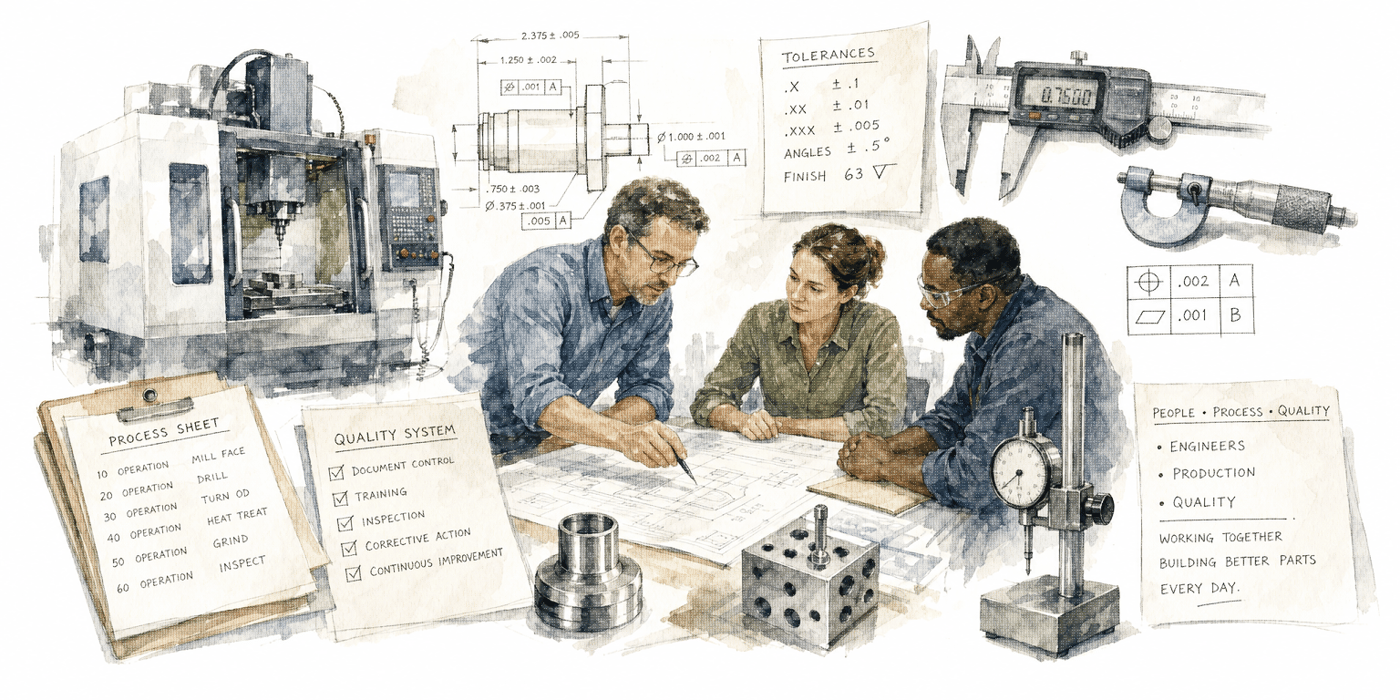
I’ve had a wonderful career making stuff, everything from munitions components and automotive safety devices to equipment designed to get oil and gas out of the ground. I’ve spent a substantial portion of my life around machine tools, drawings, tolerances, inspection equipment, process sheets, quality systems, engineers, and production people trying to figure out why something that worked perfectly yesterday suddenly doesn’t work today. So yes, I am one of the nerds.
Manufacturing teaches you rather quickly that every successful process has a pattern. There are inputs, operations, and outputs, and somewhere within all of that there are limits within which the process will reliably produce what you intended it to produce. That doesn’t mean there isn’t variation. There is always variation. Machines wear. Materials differ. Temperatures change. Operators differ. Measuring instruments have limitations. Individual operations drift. The question isn’t whether variation exists. The question is whether the variation is significant enough to change the outcome.
That distinction is enormously important.
The trick in manufacturing is discovering those limits, understanding what causes variation, determining whether it can be measured, and then controlling the process sufficiently to ensure the finished product meets expectations. Once you understand that, the objective becomes replication: producing the desired result Monday morning, Wednesday afternoon, and six months from now.
That doesn’t mean the process can never change. Quite the opposite. Good manufacturers are constantly looking for better ways to do things. Continuous improvement is practically a religion in a good manufacturing operation. But improvement requires something more sophisticated than simply changing things. You must evaluate a proposed change against the desired outcome. You experiment under controlled conditions, measure the results, determine the consequences, and only then incorporate the change into normal production.
You don’t normally redesign the process in the middle of a production run and simply hope everything works out.
There is a reason for that. A process operating within known and controlled limits produces reasonably predictable results. Push it outside those limits and the results become less predictable. Push it far enough, and you eventually produce something entirely different from what the process was designed to produce.
The older I get, the more I think this principle extends far beyond manufacturing.
Families are processes. Businesses are processes. Markets are processes. Governments are processes. Cultures and civilizations are extraordinarily complicated processes developed over generations. Each contains enormous amounts of variation, experimentation, and adaptation, but each also depends upon certain relationships, assumptions, incentives, and boundaries that allow the system to continue producing recognizable results.
Perhaps many of our modern problems come from believing we can endlessly change the inputs while demanding the outputs remain the same.
Change incentives, but expect the same behavior. Change educational standards, but expect the same competence. Change the definition of responsibility, but expect the same level of responsibility. Change family structures, cultural expectations, economic incentives, legal standards or institutional restraints, then act surprised when the resulting society behaves differently.
That doesn’t mean every change is bad. That would be as foolish as arguing that a manufacturing process developed in 1950 should never be improved. Some changes produce dramatically better results. Others make little difference at all. Some initially appear beneficial but introduce consequences elsewhere in the system that aren’t discovered until years later.
My point is simpler: change is not consequence-free.
Every functioning system has some amount of variation it can absorb without fundamentally changing its output. Somewhere beyond that lies a limit. We may not know precisely where it is, and in something as complicated as a society we probably cannot measure it with the precision of a machine process, but pretending the limit doesn’t exist doesn’t make it disappear.
Manufacturing taught me something else: when the output suddenly changes, you don’t begin by arguing with the output. You start examining the process.
What changed? When did it change? What assumptions changed? What inputs changed? Which limits were moved? Which controls were removed? Was the change intentional? Most importantly, are we still producing the thing we originally intended to produce?
Those seem like useful questions for a civilization, too.
We can certainly debate whether a particular social change is positive or negative, necessary or unnecessary, progress or regression. Those are legitimate arguments. What makes considerably less sense is pretending we can continually alter a system’s fundamental inputs without eventually altering its output.
Everything has tolerances; everything has a maximum amount of variation it can accept without fundamentally altering the end product — the difficult part is discovering the limits before we exceed them.
And the really difficult part is arguing that a change that is bad for us is actually good for the simple reason it is change.