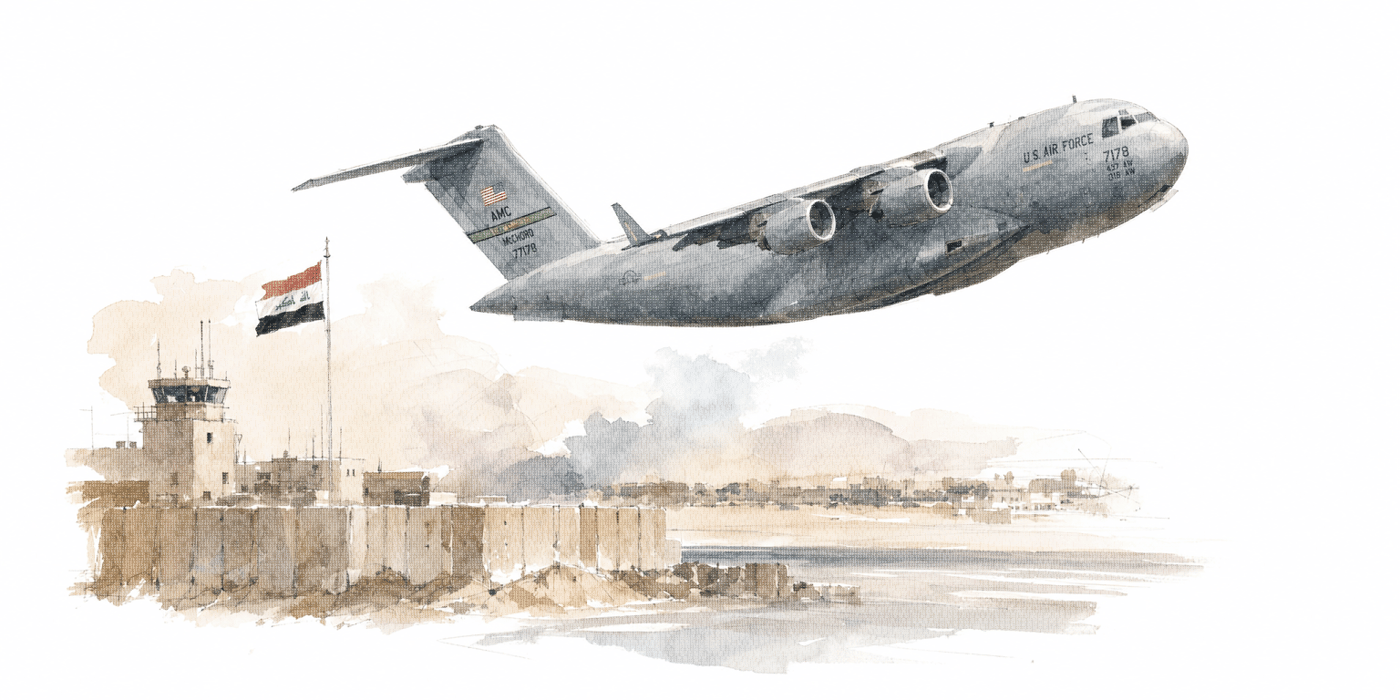

The last remaining U.S. troops in Iraq, 2,500 in total, have left the country after more than two decades of maintaining a presence in the Middle Eastern country that began as part of America’s War on Terror.
President Donald Trump recognized the event in a statement from the White House. “This day is a victory for the United States. It’s a victory for Iraq and a decisive victory over ISIS, which has been completely decimated, which is the reason we went in there in the first place,” he said. “We came to fight a caliphate, and there is no longer a caliphate, so we are going home.”
The deal to leave Iraq was brokered by the Biden administration in 2024, a deal that Trump, despite the ongoing conflict with neighboring Iran, was clearly willing to uphold. Indeed, ending America’s so-called “forever wars” was one of Trump’s policy goals touted during his first term, as he has long criticized the drawn-out nature of both the wars in Afghanistan and Iraq.
However, one can’t help but be reminded of the debacle of Joe Biden’s military exit from Afghanistan that resulted in the deaths of 13 American service members and over a hundred Afghans, and that left behind millions in military equipment and weapons for the Taliban.
In truth, the withdrawal was a needless surrender that signaled to the world that the U.S. could not be trusted to defend its allies. It was less than six months later that Vladimir Putin launched his invasion of Ukraine.
Trump rightly rebuked Biden’s handling of the Afghanistan withdrawal, which Biden sought to blame on Trump, who originally brokered the exit deal. Yet Trump’s deal rested on conditions that Biden erased, and Trump would not have let it spiral out of control.
But aside from this, the narrative surrounding both Afghanistan and Iraq — that these were “forever wars” — was quite frankly disingenuous. U.S. troops were not engaged in a state of continuous combat and warfare, nor had they been for years. Indeed, our troop presence was better described as more of a stabilizing and training force to help sustain both national governments.
In a way, one could look to the fact that, to this day, the U.S. has military bases in countries like Germany, Japan, and South Korea, even though World War II and the Korean War have long ceased.
In fact, when the U.S. first withdrew troops from Iraq back in 2011, it was a mere three years later, following the rise of ISIS, that American personnel were sent back in, having to fight once again to reconquer lost territory and help shore up a faltering Iraqi government.
Will the U.S. find itself in a similar situation again in the not-too-distant future? Much of that may depend on the outcome of the current conflict with Iran. If the Islamic Republic collapses under the current economic stranglehold the U.S. has put it under, it could create significant, long-term positive change for the region.
Domestically, Americans have tired of wars in the Middle East. And despite his current actions against Iran, Trump’s knows this and agrees with it. There’s no doubt he believed that his campaign against Iran would have brought a much quicker victory and change for the better than it has so far.
So, recognizing victory over ISIS and the complete withdrawal of U.S. troops from Iraq demonstrates Trump’s commitment to eventually ending America’s decades-long military presence in the Middle East.