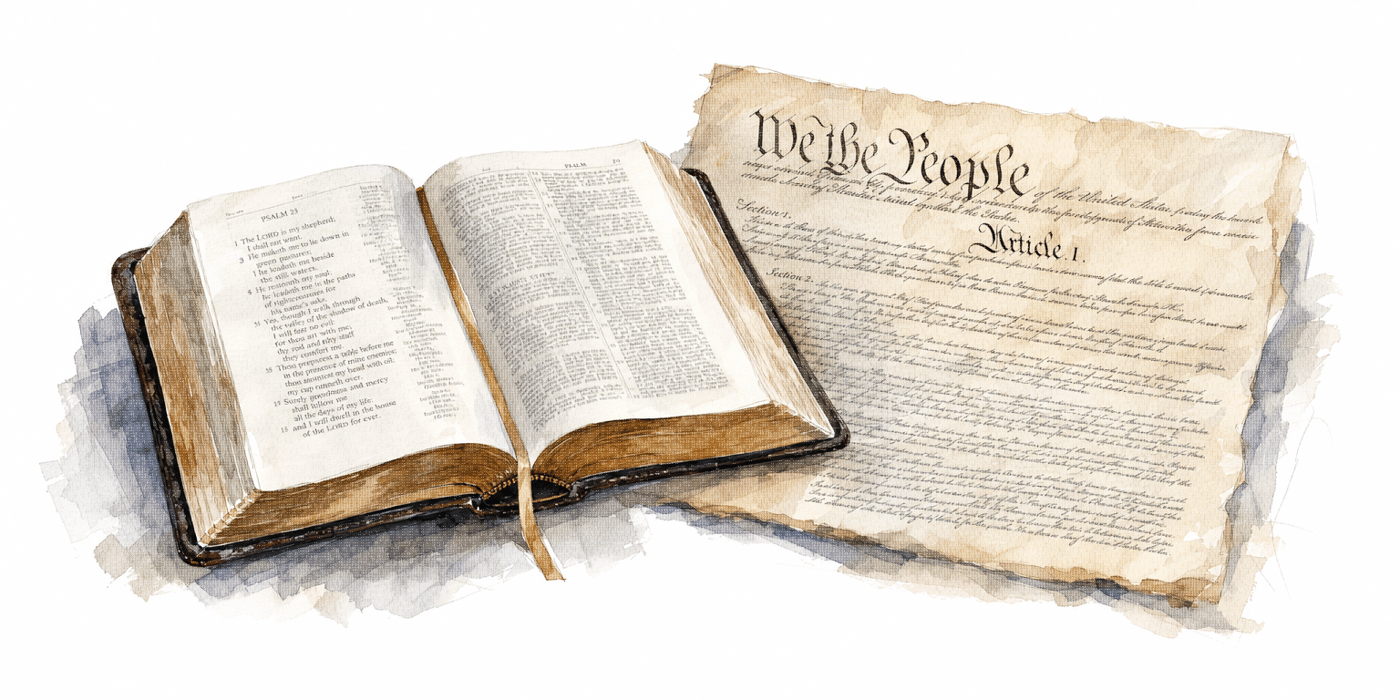

As the old adage goes, “Never talk about religion or politics.” The rationale is to foster a polite society where spiteful arguments are avoided.
And in many instances, this advice has been heeded by conservative Christians. Indeed, given the recognition of the separate spheres that the church and the government occupy within society, this is not an unreasonable expectation.
That said, both the government and the church are essential parts of society and play important civic roles in the unique American context. Simply put, the church acts as the nation’s moral conscience, and the government acts as society’s justice enforcer.
America’s Founding Fathers clearly understood this dynamic. “We have no government armed with power capable of contending with human passions unbridled by morality and religion,” John Adams famously observed. “Our constitution was made only for a moral and religious people. It is wholly inadequate to the government of any other.”
Samuel Adams pointedly noted, “Neither the wisest constitution nor the wisest laws will secure the liberty and happiness of a people whose manners are universally corrupt.”
Benjamin Franklin insightfully warned, “We have been assured, Sir, in the Sacred Writings, that ‘except the Lord build the House, they labor in vain that build it.’ I firmly believe this; and I also believe that without His concurring aid we shall succeed in this political building no better, than the Builders of Babel: We shall be divided by our partial local interests; our projects will be confounded, and we ourselves shall become a reproach and bye word down to future ages. ... I therefore beg leave to move that henceforth prayers imploring the assistance of Heaven, and its blessings on our deliberations be held in this Assembly every morning before we proceed to business, and that one or more of the clergy of this city be requested to officiate in that service.”
Franklin, a man who personally identified as more deist than Christian, nonetheless recognized the reality of God’s sovereignty over everything, including the new nation. As Scripture clearly teaches, “He makes nations great, and he destroys them; he enlarges nations, and leads them away.” (Job 12:23)
The point is, despite some who deny it, America was founded on a recognized Judeo-Christian moral structure that had long saturated the culture of the original colonies at the time of the nation’s founding.
At least in moral and cultural structure, America was founded on Christian principles.
However, 250 years later, it has become quite apparent that in our government and the broader culture, Christian-rooted moral structure has eroded significantly, replaced by a broadly atheistic secular humanism.
As this erosion has taken place, Christians, wishing to stand against this moral corruption, have wrestled with how the Church should engage both culture and government.
Calls for Christians to become more involved in government are nothing new. Neither are calls for Christians to engage in the culture wars. And indeed, recently the president of the Southern Baptist Convention, the nation’s largest protestant denomination, called on pastors specifically to address national political concerns.
“Should pastors engage in the political process? They absolutely should,” SBC President Willy Rice argued. “Because many political issues are, at their heart, theological issues and moral issues that strike at the very center of what we believe to be true and what we believe people need to know in order to flourish personally and as a culture.” He added, “I think the pastors need to step up. I think throughout American history, pastors have had a strong voice at key moments in American political history.”
This is true yet not as simple as it may sound. Pastors primarily should instruct and lead the congregation in the worship of God. Christians are called to be ambassadors for Christ, calling people to faith and salvation in Him, as the only means of entry into the eternal Kingdom of Heaven.
In other words, what should matter most to the Christian is living a life seeking to glorify God in everything we do, say, and think. This does not preclude love for our country; in fact, it should inform it. It should provide wisdom on where we should stand on the various political and cultural issues of our day.
Furthermore, living with our eyes set on eternity with Christ should not prevent us from engaging with the cultural and political issues in the world around us. We should be concerned with seeing justice and righteousness prevail and flourish in our nation, even though it is not our eternal home.
Famously, in Jeremiah 29:5-7, God tells the Israelites who had been conquered and taken into captivity to Babylon, “Build houses and live in them; plant gardens and eat their produce. Take wives and have sons and daughters; take wives for your sons, and give your daughters in marriage, that they may bear sons and daughters; multiply there, and do not decrease. But seek the welfare of the city where I have sent you into exile, and pray to the Lord on its behalf, for in its welfare you will find your welfare.”
For Christians, this means we should invest in and positively contribute to the nations God has placed us in. And for American Christians, that is our own country. This means we cannot in good conscience avoid political engagement.
At the same time, we must guard against the error of allowing political concerns to dominate or dictate what the church focuses upon when we come together to worship the Lord. We must be continuously reminded that God is sovereign; He is in total control, and He is the ultimate protector and savior of His people.
No matter how frustrating or bleak the political and cultural reality and outlook may be, the future is always bright and hopeful for those who are in Christ.