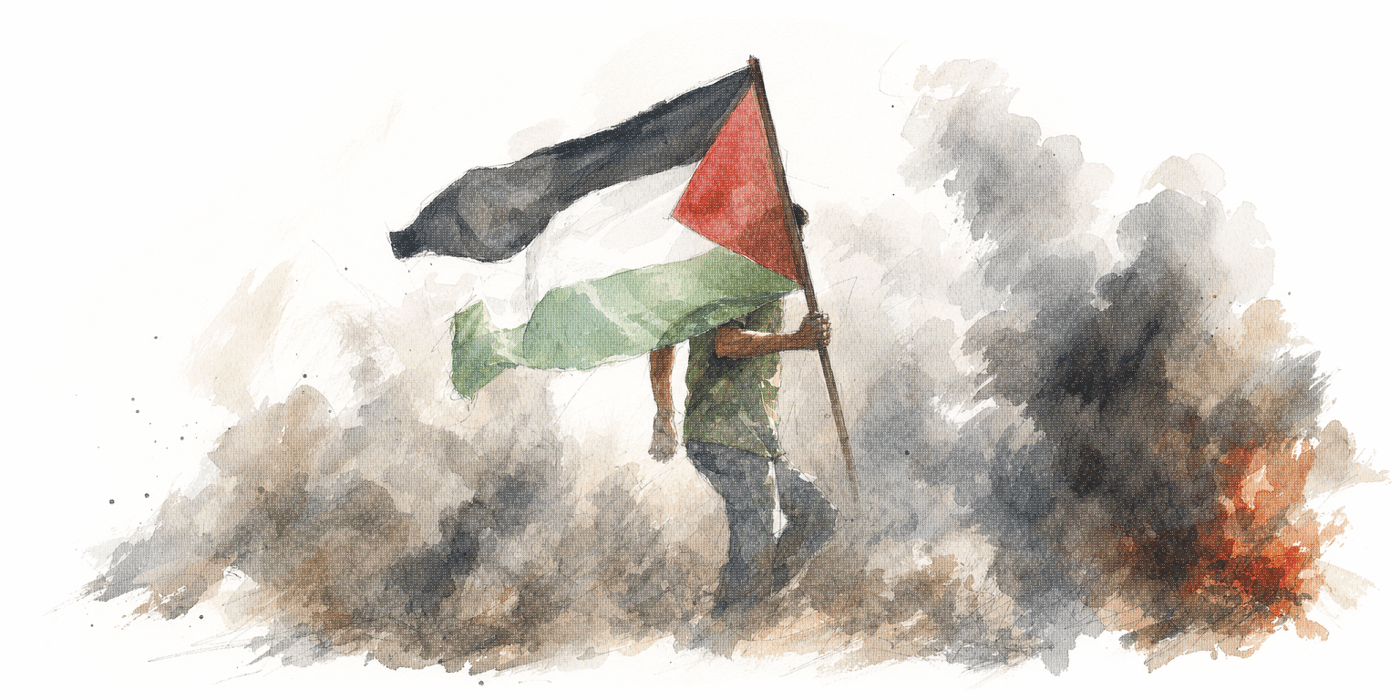

The “Free Palestine” movement existed well before October 7, 2023. But following Hamas’s slaughter of roughly 1,200 people in Israel, it gained renewed momentum, presenting itself as a so-called humanitarian cause — though reserving its compassion for only one side of the conflict — with the stated goal of freeing Palestinians from what activists claim is a history of violent attacks by Israel.
Israel responded to the vicious invasion of that day with military action, defending its land and people. These activists immediately, without question, rallied around claims that Israel was the one committing genocide, demanded liberation for the Palestinians people, and portrayed Hamas’s atrocities as justified resistance.
Initially, the renewed wave of activity focused largely on Israel, Gaza, and condemning American support for the Israeli government.
But over the last three years, something more troubling has become increasingly apparent.
From violent rhetoric and the glorification of terrorism to burning American flags and waving Palestinian flags at destructive protests across Western countries — even over issues completely unrelated to the Israeli-Palestinian conflict — the movement has continuously demonstrated hostility that extends far beyond Palestinian liberation.
For these extremists, the fight against Israel represents something much bigger: the overall fight against Western values, institutions, and influence. “Free Palestine” activists see these things as tools of oppression, and therefore all of it must be dismantled to liberate those they believe are suffering under Western power.
In other words, what was presented as a humanitarian cause — protecting the helpless and suffering in one corner of the world — has become a vehicle for hostility and destruction directed at Western civilization itself.
America. Europe. Australia. All viewed as legitimate targets in the name of fighting supposed Western oppression.
And at the heart of this ideology is the dangerous belief that hatred can be virtuous, violence can be justified as justice, and even murder can become a moral cause.
As an example, in a street interview, Miss Israel 2021, Noa Cochva, approached strangers to gauge their reactions to a horrific music festival massacre in which hundreds of innocent, unarmed concertgoers were brutally attacked and murdered. Initially, they responded with shock, sadness, and sympathy for the victims.
“That’s so sad. I hadn’t heard of that,” one man responds, while another woman expresses similar horror: “I think it was horrible.”
But the moment Cochva reveals that the victims were Israelis attending the Nova Music Festival, the tone shifts dramatically. Suddenly, the violence becomes understandable, even justifiable. Some even grow visibly uncomfortable or angry, refusing to continue the conversation.
“I’m not surprised, honestly,” one woman responds. “Palestinian people have been seeking liberation for years. They’ve had to resort often to acts of violence to make their voices heard.”
When Cochva challenges claims of ethnic cleansing by pointing to the growth of the Palestinian population, another man abruptly shuts down the exchange: “I don’t know enough to keep talking about this. This conversation needs to end here.”
What changed? Not the crime. Not the brutality. Not the innocent victims.
Only their identity.
Unfortunately, this isn’t limited to uncomfortable street interviews.
In October 2023, Fox News reported that demonstrators in New York cheered as speakers celebrated Hamas taking hostages. One activist praised the attack as a “glorious victory of the resistance.” Apparently, slaughtering civilians becomes something worth celebrating when the victims belong to the designated oppressor class.
And rather than fading over time, that mentality has only grown stronger and more deeply entrenched.
On October 7, 2025, protesters outside Columbia University distributed a publication produced by Columbia Students for Justice in Palestine (Columbia SJP), justifying Hamas’s attack against innocent, unarmed people in Israel. Columbia later condemned the glorification of violence, declaring that “Invoking Columbia’s name to glorify violence is a breach of our values.”
Even on the third anniversary of the massacre, there were several documented demonstrators across America praising the attack and chanting “long live the intifada.”
Despite Columbia University’s condemnation of violence against Israel a year earlier, hostile pro-Palestinian demonstrations erupted on campus, forcing the university to increase security to protect students from volatile protesters as they went about their daily activities.
In July 2024, demonstrators in Washington, DC, tore down American flags at Union Station, replaced them with Palestinian flags, and burned the American flags. The Daily Wire reported protesters displaying Hamas symbols: “The extremists vandalized Christopher Columbus Memorial Fountain with graffiti that said, ‘Hamas Is Coming’ and ‘Zionists Go To Hell.’”
What does burning the American flag or vandalizing a memorial honoring our nation’s history do to help Palestinian civilians?
Absolutely nothing.
France offers another clear example of how the Palestinian flag waves at violent demonstrations far removed from the conflict in Gaza.
The recent unrest in France has become a shocking sight worldwide. Images of burning barricades, damaged property, and clashes with police have emerged, and the grievances driving these demonstrations have been described as domestic, including anger over education, government policies, and living conditions.
Yet the sight of Palestinian flags amid the chaos shows how the movement has become entangled with seemingly unrelated political causes — these extremists look for any grievance to justify violence and destruction, as long as it weakens a Western nation.
Since September 2026, student demonstrations demanding better school conditions have spread across the country, with some descending into arson, vandalism, and violent clashes with police. Schools have been damaged, barricades set ablaze, and entire communities disrupted. Yet still, amid the unrest, protesters have included messages supporting Gaza.
And that’s what makes the overlap worth examining.
Why does the Palestinian cause keep appearing in protests over completely different grievances?
In her article “Why France Is Burning,” Simone Rodan-Benzaquen offers insight, pointing to Jean-Luc Mélenchon, leader of the radical-left party France Unbowed (LFI). His political strategy appears to be exploiting the growing unrest across France. In a 2012 speech, Mélenchon argued that for his political movement to succeed, it must “turn everything it touches into conflict.”
By linking left-wing opposition to restrictions on Muslim religious expression, including hijabs in schools, with the broader pro-Palestinian movement, activists like Mélenchon have brought seemingly unrelated causes together. As Rodan-Benzaquen asks, “Should we be all that surprised, then, that Palestinian flags have appeared at school protests? What does Gaza have to do with a shortage of teachers in France?”
Her explanation? Hostility toward Israel has become a powerful message for attracting young voters, and by tying it to other grievances — even protests over school conditions — ordinary demands are transformed into mob hostility against a government built on Western ideals.
That doesn’t necessarily mean Palestinian solidarity caused the violence in France. But it does add to the bigger picture of how the cause has moved past Israel and Gaza and is now used as an excuse to wreak havoc at any time, in any place — and anyone in the way deserves their wrath.
Was this ever really about opposing genocide, or was that simply a cover for a much broader global agenda?
If Palestinian freedom were truly the priority, removing Hamas from power would be the central demand. Its authoritarian rule has subjected Palestinians to years of oppression and brutality. If the movement were truly about protecting innocent lives, there would be the same level of outrage for women persecuted in Iran and Christians being hunted down and slaughtered by the thousands in Nigeria.
Yet their supposed commitment to human rights conveniently evaporates the moment the perpetrators don’t fit their narrative, and the victims are people they’ve decided deserve to suffer.
For these extremists, the world is divided into oppressors and oppressed, and those labels dictate who is justified in terrorizing others and who deserves to endure their cruelty.
Under this worldview, dismantling Western institutions becomes a moral obligation, and virtually any means can be justified.
This isn’t moral enlightenment. It’s moral inversion.
Western civilization rests on the principle that every human life has inherent worth, regardless of nationality, religion, or identity.
The moment you justify atrocities against innocent people because of who they are, you’ve stopped fighting oppression. You’ve become an apologist for it.
And that very dehumanization is what makes oppression possible.