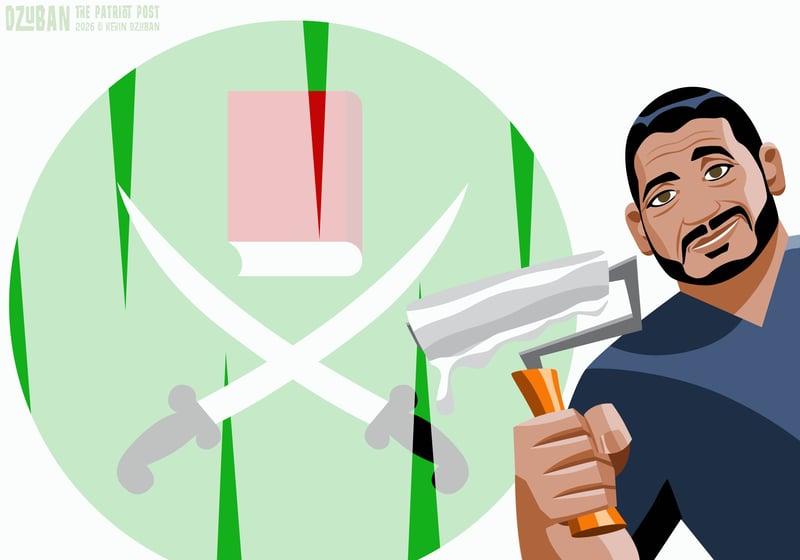
Where does Abdul El-Sayed’s loyalty lie? Americans should ask this legitimate question of anyone running for public office, especially a senator representing one of the 50 states.
And yet, when the self-identified Muslim and practical, if not technical, member of the Democratic Socialists of America was pressed during this week’s Michigan Senate debate by his Republican opponent, former Representative Mike Rogers, over his all-too-close connection with the Muslim Brotherhood, El-Sayed objected, but tellingly refused to disavow the terrorist group.
“He keeps raising this question about this association with the organization,” El-Sayed demurred. “It’s really quite beneath you.”
When faced with the following question, “Who do you think is a bigger threat to the U.S.? Iran or Israel?” El-Sayed once again equivocated and refused to give a straight answer.
For reference, it is not Israel that has a long history of supporting terrorism. It is not Israel that chants “Death to America” as one of its guiding ideological goals. This is not a difficult question to answer.
At another point, Rogers pressed the issue again, observing, “[El-Sayed] was passionate about defunding the police. As a matter of fact, he asked the Muslim Brotherhood, excuse me, head Morsi in Egypt, to defund the police there, too. I mean, it’s unbelievable.”
El-Sayed once again dodged the charge while feigning offense. “To bring into question my commitment to the Constitution is really beneath you,” he replied, adding that he was a “proud American” and that Rogers’s observation was “actually really quite shameful.”
This may be why, even among those on the Left, there is growing unease about El-Sayed — so much so that even The New York Times, while still supporting his election because it would likely be needed for any chance of Democrats gaining control of the Senate, offers only weak support.
Furthermore, the Times does note that El-Sayed’s mother worked for a charity that supported the Muslim Brotherhood and other Islamic terrorist organizations, including Al-Qaeda.
While El-Sayed likes to tout his love for America and the Constitution, his continued refusal to disavow Muslim terrorist groups, like Hamas or the Muslim Brotherhood, is highly troubling. Combined with his vocal anti-Israel position and his socialism, it becomes clear why so many are uneasy about him.
Tellingly, El-Sayed is struggling to appeal to black voters. Recently, he made the following attempt to relate, which only serves to underscore his own massively racialist lens through which he views the world:
For too many black Detroiters in particular, their experience with somebody who looks like me is not a good one. You go into a gas station, you go to a party store, you’re being talked at from behind bulletproof glass. If you’re a woman, you’re being catcalled. If you’re a kid, you’re being sold a Lucy out the back, being denied a bathroom. I’ve always tried to be on the right side of that. But I also understand that, like, if that’s your experience with someone whose name is like mine, that leaves a terrible taste in your mouth.
He knows that to win this tight race, he must appeal to one of the Democrat Party’s most important voting blocs. But it’s not his Egyptian ethnicity that’s keeping him from gaining traction with black voters. It’s El-Sayed’s fixation on supporting Gaza and his anti-Israel advocacy. How does supporting Gaza tackle any of the problems facing blacks in Michigan?
This is one reason The Detroit News has endorsed Rogers in the race.
El-Sayed’s radical leftist socialism is bad enough, but combined with his animosity toward Israel and his refusal to disavow Islamic terrorism, the choice for any serious voter should be clear.