

“Purposed” — it’s not a word we are familiar with in our current culture. The closest I can come is the “all-purpose” flour Lynne buys at the supermarket as she heads into her holiday baking frenzy. But what about that word, “purposed”?
The Merriam-Webster dictionary defines it as “the feeling of being determined to do or achieve something” and provides the words “resolution” and “determination” as synonyms. With those definitions, you may be thinking of some professional athlete or a movie star. I think of a young man who lived a long time ago in a land far away.
Daniel was a young man, possibly in his late teens, when he and other Jews were taken to Babylon by King Nebuchadnezzar. Daniel and his three friends, Hananiah, Mishael, and Azariah, were taken to the king’s court. Their names were changed and they began their indoctrination into Babylonian culture.
I can relate. I joined the Marines at 17, left home, and was immersed in a new culture. I regret that I was not a Daniel, about whom Scripture tells us this:
“But Daniel purposed in his heart that he would not defile himself with the portion of the king’s meat, nor with the wine which he drank: therefore he requested of the prince of the eunuchs that he might not defile himself” (Daniel 1:8, KJV).
The ESV renders the word “purposed” here as “resolved.” The Hebrew word is sum, which Young’s Concordance defines as “to set, place.”
That’s a spunky kid there who goes to the guy in charge and says, “I don’t want to defile myself with your food and wine.” But notice his method here. He “requested” that they might abstain, and God gave him favor in the eyes of the eunuch.
That’s what God does for His children who seek to honor Him. In Proverbs 3:4, we see that those who seek to obey God’s commandments “will find favor and good success in the sight of God and man.”
The book of Daniel documents that principle as Daniel was elevated by King Nebuchadnezzar and was prominent in his court. In Chapter 4, Daniel interprets a dream of the king and boldly challenges him to humble himself before God. As an adviser to the Babylonian king, one would expect he would be killed when Babylon fell to the Medo-Persian empire, but instead, he is again elevated to the royal court of the Persian king. He was God’s guy in the moment.
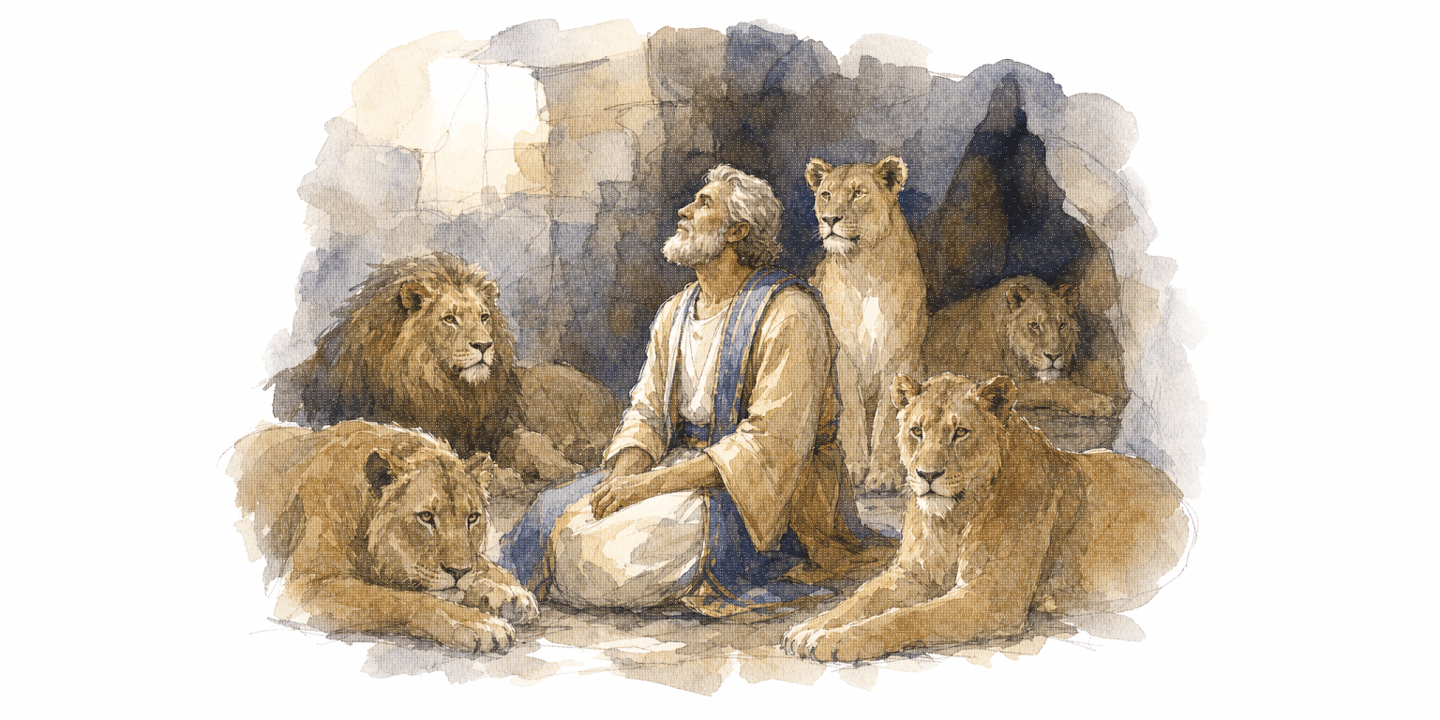
I want to point something out here. Scripture shows that it was only Daniel who went and asked for permission to refrain from defiling himself, but his courage inspired his three friends as well. As a result, his friends became as bold as Daniel — so bold, in fact, that they would not bow down to a golden idol the king had made, despite being threatened with death in a fiery furnace. They were delivered from the fiery furnace. Daniel was delivered from the lion’s den.
We need Daniels today — men and women who will not compromise with a corrupt culture. The devil tries to convince us to go with the flow, to “go along to get along.” When our Daniel “purposes” to stand strong, we are encouraged to do the same.
I want to be a Daniel, and by the grace of God, I am “purposed” that I will not be defiled by the culture of the day.
What say ye, Man of Valor?
Semper Fidelis!