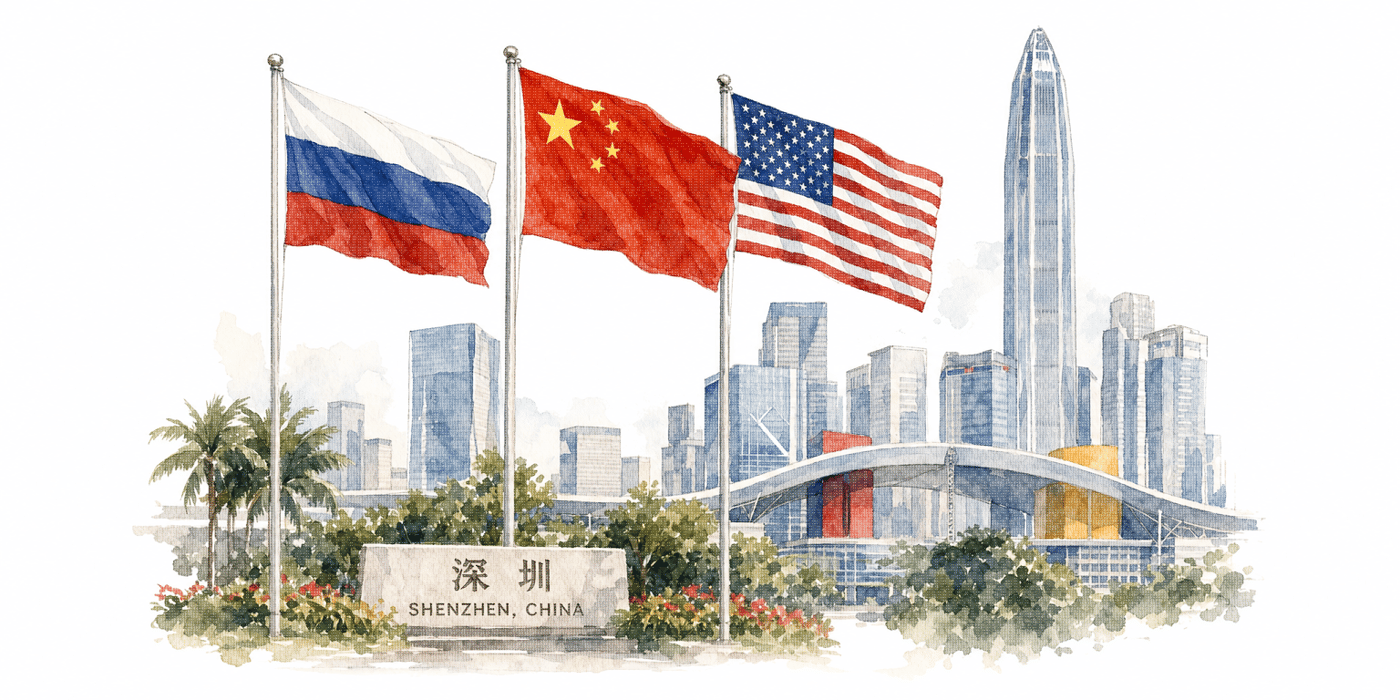

It’s a historic first. The leaders of the three most nuclear-armed nations, President Donald Trump, China’s President Xi Jinping, and Russian President Vladimir Putin, met in Shenzhen, China, for the Asia-Pacific Economic Cooperation (APEC) summit.
This unprecedented summit meeting has been billed as an opportunity for the three leaders of the world’s leading military powers to address a number of geopolitical concerns, with the primary pretext of dialogue over the possibility of finding a way to reduce the risk of nuclear weapons.
“We are really making history,” Trump observed following their opening 90-minute meeting, in which the three leaders sat around a large round table. He then added, “No problems were ever solved under the old school, refusing to talk about them.”
The three leaders also reiterated the primary premise behind the development of nuclear weapons: deterrence, as they said in a joint statement that “a nuclear war cannot be won and must never be fought.”
Indeed, reducing the risk of nuclear weapons is primarily behind Trump’s actions against Iran.
With China and Russia pursuing greater geopolitical dominance — Beijing’s South China Sea buildup as it eyes Taiwan and Putin’s war with Ukraine, both pretexts for their larger aims — concerns have been raised over how Trump would navigate these threats as leader of the free world.
Two autocrats with lifetime tenure are facing off against a democratically elected president entering the last two years of his term, weakened at home after a midterm shellacking. How will things go?
To his credit, Trump seems fully in his element with these types of unprecedented summit events. As he stated before leaving for the summit, “All my life I read you’d never want to have Russia and China team up. That was like 101 in politics or in warfare.” Then, in typical Trump fashion, he added, “They both like Trump. Now, what happens after me? That I can’t tell you.”
The three leaders want a noninterference agreement for their own delineated global regions. For Putin, that is Ukraine, which is why he has been pushing the U.S. to stop supporting Kyiv. For Xi, it’s Taiwan. And for Trump, it is the Western Hemisphere, where he has promoted the “Donroe Doctrine,” a reestablishment of the Monroe Doctrine.
Will any deals get done, specifically nuclear arms reductions?
Not likely, as Trump opined, “They look at me, and they say, ‘Ok, we’ll do it, but will you reduce your nuclear weapons by 2,000 weapons?’ ... It’s a hard thing to do. For me, it’s a hard thing. And it’s probably hard for them to do also.”
In other words, Trump is not about to give away any of America’s nuclear strength. He clearly knows what’s at stake, but he is also not against exploring better relations with China and Russia.
Indeed, upon arriving, Trump’s greeting of Putin is a classic example of his strategic diplomatic acumen at play. “He’s my friend,” Trump said as he warmly greeted Putin, adding, “We knew each other for a long time, and I think a lot of wonderful things can come out of this.” Tellingly, in the background is Xi, while hosting the meeting, looking like the outsider or the classic third wheel in this interesting relationship.
And then there’s Trump’s message to Xi, a relationship he labeled as “very special.” Trump said to Xi, “As long as you and I are in charge of things, we’ll never have a problem.” He then added, “We’re never gonna have a problem.”
This is classic Trump. It’s as if Trump is harkening back to that famous line from The Godfather Part II: “Keep your friends close and your enemies closer.”
Trump shows Putin and Xi respect because he knows they represent his biggest global rivals. But he is not fooled by their objectives, which directly conflict with his America First policy. He’s just keeping his enemies close.