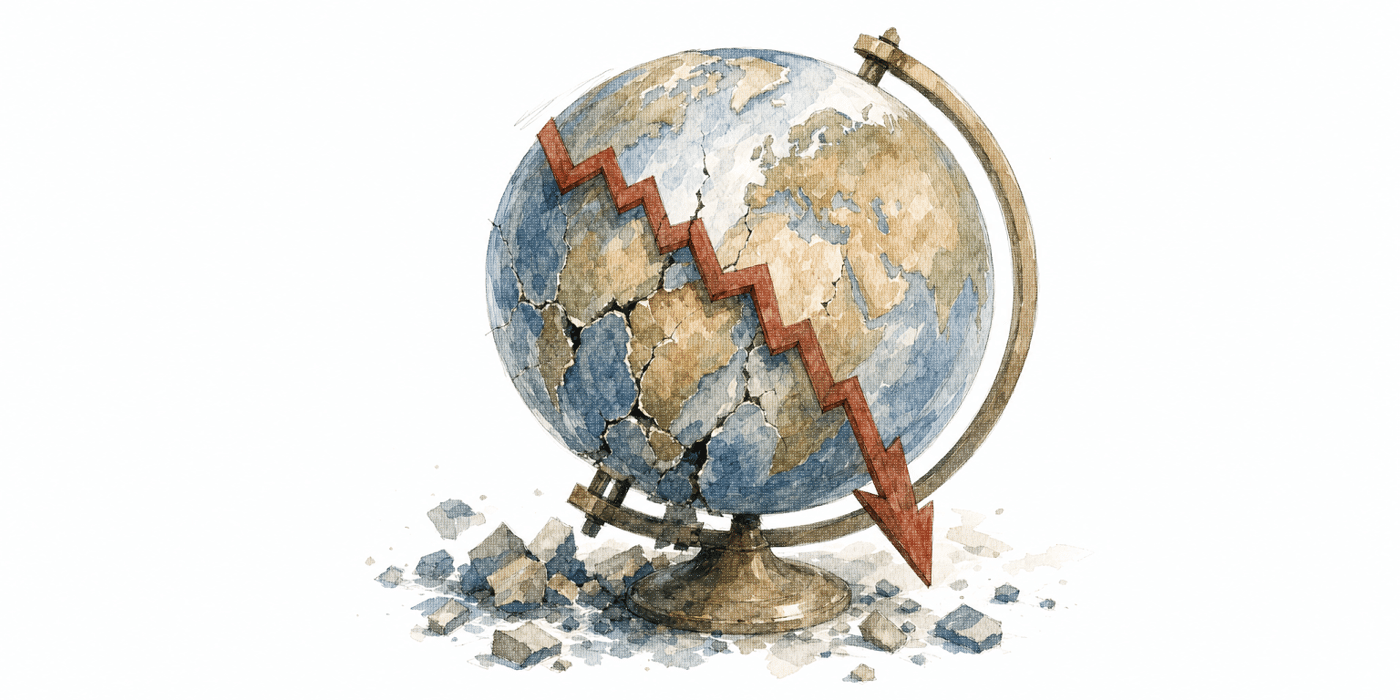

Financial markets have an interesting phenomenon called short-selling.
That’s where investors bet that the value of an asset will decline rather than increase. If they are right, they make money. If they are wrong, they lose money, sometimes spectacularly. An entire class of people has discovered how to apply the same principle to human civilization, betting against humanity’s future without suffering any financial consequences when they’re wrong.
I call it short-selling life, and judging by how many people have made careers out of predicting civilization’s imminent collapse, business is booming.
Consider the history of modern apocalyptic predictions.
Paul Ehrlich’s The Population Bomb warned of mass starvation resulting from uncontrolled population growth. The Club of Rome predicted resource exhaustion. Marxists have been predicting capitalism’s inevitable collapse for more than a century. We survived the Y2K computer apocalypse, though considerable effort went into preventing genuine technical problems, and now we are assured that artificial intelligence may eventually become Skynet and decide humanity is an unfortunate biological inconvenience. Meanwhile, Al Gore made a fortune as environmental activists have spent decades warning that our continued prosperity depends upon abandoning the very energy resources that made much of that prosperity possible. The predictions of rising oceans certainly haven’t kept Barack Obama from purchasing oceanfront property in Hawaii or Martha’s Vineyard.
Some of these concerns hold merit, and others have proved spectacularly wrong. Rather than oppose efforts to identify potential dangers, I object to the increasingly profitable enterprise of transforming uncertain futures into imminent catastrophes, then demanding that society surrender enormous amounts of wealth and liberty to prevent them.
It’s almost as if the Masters of Disaster don’t really believe the bilge spilling from their blowholes...
Their business model is remarkably simple. Identify a threat, exaggerate its immediacy, declare that ordinary human ingenuity and market forces can’t address it, and exhort government intervention as the only possible solution. The resulting legislation, regulation, subsidies, research grants, and bureaucracies create entire constituencies whose livelihoods depend upon the continued existence of the problem. Should the predicted disaster fail to materialize, simply announce that the interventions worked, or that the catastrophe has been postponed.
Either way, the checks keep coming.
California provides a particularly entertaining example of this peculiar arrangement. After decades of pursuing policies designed to eliminate dependence on hydrocarbons, the state has watched refining capacity disappear while demand for petroleum products remains substantial. They now have to import refined fuels, produced elsewhere under environmental and regulatory conditions California cannot directly control. Having helped create an economic environment in which refineries struggle to justify continued investment, the government now finds itself looking for ways to persuade them to remain.
Apparently, hydrocarbons become considerably less objectionable when someone else refines them, proving the NIMBY (Not In My Backyard) paradox is alive and well in California — and other “blue” states across America.
Speaking of which, blue states reveal a subtle but vital part of the American Left’s agenda, particularly the DSA’s, that deserves attention.
It is socialism by stealth.
When California banned refining hydrocarbons within its borders and then tried to bring refineries back to life by getting them to crawl into the iron lung of government subsidies, they proved that government need not actually nationalize an industry to exercise substantial control over it. Regulate it sufficiently, make its continued existence dependent upon government assistance, and the state acquires considerable influence over production without assuming ownership or the associated financial risks.
The shareholders retain the responsibility for making the business work while politicians determine how it operates — an ingenious arrangement, provided you happen to be one of the politicians.
The deeper philosophical problem is that the entire enterprise depends upon a remarkably pessimistic understanding of humanity. The prophets of catastrophe routinely extrapolate today’s problems into tomorrow while assuming tomorrow’s human beings will possess only today’s knowledge, technology, and ingenuity. They regard people primarily as consumers of finite resources rather than creators of new possibilities.
People, however, built civilization and refused to accept that the limitations of their own time were permanent. Human progress has never depended upon the absence of problems. It has depended upon our ability to solve them, and if the past century has proven anything, it is that our ability to solve problems greatly outstrips the availability of catastrophes — so politicians have to invent more.
There will always be genuine threats to human prosperity, and prudence demands that we take them seriously. But we should be suspicious of people who insist the world will end unless we give them more money and more power to save it. They have been short-selling humanity for centuries, and humanity has been making fools of them for just as long.
Unfortunately, the rest of us keep paying their commissions.