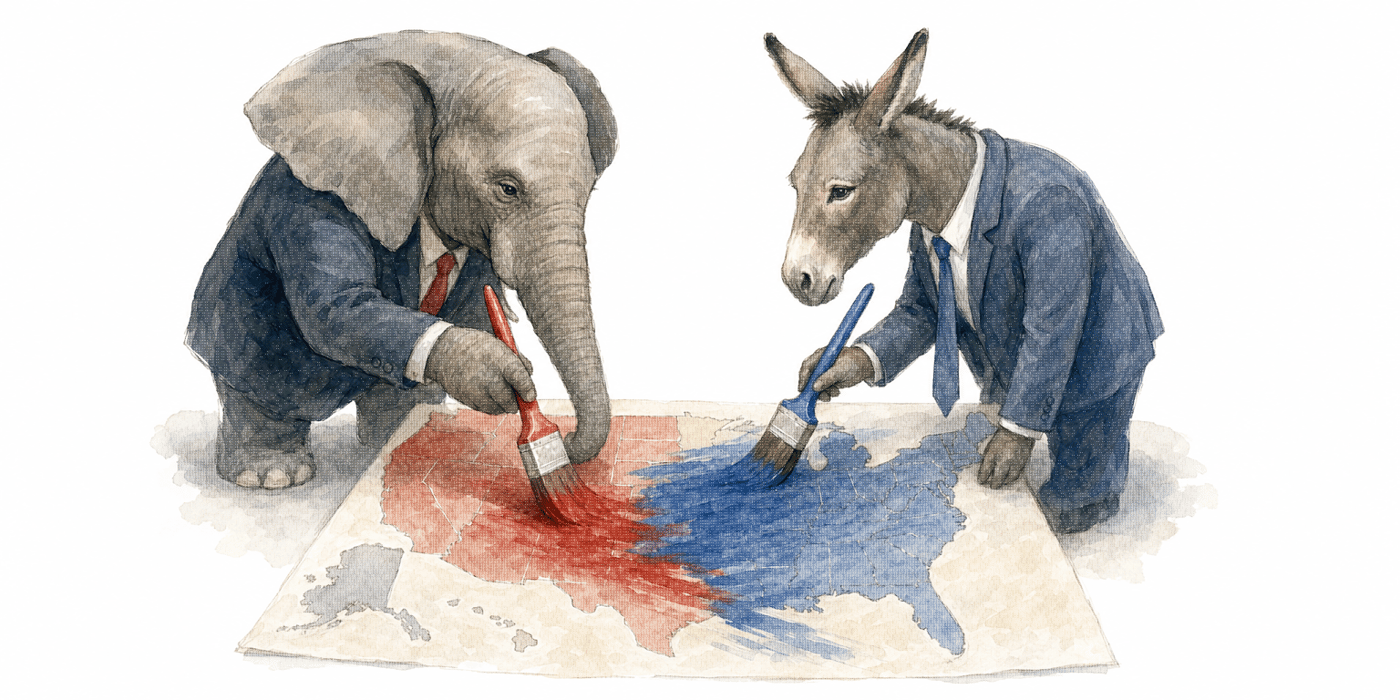

Sometimes the national GOP reminds us of Wile E. Coyote — the schemes Republicans think will finally catch that pesky Democrat Roadrunner end up blowing up in their faces.
Republicans, however, had reason to be angry: the initial congressional districts drawn after the botched 2020 Census favored Democrats, who took advantage of a few liberties with the population count.
While the courts thwarted a call last year for a new Census to repair these issues, Republicans cheered when the Supreme Court ruled in the Callais decision earlier this year that creating congressional districts solely based on racial makeup was unconstitutional. At that time, even the Senate Judiciary Democrats whined that it could wipe out practically every congressional Democrat in the Deep South.
When Republicans redrew Texas last year, they assumed that they would pick up five seats. But our Nate Jackson spied one possible flaw with the idea, noting, “Essentially, Texas Republicans are consolidating Democrat-heavy areas and moving Republican voters into other districts to secure wins. It puts some GOP incumbents in more competitive districts, but Republicans hope to have a stronger overall position.” Indeed, instead of endangering the two particular Democrat stalwarts, both were reelected despite the revised districts.
On the other hand, California’s redrawing netted Democrats the five erstwhile Republican seats they sought to “avenge” Texas. And the Virginia Democrats who conspired to ensure a 10-1 congressional advantage in their state but were blocked by cooler heads in their state judiciary still managed to pick off two Republican incumbents with their existing districts to gain an 8-3 Democrat advantage in their state delegation. Perhaps they may have gone 11-0 with their redistricting scheme given this year’s electorate, but we will never know.
Ultimately, what Jackson called “more competitive districts” for Republicans were replicated across the country — and they went to Democrats, dashing GOP dreams.
All in all, the GOP suffered what could be termed a “dummymander,” as detailed by Daniel Foster at National Review. “A dummymander is what happens when a party gets too clever with its gerrymandering, spreading voters too thinly across too many districts in an effort to squeeze out the most seats at the margins,” explained Foster. “Logically enough, when you go too far, you end up with more skin-of-the-teeth seats and fewer safe ones. That, uh, matters when you take a pasting like Tuesday’s.”
In fact, one analysis in Indiana from The Hill contends Republicans may have lost all nine districts based on the voting in the statewide race for secretary of state, but concedes that campaign was a “high-profile” race led by Beau Bayh, son and grandson of the longstanding senators. The Bayh family may only be rivaled in name recognition in the Hoosier State by the late Bobby Knight and Larry Bird, though, so perhaps that’s a flawed analysis.
Thus ends the great gerrymander caper of 2026. “Creating a bunch of razor’s-edge districts proved particularly unwise for a Republican Party that relies on a novel and polyglot voting coalition with few persistent shared interests, that is instead tethered to the fits and fortunes of a single man,” Foster concluded.
But the fun is not done yet. When I wrote on the subject two years ago, I noted my former home in Maryland “went from a state with an evenly split congressional delegation at the dawn of this century to now having just one congressional Republican out of the eight, who represents the heavily GOP Eastern Shore. Democrats packed as many Republicans as they could into that one Republican district while taking the other GOP stronghold area in western Maryland and cracking it up, dividing it, and blending those smaller areas into two heavily Democrat districts in the Washington, DC, area.”
Last week, however, Maryland voters in the solidly blue state passed a ballot initiative allowing the state to redraw its map once again for 2028 with the express intent of wiping out its last Republican representative, Andy Harris, the current Chair of the House Freedom Caucus. His Eastern Shore district may now stretch directly across the Bay Bridge, with one proposal sticking the district’s tongue into a Democrat-rich area around Annapolis and toward the far suburbs of Washington, DC. Whether they’ll run the risk of making other districts a little more vulnerable to yet another wave election the other way (in a presidential year) remains to be seen. But these redistricting follies will never cease until that vast honey pot of federal funding is removed from our nation’s capital.
That should occur about the twelfth of never.