
After the Republicans’ shellacking last Tuesday, voters on the Left and a surprising number on the Right still want the U.S. government to “do something” about the price of tea in China (archaic reference alert).
It’s partly because politicians condition voters by constantly offering more government as a solution to bad government. But it also reminds me of James Madison.
On January 10, 1794, Madison rose in the House of Representatives to challenge a proposal to provide financial assistance to French refugees who had fled the violence in Saint-Domingue (present-day Haiti). We’re still paying for the Haiti benevolence program 232 years later.
Madison did not question the refugees’ suffering or the humanitarian impulse behind the appropriation, but rather whether Congress possessed the constitutional authority to spend taxpayers’ money on charity.
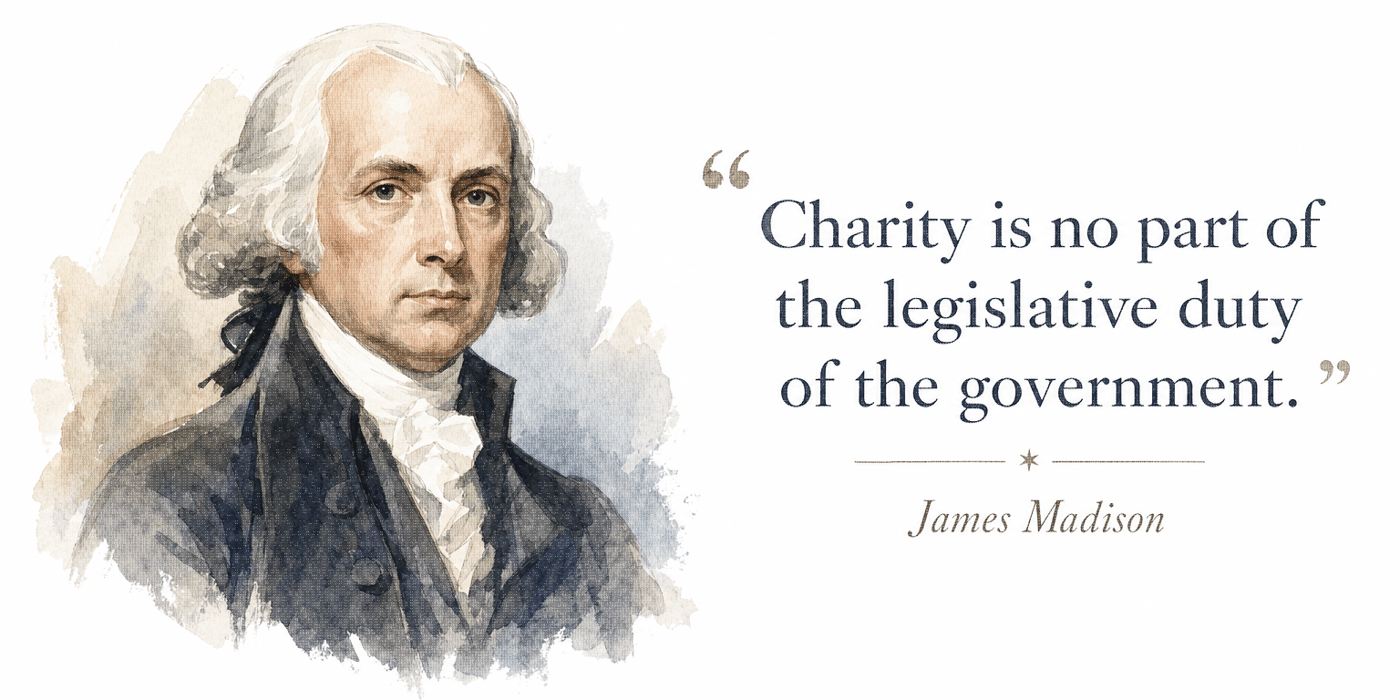
According to the Annals of Congress, Madison declared: “Charity is no part of the legislative duty of the government.”
He continued: “It would puzzle any gentleman to lay his finger on any part of the Constitution which would authorize the government to interpose in the relief of the St. Domingo sufferers.”
The congressional record also describes Madison’s concern that he could not identify constitutional authority permitting Congress to spend constituents’ money on objects of benevolence. They spent the money anyway, sidestepping Madison’s ironclad objections by taking a $15,000 credit against France’s debt to the U.S. — not taxpayer money, just a little bookkeeping sleight of hand.
“Benevolence” leads to a loss of independence, a “he who pays the piper, calls the tune” sort of situation. That’s about as anti-liberty as it gets. People depending on the government must abide by its rules and regulations to get handouts. Once you sign up, you must submit to the whole enchilada of limitations and surveillance.
But government oversight and control also threaten the individual liberties of taxpayers who fund such “benevolence” but have no say in where, how, or to whom the government transfers their money. Because economic and individual liberty remain inexorably intertwined, these programs also compromise the freedom of those forced to fill their coffers.
Madison’s objection apparently marked the last time anyone in government felt shame over such spending. Today, depending on how broadly we define benevolence, roughly two-thirds to three-quarters of federal spending funds social insurance, income support, healthcare, and other programs that provide financial or material benefits to individuals. A remarkable proportion, especially considering Madison’s argument against just $15,000 on humanitarian relief.
Which brings me to the “affordability” crisis, and how the newly anointed Democrat controlled government deigns to “solve” it.
The Democrats’ own Space Cadet, Senator Mark Kelly, said he supported the Working Americans’ Tax Cut Act, which aims to provide tax relief for low- and middle-income Americans by eliminating federal income taxes for those earning under $46,000 and funding this through a surtax on millionaires’ incomes over $1 million.
The Left has no intent to work on supply chains, cut waste and fraud, reduce taxes and regulations on businesses, or decrease the profligate government that caused inflation in the first place. Democrats use the ObamaCare methodology: offsetting price increases for one group through subsidies funded by targeted taxes on another, less politically popular group.
That methodology works so well that the Democrats shut down government last year to force more spending on COVID-era “temporary” extensions of Medicare/Medicaid funding. If only you and I could live as long as “temporary” federal programs.
When combined with government, the only human characteristic stronger than the desire to be benevolent toward others is to do it with someone else’s money!
Their answer to affordability is a downward spiral of taxing and spending, appropriation and borrowing, and the dependency that created the need for the “benevolence” in the first place.
Sure, that will fix it.
Did I mention we are still sending aid to Haiti 232 years later?
James Madison is probably rolling in his grave.