
Democrats are only weeks away from taking the reins of power from Republicans in the House and Senate, and they’re planning a bold agenda including everything from amnesty for illegal aliens to abolishing the Electoral College to packing the Supreme Court.
Some of their ideas, though, aren’t new at all.
Take gun control. Democrats have long been obsessed with taking guns out of the hands of law-abiding citizens, often resorting to finding imaginary loopholes in the Second Amendment to suit their purposes.
For example, a recent article in The New York Times claims a 2008 Supreme Court ruling that the Second Amendment protects citizens’ right to own firearms is invalid because of an alleged misquote by then-Justice Antonin Scalia.
And there you have it. With the stroke of a few keys on The Gray Lady’s keyboard, there goes the Second Amendment.
They wish it were that easy, that those of us who believe in our God-given right to defend our lives, families, and communities would just throw up our hands and surrender. They wish they could wipe out our freedom without having to put up with that pesky Constitution of the United States.
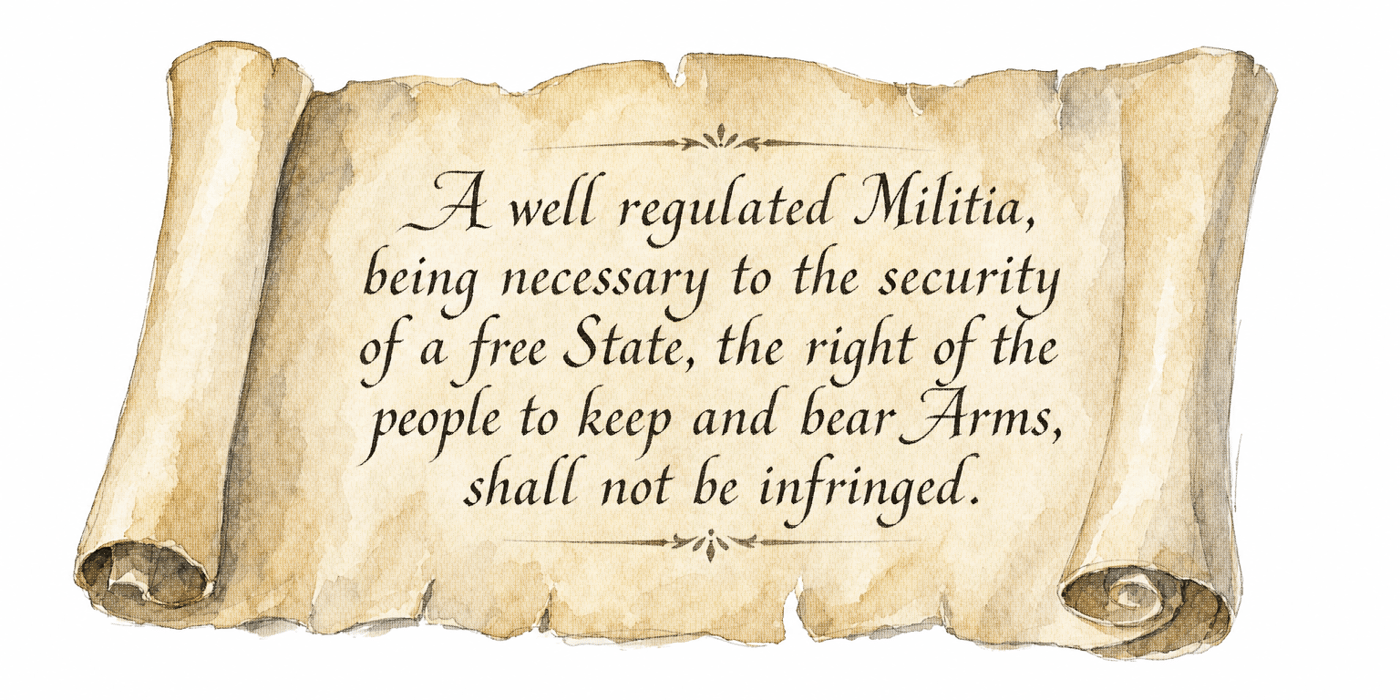
Opponents of the Second Amendment have engaged in an endless campaign of legal and linguistic contortions to work around language in the Constitution that is clear as day: “The right to keep and bear arms shall not be infringed.” The same crowd tries to convince us that race and gender are social constructs and truth is whatever you want it to be while simultaneously demanding that everyone else conform to their shifting definitions, abstract concepts, and gobbledygook terminology invented by academics who don’t live in the real world.
In the 2008 landmark District of Columbia v. Heller decision, Justice Antonin Scalia affirmed the right of citizens to own guns “in common use at the time,” though he also noted that restrictions on weapons are supported to some degree by the historical tradition of prohibiting “dangerous and unusual weapons” not typically owned for lawful purposes. The majority cited various legal historians, including William Blackstone, known for his Commentaries on the Laws of England written in the 18th century.
One might think gun control advocates would welcome this acknowledgment by a conservative justice that seems cut and dry unless you’re a Democrat desperately looking to bring down the Second Amendment on a technicality. Then again, a technicality is based in reality instead of a nonsensical twisting of reality.
The Times asserts that Scalia used the conjunction “and” (“dangerous and unusual”), whereas Blackstone used “or” (“dangerous or unusual”). The article contends this shift from “or” to “and” created a favorable Second Amendment doctrine that courts have used since 2008 to strike down “assault weapon” bans and other gun-control laws.
Second Amendment opponents claim it’s now much harder to prove a weapon is both dangerous and unusual thanks to Scalia’s ruling, which opened the floodgates for other legislation protecting ownership of semiautomatic rifles and standard-capacity magazines owned by millions of Americans. Now, desperate to negate the Heller case and those that followed, gun-grabbers claim it was all a misunderstanding based on a misquote by Justice Scalia. To back up their invented case, the Times points to a citation in the case that refers directly to Blackstone. Since Blackstone wrote “dangerous or unusual” and Scalia wrote “dangerous and unusual,” they maintain Scalia misquoted Blackstone.
The quote by Blackstone in the Heller case “is followed by the signal ‘See’ and numerous citations, the first of which is Blackstone,” explains Jonathan H. Adler. “The Blackstone source says ‘dangerous or unusual weapons’ (‘or’ instead of ‘and’), but a number of the sources that follow say ‘dangerous and unusual weapons,’ in addition to sources that use the Blackstone disjunctive framing.”
Even though the other sources include the phrase “dangerous and unusual,” the Times thought citing Blackstone first gave it preeminence because it’s in alphabetical order. “See” is used by the court to refer to other sources supporting the case, but not necessarily direct quotations. Checking those other sources shows a long tradition of banning certain types of firearms that are “dangerous and unusual.”
In 2008, the Supreme Court “seriously considered the amendment’s text, history, and place in the structure of the Constitution, [and] ruled correctly that ‘the right of the people to keep and bear arms’ meant ... well, ‘the right of the people to keep and bear arms,’” Charles C.W. Cooke writes at National Review. “Its case was unanswerable. And yet, as the Times’ latest attempt shows, we are all still at the mercy of a bunch of ridiculous die-hards who remain desperate to find that elusive One Weird Truck that will finally remove part of the Bill of Rights.”
“That trick does not exist,” adds Cooke. “One can not find it by butchering the preamble, or by falsifying the historical record, or by redefining the word ‘militia,’ or by pretending that originalism works in a way that does not. If the Second Amendment is to be excised out of the Constitution by judges, it will not be achieved by scholarship, but by the exercise of raw power. The Times’ erroneous piece arrived a few days after the Democrats won a big political victory. Coincidence? I think not.”
Ultimately, the debate over the Second Amendment comes down to whether words in the Constitution mean what they say. In order to obscure the meaning of those words, gun opponents have engaged in decades of redefining, shifting, and obscuring language to convince Americans that the Founders didn’t really think we have a right to self-defense. In other words, it was all just a big misunderstanding.
Moving forward, defending the right to keep and bear arms requires judges and lawmakers to uphold the Constitution’s original text and follow historical legal traditions, not yield to those who seek to destroy our rights through deception.