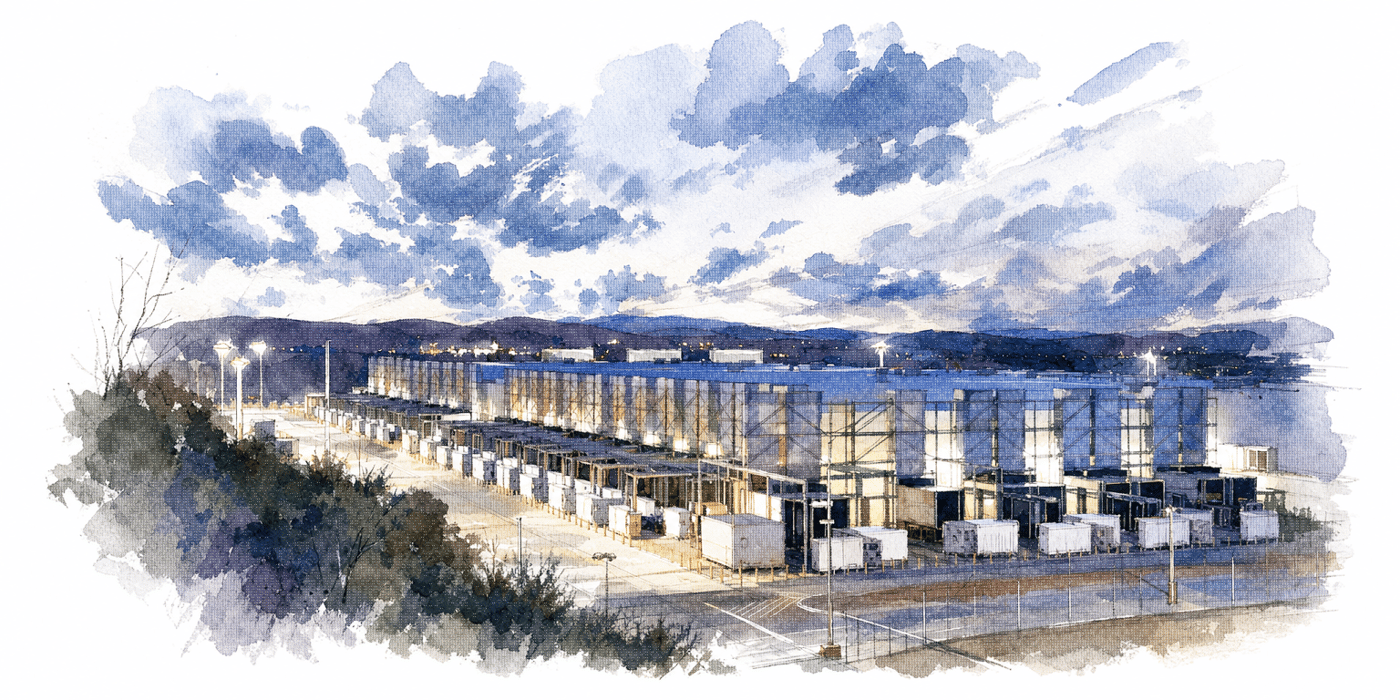

The average American would likely object to the newfangled data centers, concerned over rising electricity costs and sucking up millions of gallons of water. There are other concerns, too, from noise to cattle health. Unfortunately, most of what they believe comes from hype and misinformation, for data centers have been operating for the last 20 years or so.
As the amount of data on the information superhighway increases thanks to artificial intelligence, the need for facilities that can handle that much data has rapidly increased. Already, the commonwealth of Virginia has a significant share of the 4,500 data centers currently in operation — an industry that now supplies nearly half the tax revenue for Loudoun County, Virginia, a community just outside the Beltway from our nation’s capital. And the county started lining up its leadership role back when George W. Bush was still in office, so it’s nothing new to them.
Moreover, investors are pursuing the industry despite this opposition, as the demand increases. “Data-center builders and operators across the U.S. are working with bankers to sell majority equity stakes worth tens of billions of dollars in their companies this summer, according to people familiar with the efforts,” reported The Wall Street Journal recently.
Last week, the state of New York threw a spanner into the works. Democrat Governor Kathy Hochul announced a one-year halt on data center construction in her state, a moratorium The Washington Post called “a striking setback for artificial intelligence companies that politicians once courted for investment but have now triggered public fears about energy prices and water use.”
Piling on, The New York Times reported that electrical grid operator PJM — which serves much of the eastern United States, from North Carolina to Illinois and including the Washington, DC, metro where scores of data centers are already in place — announced the results of a recent auction that would “add $6.3 billion in costs” for beleaguered ratepayers in their region. “PJM’s annual auctions help determine the electricity costs for the two years after the auction. Since 2024, the auctions have added in total about $29 billion in costs to all utility customers in the PJM region because of data centers, according to Monitoring Analytics, PJM’s independent market monitor,” the Gray Lady reported. “The market monitor also produced the estimate of $6.3 billion in additional costs from the latest auction, which was held on June 30.”
While the editors of National Review consider Hochul’s move “silly” and “a concession to Luddism and hysteria,” she’s only reacting to the perception being shared by her state’s national news organ and many others in an election year for her. “Why has Hochul taken this silly approach?” the editors ask and answer. “Presumably, for the same reason that many other politicians have: because, over the last couple of years, tens of millions of people in the United States have been captured by a moral panic about ‘data centers’ that is almost completely divorced from reality. The rise of artificial intelligence will certainly present some challenges, and we regret that its architects have sometimes been blasé about that or even played up potential disruptions. But data centers, which represent the building blocks of the internet as it exists right now, have been a mainstay of American life for nearly three decades.”
As fellow NR writer Noah Rothman adds, “If Hochul isn’t afraid of innovation, she must be scared of something. Most likely, what has spooked her are the polls that consistently expose Americans’ apprehension over the development of data centers as a proxy for their trepidation toward artificial intelligence. Some left-wing outlets even contend that the Democrats who have failed to pander to this sentiment are putting the Democratic Party’s midterm election prospects at risk. Fearing the backlash, Hochul opted to get ahead of it.”
Why the sudden opposition to what has been powering our online world for “nearly three decades,” as National Review put it? Argues columnist David Harsanyi, “The effective voices against data centers, after all, are the same Luddites who’ve spread environmental apocalypticism to stop modernization projects such as pipelines and power plants and fracking. Most of their arguments don’t hold water. That doesn’t mean they’re not winning.”
To believe David Strom at Hot Air, “The massive campaign to slow down or stop the building of data centers ... is built on a stack of lies and funded primarily by China, which finds itself behind in the race to dominate the AI space.” Similarly, Fox News blames the specter of “Chinese propaganda” and “foreign dark money” in their reporting.
Among the prominent voices opposing data centers are the so-called Democratic Socialists. Stu Smith at City Journal goes through the litany of names. “Organizers for the Democratic Socialists of America (DSA) link data-center growth to rising utility costs and concentrated Big Tech power,” he writes. “‘Anti-imperialist’ groups portray AI as a tool of surveillance and militarization. Anti-ICE activists argue that data centers enable immigration enforcement and expand domestic surveillance. Together, these strands are converging on the proliferating facilities as a target, making data centers a potent tool for drawing everyday Americans into the web of left-wing activist groups — and creating opportunities for ‘direct action’ against increasingly vital infrastructure.”
But while the opposition is a cause célèbre among leftists, reality is smacking data center proponents in the face. As of a June analysis by JP Morgan featured in The Wall Street Journal, “More than 60% of data-center capacity planned for completion in 2027 isn’t yet under construction, and another 7% is delayed.”
National Review’s Jim Geraghty further explains that building these data centers isn’t easy. “The U.S. simply can’t manufacture enough transformers, switchgear, and batteries to keep up with demand,” notes Geraghty. There’s another factor to consider: a shortage of skilled workers capable of meeting the highly technical demands of construction. It can be lucrative for the right worker who doesn’t mind travel — except to New York.
People think that data centers are coming. The reality is that they’re already here — we’re just making them bigger and faster. But consider the trajectory of technology to become smaller. The computing power of the laptop I write this on once filled a room. Note also that it’s in the interest of data center companies to use less water — despite what we’ve been told, golf courses use more water than data centers — and to create their own electricity from a reliable source, such as the useful technology of SMR nuclear plants.
After all, if America doesn’t maintain its lead in the AI business, that crown may fall to China. And as we see how the ChiComs have us over a barrel on rare earths, there’s a reason they want us to fail badly enough to tip the AI scales.