
My dad came from a dirt-poor, dysfunctional home. He was abused as a child by his stepfather. His mother, Polly, concealed his real father’s identity from him and her husband, giving him the Ramsey name, because a local fellow had gotten her pregnant while she was married to Herb Ramsey. Dad never knew his real father. It wasn’t until much later in life that he learned Ramsey wasn’t his father, who had died at a relatively young age.
His childhood and upbringing could have made him a hateful, violent man. But it didn’t. Instead, he decided to make something of himself.
He left the abusive home at 14, as soon as he felt able to fend for himself. Big for his age, he could pass as an adult. With a sixth-grade education, he wasn’t qualified for much, so he joined the Civilian Conservation Corps (CCC), a Depression era creation of FDR that planted 2.3 billion trees, laid 100,000 miles of telephone lines, and constructed 126,000 miles of roads and trails. The CCC built millions of dams, bridges, buildings, artificial lakes, water supply systems, fire lookout towers, and much of our National Park system.
For five years, Dad worked hard in unforgiving weather all over New England. Despite a horrible family life and having to survive alone, his service inspired him to love our nation and value its beauty and greatness.
By 1941, he had married and divorced and was a young single man with a two-year-old daughter. To support himself and his daughter Ann, he became a bus driver in Jamestown, New York. Then came the attack at Pearl Harbor. Without the slightest hesitation, he joined the Navy, leaving Ann in his mother’s care.
After boot camp, he was assigned to the USS Hobson, DD-464, a new Destroyer. With his limited education, the Navy decided to make him a cook. That didn’t quench his energy, determination, and grit. The Hobson had a crew of 275 crammed into a ship only 348’ long. Dad lived spartanly on Hobson until the Japanese surrender ended the war. The small ship saw combat in the Atlantic, including the invasion of North Africa, the Battle of Norway, hunter-killer anti-submarine patrols, the Battle of Normandy, the bombing of Cherbourg, and the invasion of Southern France.
During Normandy, their sister ship, the USS Corry, sank to an eight-inch shell from a German shore battery that struck her midships. Witnesses described Corry as “back broken between the stacks.” Hobson rescued three boatloads of Corry’s survivors, many wounded or badly burned. Dad recalled pulling men from the water and lifting them onto the destroyer’s deck, their burned skin peeling away in his hands. The stomach-turning experience haunted him for years. All the while, German batteries continued to fire, but the Hobson continued to bombard the shore while rescuing survivors.
Late in 1944, Dad got a brief shore leave, with enough time to marry my mother, Marion Engdahl, at a courthouse in New York City. He had been courting her for a while, despite her dad trying to keep them apart. But after recognizing my dad’s heroic service, Grandpa Engdahl (WWI horse soldier veteran who served in France in 1917-1918) relented and gave his blessing. It was meant to be. They remained happily married until Dad passed in 2005 at age 87, having been married 62 years and raising four children.
After Hobson was converted to a destroyer-minesweeper, the ship saw heavy combat in the Pacific. According to the Naval History and Heritage Command, Hobson’s action at the Battle of Okinawa began on April 16, 1945, at about 0500, when roughly 15 Japanese aircraft began probing their formation. At 0920, a single-engine kamikaze struck their fellow ship, the USS Pringle, breaking her in two with a bomb. Another kamikaze attacked Hobson’s starboard side. Hobson’s five-inch gunfire disintegrated the plane just short of the ship, but a delayed-action bomb still penetrated the deckhouse, blowing a hole in the forward engine room; severing steam and electrical lines; and ripping apart the gunnery, machine shop, and electrical shop. Four sailors were killed, and others were injured.
During the engagement, however, Hobson destroyed four Japanese aircraft. The crew extinguished the fires, restored emergency power, and rescued 136 Pringle survivors. Fortunately, Dad escaped unscathed. Physically, at least. Only the passage of time eased the high stress of years of combat service.
In less than a year, in two war theaters, my dad participated in two of the biggest battles in naval history. But for the grace of God, Hobson could have followed Pringle’s and Corry’s fate. With how brutal the war was, Dad considered surviving a miracle. Even when the U.S. was winning, the Japanese fought ferociously. Despite the danger, Dad and his fellow sailors did their duty. The Hobson was awarded a Presidential Unit Citation and six battle stars.
When America dropped bombs on Hiroshima and Nagasaki — the only thing that induced Japan to surrender — every Sailor, Marine, Soldier, and Airman felt they had been rescued and given a new lease on life.
Dad’s service in WWII set the stage for a brilliant 35+-year career. A practically illiterate runaway grew into a man of substance, service, and accomplishment. Highlights of his career are of note:
- He became a recruit company commander, the first cook to do so in the history of the Navy. Twice, his company became the honor company of the entire Recruit Training Center (RTC). For that accomplishment, he advanced to Chief Petty Officer and became the Career Counselor for the RTC, another first for a “stew burner.”
- When the Navy created the positions, he advanced to Senior Chief and then to Master Chief for the remaining 10 years of his career.
- As a Master Chief, he led the Southwest Field Food Service team and improved food services for dozens of West Coast ships and installations.
- While in Long Beach, CA, he took classes in his spare time and graduated with an Associate of Arts degree from Long Beach State. He was valedictorian of his class and gave the Commencement address in his dress Blues.
- In 1961, he became the Chief Recruiter of a Naval District, and his responsibility expanded to four states, with 200+ recruiters under his charge.
- In 1962, he became the first enlisted Food Service Officer for several Navy galleys in the Washington, DC, district. Prior, the accountable individual had always been a commissioned officer.
- In 1965, he was assigned the same duty for two galleys at Guantanamo Bay, Cuba, before returning to the same job in DC until his medical retirement in 1969. A foot injury from wearing ill-fitting Navy boots at Bainbridge prevented him from staying.
- Even after leaving active duty, he worked for the Navy as a civil servant at the Washington Navy Yard, supervising a food quality award service.
Dad had no upbringing in the church. But my mother, a devout Christian, raised us kids in the church. Dad began visiting the Navy chapel with the rest of the family. When we moved to Chicago, we lived in a two-story brownstone. A Baptist preacher lived on the first floor. Dad spent hours discussing Christianity with him. We joined the Baptist church down the street and worshiped there every Sunday. Not too long after, Dad gave his life to Christ, serving the Lord well for the rest of his life.
Though the roots of poverty were always with him, he worked hard, kept his sense of humor, and grew in faith in the Lord. More than anything, he loved his faith, family, and country. Despite a slow start in school, he educated himself and succeeded in his Navy career. He was a devoted husband to my mother and a loving Father to his children. He was buried with full military honors at Arlington National Cemetery in 2005.
You might think my dad’s life is remarkable. Our family certainly thinks that. But two things are even more remarkable.
First, Dad’s life story unfolded in an America full of promise, opportunity, courage, and virtue despite the Great Depression and the horror of WWII. America, for all its flaws, inspired him to go above and beyond the call of duty, giving back to the land he loved.
Second, his story is matched by the stories of countless other veterans of this generation and others who love America, love their families, and give their lives in service to both. We should celebrate every time we draw a breath. I do. Not a day goes by without me remembering and thanking my dad for who he was: a hero and inspiration for my own service.
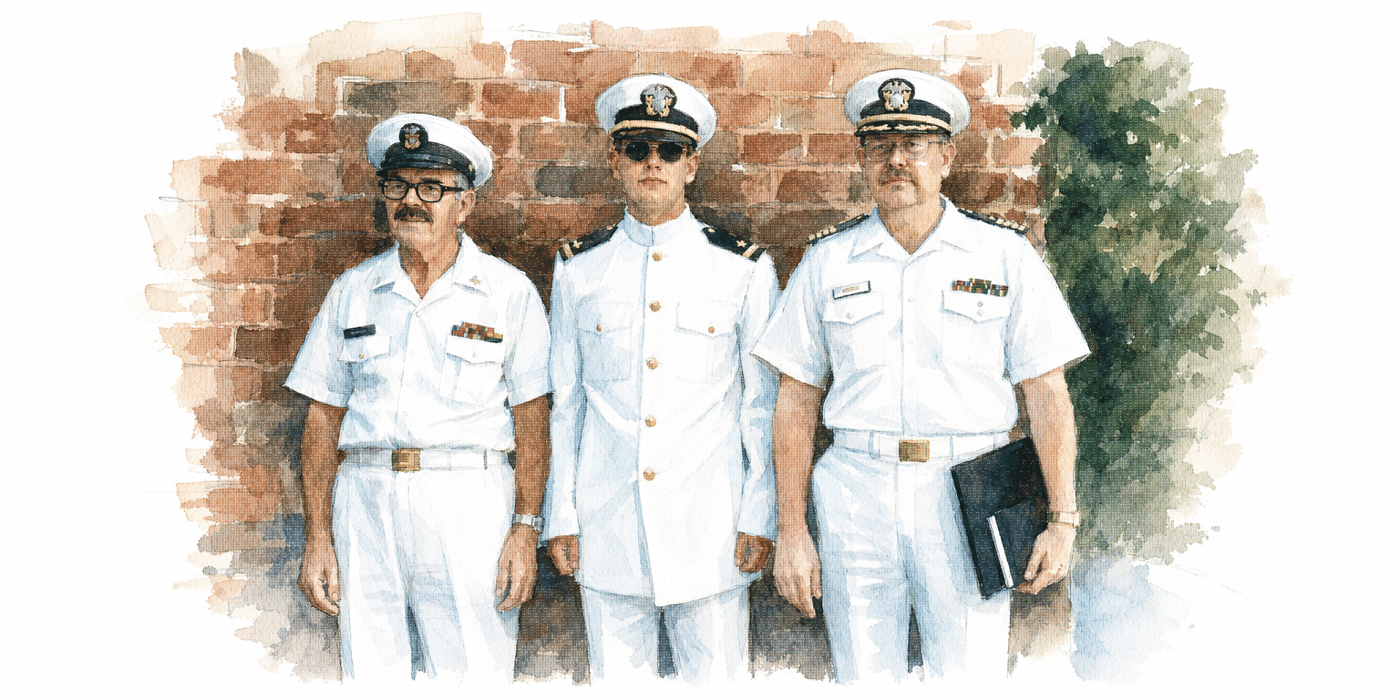
The photograph at the top of this article was Dad’s favorite, taken at his grandson’s commissioning ceremony at the University of Virginia in 1995. I had the pleasure of being my son’s commissioning officer while my dad, Master Chief Ramsey, looked on with pride. Three generations of Ramsey men served their nation proudly for over 78 consecutive years.
Brent Ramsey is a retired Navy CAPT who served 30 years and commanded twice. He also served in Navy Civil Service for 23 years, culminating as the Executive Director, Construction Battalion Center, Gulfport, MS. He has been published extensively in The Patriot Post, Real Clear Defense, American Thinker, and Armed Forces Press. He is a Director with the Calvert Task Group, on the Board of Advisors of STARRS and the Center for Military Readiness. He is active in his church, serving as a Trustee, as Secretary to the Hopeful Foundation, and on the Hopeful Cemetery Board. He is a member of the United States Naval Institute, the Navy League of the United States, the Association of the United States Navy, the Military Officers Association of America, and the Vietnam Veterans of America.