
It’s honestly impressive how someone so underqualified could beat out some of the smartest individuals on the planet using nothing but smoke and mirrors.
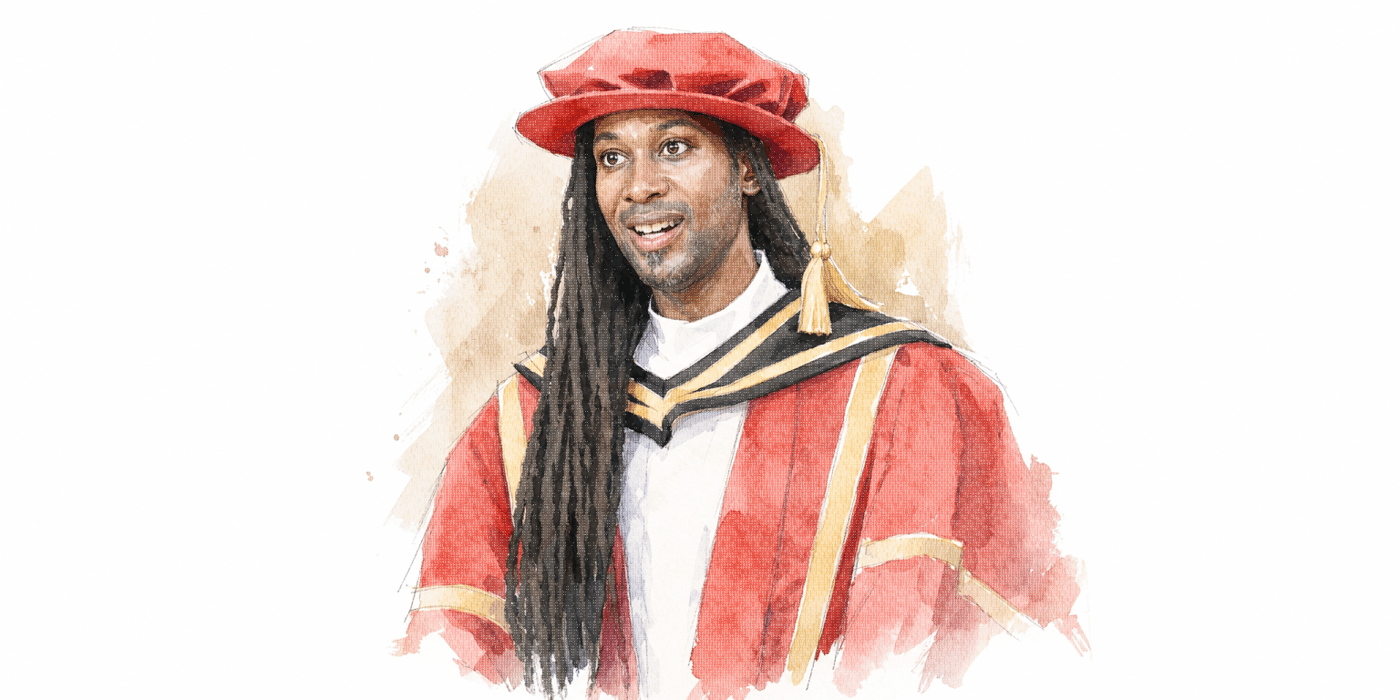
That’s exactly what happened in 2023, when the University of Cambridge hired then-37-year-old Jason Arday, the youngest black professor in the school’s 800-plus-year history.
His rise painted him as a Hawking-esque prodigy, an inspiration to many. National news articles on both sides of the pond praised him as the man who overcame all odds to reach the top of his field.
To be fair, he had a difficult childhood. He was diagnosed with autism and was nonverbal until the age of 11. He reportedly couldn’t read or write until he was 18. Someone like that doesn’t even go to college, let alone become a full professor at one of the world’s most prestigious universities.
On top of that, he includes on his laundry list of accomplishments that he ran 600 miles in six days, single-handedly raised five million pounds for charity over his academic career, and played professional soccer in his youth.
If those are all facts, then I’m Michael Jordan.
One way or another, he climbed the academic ladder. But Arday discovered that the higher you climb, the more visible you become.
For a long time, he didn’t see any real opposition. While many of his peers found his writings and claims suspicious, no one wanted to sacrifice their career to call him out on it. Jason Arday had weaponized his ethnicity and his notoriety, with a law team ready to destroy any hint of libel. That said, Arday’s intimidation wouldn’t last forever.
The floodgates opened when Nathan Cofnas, a former professor at Cambridge, wrote a blog post claiming that Arday had plagiarized large portions of his PhD dissertation. Cofnas had run the document through a plagiarism checker, finding that Arday had taken more than 1,000 passages from a different PhD student’s dissertation from six years prior. Arday’s dissertation also had numerous grammar and spelling mistakes, which is odd given it was written in 2015, when grammar checkers had been commonly used for years.
This professor went on to show repeated examples of plagiarism, including papers in which Arday took pride. Of the 10 papers he listed on Cambridge’s website as the ones that he says represent his best work, four had elements that were plagiarized in some form.
Cambridge had previously defended those cases because Arday had allegedly suffered many instances of racism that deeply affected his ability to produce his research. The university that gave him his PhD chalked up the plagiarism to an honest mistake. Yuan Yi Zhu at The Free Press said it best: “It is not so much that Arday benefited from the soft bigotry of low expectations as he gained from the hard prejudice of no expectations at all.”
Cofnas’s post gained enough traction for Cambridge, among others, to investigate Arday’s work and his credentials, and the house of cards began to fall.
Surprise surprise, many of Arday’s claims were lies. He claimed to be a visiting lecturer at Ohio State. The Buckeyes revealed they had no record of Arday. He claimed that someone sent him a severed pig head to his house, but when asked about the lack of evidence, he said that he threw it away and waited months to report it to the police. Maybe he just saw “The Godfather” too many times. He also said that multiple masked men with knives attacked him at the university. Security footage picked up nothing.
The investigation is still ongoing, but it seems Arday saw the writing on the wall. He resigned from his post at Cambridge, citing emotional distress and excessive criticism and racism he simply could not handle. Yet even there, critics believe he used AI to write his resignation letter.
Thus ends the saga of Jason Arday, one of the biggest benefactors of the DEI era of schools and one of the most obvious examples of its failures for majority and minority ethnicities alike. In other words, if someone is too good to be true, they probably are.
UPDATE: A week after his resignation, Arday committed suicide.