
There is a growing belief in American politics that democracy means one desirable thing: majority rule. If 51% of voters want something, the argument goes, then government should deliver it. Any institution that gets in the way — the Senate, Electoral College, Supreme Court, or even federalism itself — is therefore labeled undemocratic.
But that understanding completely misses the purpose of the American system.
The United States was never designed to be a direct democracy. It was designed to be a constitutional republic that uses democratic elections while placing serious restrictions on what elected majorities can do. Those restrictions are not defects in the system. They are the entire reason the system works.
“Remember democracy never lasts long,” John Adams once wrote. “It soon wastes, exhausts, and murders itself. There never was a democracy yet that did not commit suicide.”
Just look at the Bill of Rights. Plenty of countries claim to protect freedom on paper. China’s Constitution formally guarantees citizens freedom of speech, press, assembly, and association. Yet nobody seriously believes Chinese citizens possess the same ability to criticize their government that Americans do.
The difference lies not simply in the words written in the Constitution, but in the institutions surrounding them.
Rights mean very little if the government can ignore them whenever enough powerful people deem them inconvenient. America’s system was designed around a fundamental distrust of concentrated power. That is why we have separate branches of government, two chambers of Congress, an independent judiciary, state governments, and constitutional protections that are deliberately difficult to change.
Take the Senate. Critics — especially from the growing socialist wing of the Democrat Party — constantly point out that Wyoming and California each receive two senators despite their enormous difference in population. Apparently, that alone makes the institution illegitimate.
But population is already represented in the House.
The Senate exists for a different reason: to represent the states. Without it, the largest states and population centers would gain even greater control over national policy. In contrast, smaller states would have significantly less influence over the federal government they agreed to join.
The Electoral College works under the same principle. America is not one enormous national district. It is a union of states. Presidential candidates are therefore forced to compete across different regions of the country rather than simply running up their totals wherever the most voters live.
Then there is the Supreme Court, perhaps the easiest institution to call “undemocratic” because justices are not elected at all.
But that is precisely why the Court matters.
If constitutional rights depended entirely on elections, they would not really be rights. They would be privileges temporarily allowed by the majority. If 51% of Americans decided tomorrow that an unpopular religious group should lose its freedom to worship, the fact that a majority supported it would not make the policy democratic in any meaningful sense.
The Court exists to say no when the government crosses a constitutional line.
This debate becomes particularly important as the Democrat Party increasingly embraces politicians associated with the socialist movement. Ten years ago, the Democrat establishment fought aggressively to stop Bernie Sanders from taking control of the party. Today, figures like Alexandria Ocasio-Cortez and Zohran Mamdani represent a political movement with far greater influence than socialists had even a decade ago.
Many on the Left increasingly view institutions that restrain majority power as obstacles that should be weakened or eliminated. But removing those barriers would not create more democracy. It would simply make it easier for whichever political movement wins an election to exercise enormous power over everyone else.
History has warned about this problem for thousands of years. In Herodotus’s famous constitutional debate, Otanes argued for government by the many and equality before the law. At the same time, Megabyzus warned that mass rule could become dangerous when political decisions were driven by emotion rather than judgment.
Both concerns matter.
People must have political power, but political power must have limits.
The Founders understood that distinction. They did not create the Senate, federalism, judicial review, or the Electoral College because they feared participation. They created them because they feared absolute power.
Voting is essential to what Americans have come to call our “democracy.” But democracy cannot simply mean that the winner gets everything. The institutions increasingly attacked as “undemocratic” are the very institutions preventing temporary political majorities from becoming permanent rulers.
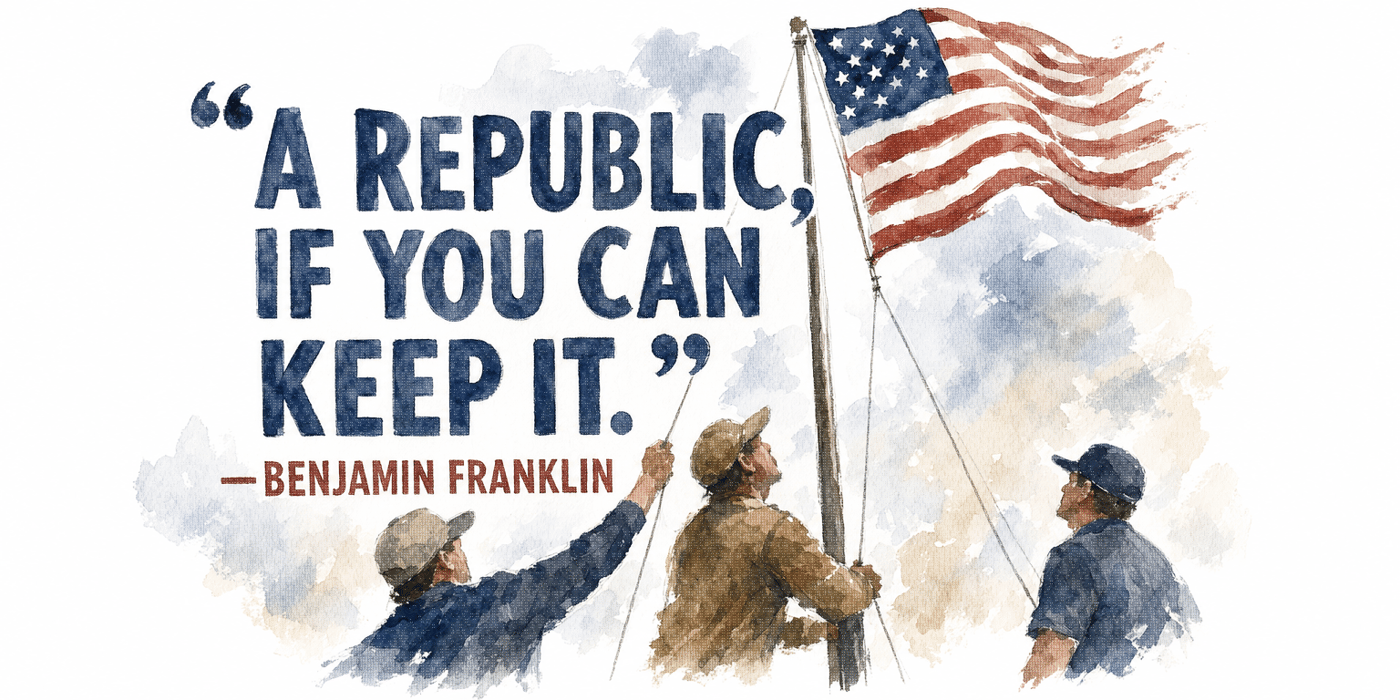
That’s why our Founders established a Republic. If we can keep it.