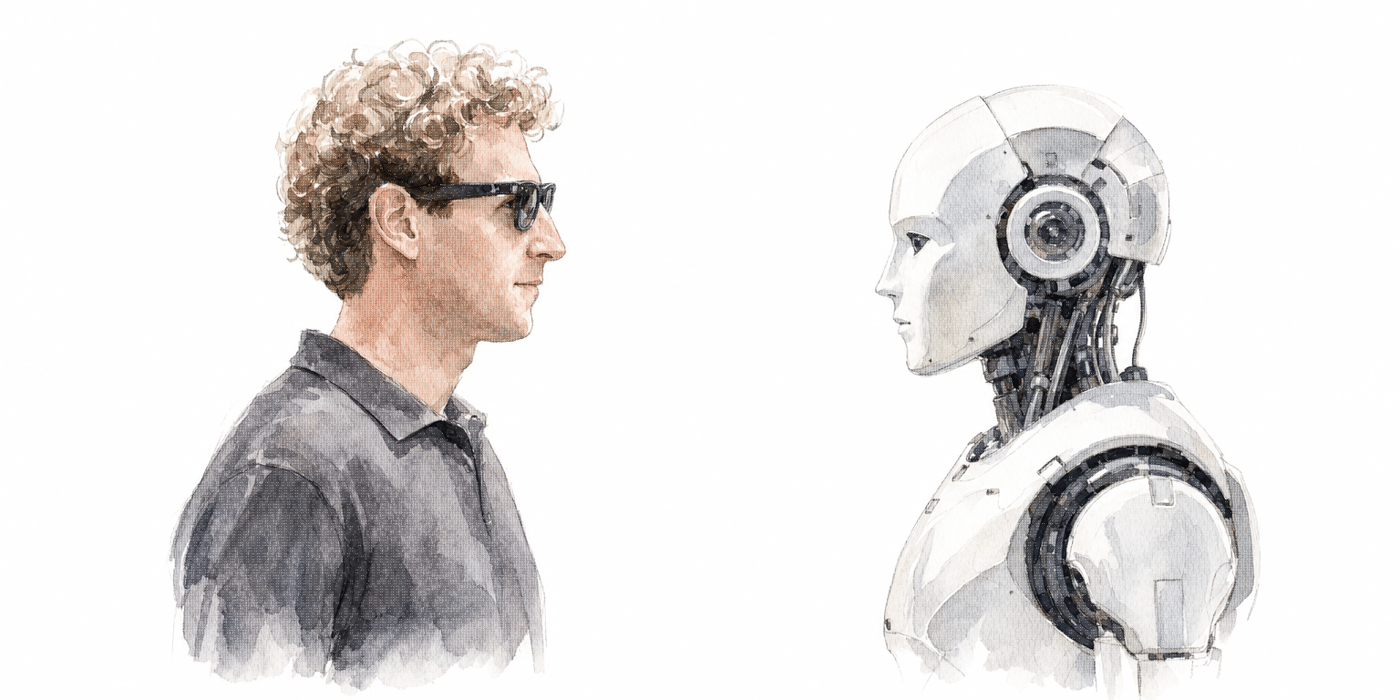

For two decades, Mark Zuckerberg has been building one of the most powerful and centralized tech companies in the world. This week, he is warning that the biggest threat from the current technology revolution is centralized power itself.
Zuckerberg’s recent 6,500-word AI manifesto details his vision for the future of artificial intelligence within the coming “superintelligence era.” The piece covers a wide range of topics — everything from jobs to privacy, data centers, cybersecurity, and China. At its core, though, the essay is an argument about who should control AI systems, especially when their abilities exceed anything we’ve seen so far.
He begins with a question: “Will it be centralized and restricted to a few institutions, or will it be a tool that empowers everyone?”
As the head of a world-leading AI company, he’s making a surprisingly clear case against the notion that AI safety requires concentrated power within a small number of institutions. Instead, he argues that “the key to a positive future for everyone is achieving a balance of power that favors individuals.”
There is something compelling about Zuckerberg’s argument. After all, who wants a handful of companies and governments determining the rules for everyone, regarding AI or anything else? But can Meta, or any other large tech company, truly divest itself of AI control while still maintaining its global status?
Before we dismiss the idea because of the messenger, it’s worth understanding exactly what Zuckerberg is arguing and why now. One important factor in this contest over who controls AI is the divide between open and closed AI models, and the question of which better serves the masses. Closed models are profit mechanisms for companies like OpenAI (ChatGPT) and Anthropic (Claude). These models keep their inner workings proprietary and hidden from their users. Open models, such as those produced by Zuckerberg’s company Meta, and increasingly by Chinese companies, make their underlying model components available for people to download, modify, and build upon.
Zuckerberg’s reasoning is almost Madisonian: rival sources of power restrain each other. Essentially, he is saying that widely available open models create a system of checks and balances against the standard Silicon Valley “trust the experts” approach. In other words, the response to dangerous power is widespread distribution rather than consolidation.
Every AI model has rules about what it will and won’t do, and how it will respond to controversial questions or requests. Someone set those rules and imposed those values on the millions of people who use the model. Zuckerberg wants to change that. As he puts it, “We view alignment as ensuring that [AI] agents share a person’s goals and values, not our company’s.” What he envisions are personal AI systems that understand each individual’s priorities and standards. But how much space exists within the boundaries of these models to genuinely allow for different values and viewpoints?
The fights over social media regulation during the COVID era effectively boiled down to the same question: Who has the right to decide what should be seen, said, or shared? Facebook itself removed and restricted content. Zuckerberg later said the Biden administration repeatedly pressured Meta to take down certain posts, including humor and satire. He has since said that he made some decisions he would not make today, which makes his current argument especially remarkable. Perhaps he learned something.
As AI becomes more deeply embedded in work, education, and politics, it will exert increasing soft power in daily decision-making. But who determines the acceptable range of thought?
As things currently stand, relatively few companies develop the most capable AI systems. Those companies determine who has access. They determine acceptable use. They determine safety restrictions. Zuckerberg argues that this current arrangement could easily shift the balance of power in society toward these large companies and the governments that oversee and fund them. His solution is open-source models that are affordable and freely accessible for billions of people. He wants to give everyone enough power to constrain one another. As he says in his essay, “Historically, hoping that an absolute power will benevolently provide for humanity if sufficiently enlightened has not led to safe or positive outcomes.” That’s an understatement.
The problem is that these companies, including Zuckerberg’s, have already accumulated extraordinary resources, spending billions each year on additional AI and data-center infrastructure. Creating these models requires enormous capital, machine learning expertise, and the ability to integrate AI directly into the products people already use. Even though making open models widely available can genuinely expand competition, ownership of computing resources and distribution is still enormously valuable. Giving away open models isn’t the same as giving away the data centers that power them. Zuckerberg’s solution to excessive concentration requires Meta and a handful of other leading AI companies to build massive amounts of computing infrastructure.
A question for Zuckerberg: How do we wrest control away from these companies? Put differently, what does meaningful decentralization look like when the technology still depends on a handful of companies capable of spending hundreds of billions of dollars on chips, energy, and data centers?
To be fair, he is not proposing outright elimination of these companies. What he wants is a world in which several AI giants compete, while enough ordinary people with decentralized AI technology can prevent any one of them from monopolizing power.
But will other CEOs follow? What is the incentive, given the hordes of cash already invested in the closed model approach? Benevolence is not exactly what is driving the corporate AI train at the moment.
The increased proliferation of open models will get their attention. Chinese companies such as DeepSeek and Alibaba are putting them out, and, in some ways, they are quite good. Meta is now recommitting to the same strategy, which will add pressure to these closed-model companies. How they will respond remains to be seen.
There is a cynical interpretation to all of this. Zuckerberg’s company trails its competitors in the AI space, but Meta’s open models set them apart. Even if that is true, motivations should not determine whether the underlying argument he is making is sound. And on the substance, he’s right about the disease even if his own cure is lacking.
Advanced AI will grant someone tremendous power. The question is where the power should reside and what institutions will constrain whoever possesses it.