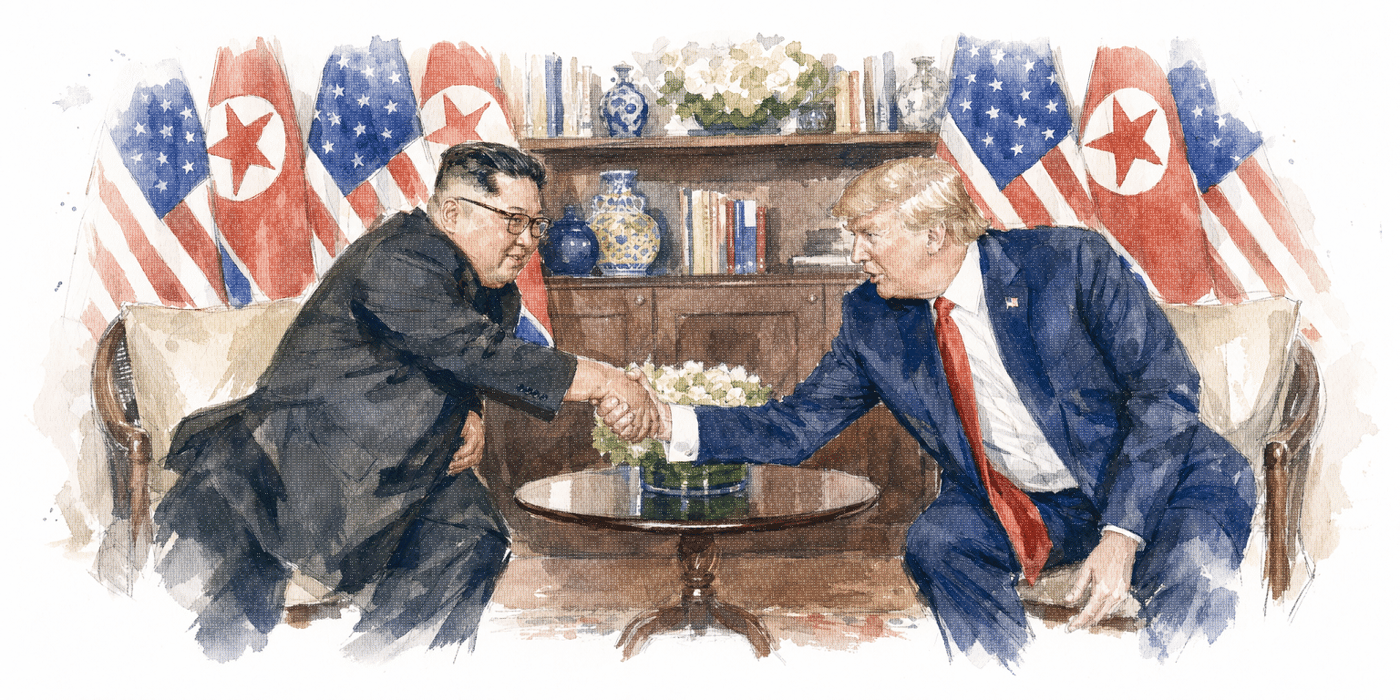

President Donald Trump has repeated a move he made during his first term: He directed War Secretary Pete Hegseth to “substantially reduce” the annual joint military exercises with South Korea.
The 11-day war games scenario in which the U.S. and South Korean militaries drill for potential war actions against North Korea has long been a staple of the U.S. deterrence against the communist Kim Jong Un regime.
And every year, as the schedule for the joint exercises nears, Pyongyang voices its opposition and threatens militaristic consequences. Indeed, the Kim regime has used these war games as an excuse to militarize and develop both missile and nuclear weapons technology.
From Trump’s perspective, these joint exercises are overly costly and offer little return on investment. In a post on Truth Social, Trump wrote, “These exercises are not only costly, with much of these costs paid for by the United States of America (as usual!), but send a signal that is totally inappropriate and hostile, to a Country that, as long as Donald J. Trump has been President, has been unthreatening and respectful.”
Trump also relayed that he “recently asked the President of South Korea if they would like to join us in the Denuclearization of the Islamic Republic of Iran,” but Seoul declined. Trump noted that South Korea’s rejection did not influence his decision on the joint military exercises, but it certainly did not help.
Furthermore, Trump contended, “Based on my very good relationship with Kim Jong Un, of North Korea, I am not happy with the fact that the United States has, long ago, agreed to participate in Joint Military Exercises with South Korea.”
Some critics, however, see Trump’s decision as signaling weakness and inconsistency, which they argue undermines America’s relationship with its allies in the Far East, namely Taiwan. They see China’s strongman Xi Jinping as welcoming Trump’s apparent militaristic withdrawal as an opening to further his own regional ambitions.
However, there are a few notable caveats that don’t necessitate a view that Trump is simply reacting to South Korea’s rejection of help with Iran.
Significantly, over the last couple of years, Kim has signaled a major policy change for North Korea. Early in 2024, Kim reportedly told the Central Committee of the Workers’ Party that a reunification of the two Koreas was realistically “impossible” and called for a “decisive policy change” toward the enemy to the south. North Korea had long held the aim of reunification, but now officially labels South Korea as a “primary foe and invariable principal enemy.”
Any vestigial notion of a peaceful reunification and view of South Koreans as fellow countrymen have now been dispelled. The big issue here is not a view of South Korea as an enemy, as it has always been for all intents and purposes, but that Kim has essentially rejected reunification as an official policy goal.
This changes the outlook for potential future foreign policy agendas between the two Koreas.
Even before this change, Trump opposed joint military operations with South Korea. As he explained to reporters back in 2018 following his first meeting with Kim, “We will be stopping the war games, which will save us a tremendous amount of money, unless and until we see the future negotiation is not going along like it should.” And in explaining his recent order, Trump stated, “Based on the fact that it is too late to cancel, I have instructed Secretary of War, Pete Hegseth, to substantially reduce the Joint Military Exercises!”
Yet Kim’s deployment of several thousand soldiers to aid Russia in its war with Ukraine has given North Korea valuable wartime experience, raising concerns that the regime is more belligerent and ready to fight South Korea than it has been in years. All of which is concerning.
Interestingly, South Korea’s current liberal government has also sought to improve relations with China. This would complicate matters for Pyongyang if it were to act against the South.
Clearly, foreign policy relationships are never clean and uncomplicated. As dynamics change both globally and domestically, policy change will be inevitable, and not everyone will agree with those decisions. South Korea is still very much an American ally, and President Donald Trump’s decision here does not threaten that allegiance, even if it raises questions.