
In the 18th and 19th centuries, newspapers across America lampooned politicians, business tycoons, and cultural figures through political cartoons that sparked serious discussions about the important issues of the time. In the 20th century, the power of parody found its way into television and film, and today we have video shorts, social media posts, and AI content.
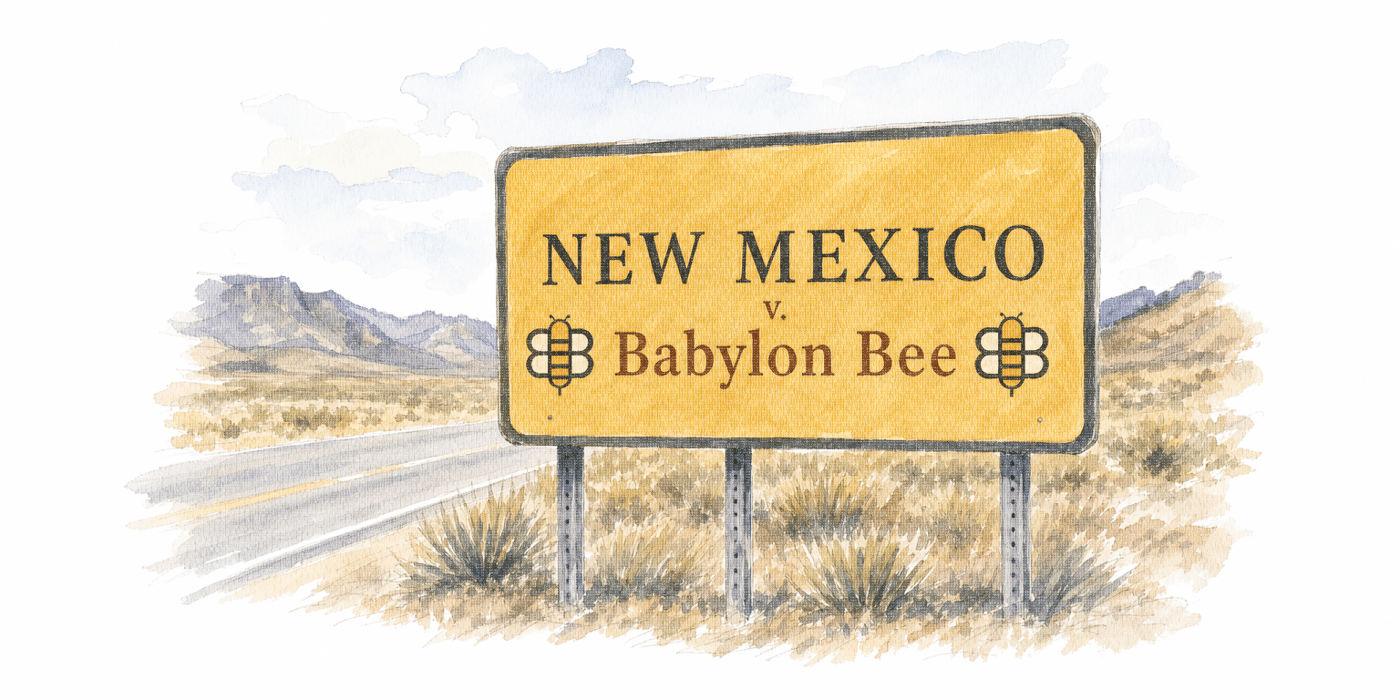
The freedom to mock the powerful and hold them accountable can be traced back to the biting political satire of the ancient Greeks, and it’s been a mainstay of expression in America thanks to the First Amendment. But that’s not stopping New Mexico’s government from going after online publications like The Babylon Bee, a site known for satirizing American politics and culture from a Christian and conservative perspective.
Instead of letting educated and informed citizens make up their own minds, the state legislature amended New Mexico’s Campaign Reporting Act to require publications to label satirical content before readers even get to the joke in the first place.
As Fox News reports, “HB 182, passed in 2024, amended New Mexico’s Campaign Reporting Act to add disclosure requirements for political advertisements containing what the law defines as ‘materially deceptive media.’ The law mandates that relevant images, video or audio manipulated or created through artificial intelligence must display a prominent AI disclaimer identifying the content as created or manipulated by artificial intelligence.”
In other words, New Mexico wants to require a government stamp of approval before anyone posts content.
New Mexico’s law “covers everything from flyers to social media posts to memes, and threatens steep penalties, including fines up to $20,000,” the Alliance Defending Freedom explains. “HB 182 empowers state officials to punish core political speech, including criticism of political candidates and proposed ballot measures. That not only interferes with online satire website The Babylon Bee’s constitutionally protected freedom of speech, but it also strikes at the very reason the First Amendment was ratified — to ensure wide-open political debate.”
The core issue with HB 182 is that it’s a blatant and dangerous assault on speech. Once New Mexico and other government authorities have the power to silence different viewpoints and opinions, then the First Amendment dies. Many Americans share concerns over AI-generated content that appears so real it’s difficult to determine reality from fiction. But the government should not settle that debate.
New Mexico isn’t alone. California, Connecticut, Utah, and Washington have also passed transparency laws, and New York and Oregon are moving forward with similar legislation.
The issue with embedding metadata in AI content is that it gives the government and media platforms the power to instantly censor or completely ban labeled content. Additionally, government entities can easily track such content and identify its creators, removing anonymity from the process. As a result, media organizations and citizen journalists are less likely to create or share content out of fear of surveillance and intimidation.
With these concerns in mind, The Babylon Bee is suing New Mexico to defend its First Amendment rights. Julia Cassidy explains at Town Hall, “The complaint also claims the law is discriminating based on content, restricting entertainment, satire, parody, and cartoons while offering protections for news content. Members of the Ethics Commission who enforce the provisions are named in the complaint, which asks the court to issue injunctions to prevent enforcement. The complaint also mentions the possibility of up to $20,000 in fines for noncompliance with the law. Similar laws were struck down through the Babylon Bee and ADF’s legal action in Hawaii and California.”
It’s important to challenge these threats to free speech. Otherwise, allowing government to chip away at the First Amendment will leave us in the same state of affairs as people living in Europe, where there are no constitutional protections. In 2024, the European Union implemented the AI Act to regulate content labeling. In just two short years, the authorities’ power to monitor and censor content has grown exponentially.
Both here and abroad, technology has evolved over time, and the ways we express our ideas and opinions are more varied than at any time in our history. One thing that hasn’t changed is our fundamental right as American citizens to say or write what’s on our minds. That right has been challenged for more than two centuries by people who want to silence those who dare speak out against power.
As the Foundation for Individual Rights and Expression explains, “We have yet to see how lawmakers and judges will address the challenges posed by this emerging technology. But they will not be writing on a blank slate. First Amendment doctrine does not reset itself after each technological advance, and modern First Amendment jurisprudence has navigated the advent of television, motion pictures, personal computers, the internet, smartphones, and more.”
Artificial intelligence has complicated the debate over free speech, as it’s becoming increasingly difficult to distinguish between reality and computer-generated audio, video, and images that appear real. These concerns are worth discussing, and we can find proper solutions to preserve our freedom, although no solution is better than educated and informed citizens.
Moving forward, whatever path we take shouldn’t include empowering the government to control content and track citizens who express unpopular opinions or parody those in power.