

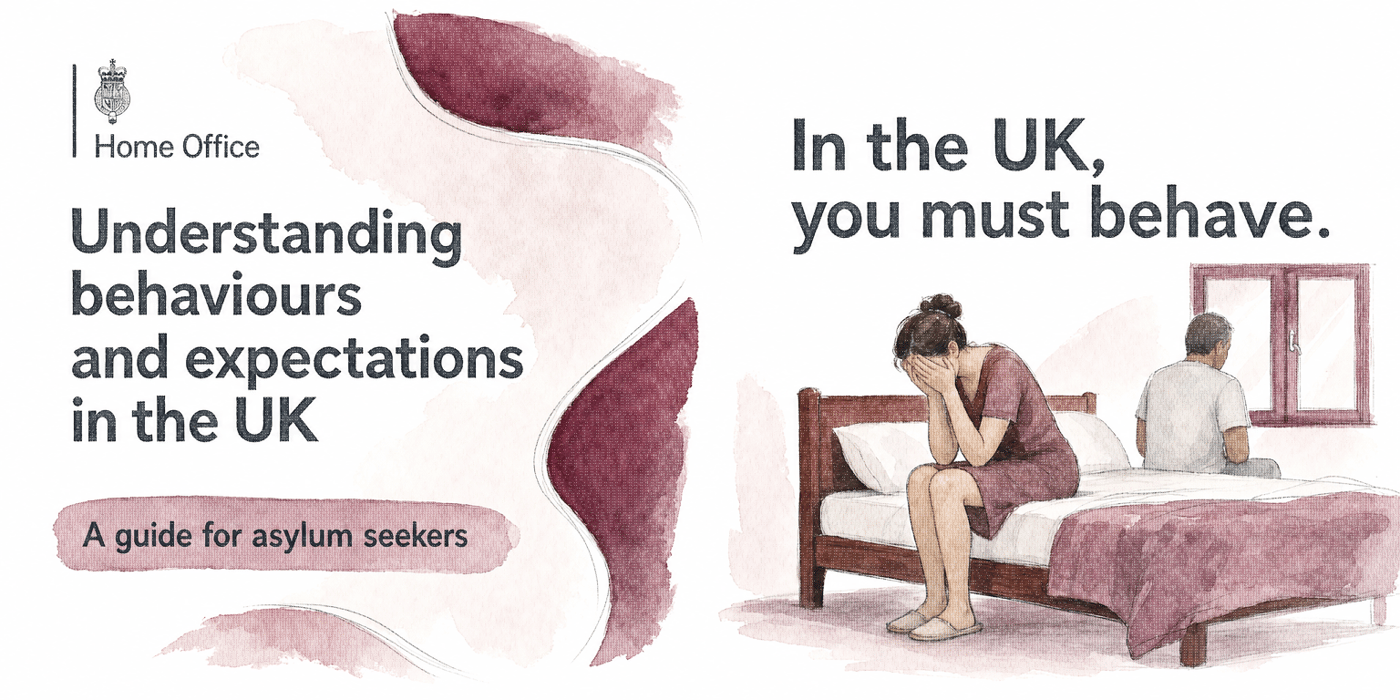

Great Britain has apparently reached the point where Prime Minister Andy Burnham's government needs to hand asylum seekers a nine-page booklet explaining that rape is illegal, women have equal rights, children cannot consent to sex, and following women down the street making kissing noises is frowned upon.
Yes, seriously.
On August 19, the United Kingdom Home Office published Understanding Behaviours and Expectations in the UK: a guide for asylum seekers, covering gender equality, domestic abuse, sex and consent, and appropriate behavior in public.
Among its lessons: "In the UK, men and women have equal rights." It explains the basics of women's rights — that women may work, attend school, travel freely, choose whom they marry or remain single, and make their own decisions without permission from a male relative. Among the lessons were basic standards that, shockingly, officials apparently felt needed clarification: "If you have sex with someone without their consent, this is called rape."
We aren't talking about a pamphlet explaining which side of the road to drive on or how seriously the British take waiting in line. We are actually talking about teaching adults some of the most fundamental expectations of Western civilization, like the idea that it's not your right to assault another person, and that women aren't yours to do with whatever you please — they're individual human beings with the same rights as men.
And that raises a question that needs to be revisited and addressed with clarity: Can we agree that assimilation is as much about safety as it is about a national identity?
For most of history, moving somewhere new came with a fairly obvious expectation: You adapt to your new home. You don't have to abandon your food, language, religion, traditions, or family heritage. But you do have to obey the laws and accept the basic civic standards of the society welcoming you.
The Daily Wire's James Price describes the new British guidance of having to explain "that rape is a crime, that sex with children is a crime," along with rules against sexually harassing women in public as "absurd and tragic," proving how far their society has truly fallen. Chloe Trapanotto makes the broader point through the analogy of inviting someone into your home who refuses to respect the hosts or their rules: eventually, you have to realize that you made a mistake.
The Federalist argues much more bluntly: "If a foreigner needs to be told that women should not be raped, it is already clear they are never going to be able to fully assimilate into the culture. A pamphlet isn’t going to make a difference."
Unfortunately, our growing obsession with "diversity" has somehow made these incredibly basic — yet crucial — standards increasingly difficult to say out loud, much less enforce. Heaven forbid we hurt the feelings of someone who came to our country from the Third World by informing them that, no, they cannot do whatever they want to women and children — and that we take those offenses seriously enough to put people in prison for a very long time.
It is not intolerant to acknowledge a basic reality: not every culture shares the same values. Recognizing our differences isn't bigoted or hateful; it's just the truth.
The truth is that cultures disagree dramatically about women's rights, religious freedom, homosexuality, forced marriage, individual liberty, criminal justice, and the relationship between citizens and government.
Diversity can be perfectly compatible with a functioning society — but people coming together from different backgrounds have to agree to share a basic civic and moral framework. When "inclusion" means a society can no longer defend its own values for fear of offending newcomers, maybe it's time to admit that a little exclusion isn't such a bad thing. If someone cannot adapt to the laws and values of the country they chose to enter, or consistently express their disdain for it, they don't have to be welcomed in. Sometimes protecting your home means rolling back the welcome mat.
Of course, cultural gratitude apparently isn't exclusively an immigration problem. For the lighter version of this phenomenon, we have Prince Harry and Meghan Markle.
They famously left Britain and royal life for California after describing the situation in the UK as essentially untenable. Harry said only last year that he couldn't "see a world" in which he would bring his family back to Britain. Now, according to recent reporting, they're considering returning.
It's almost impressive.
Meghan escaped Britain, Harry escaped royal life, and together they landed in America — a country founded on telling the monarchy, "thanks, but no thanks" — while somehow still clinging to the prestige of being royal-adjacent. Now, Britain may be back on the menu. One half of the couple has made her disdain for life in the UK abundantly clear, while the other has repeatedly criticized America. Meanwhile, both seem remarkably skilled at overlooking the extraordinary privilege and opportunity each country has afforded them — and what they might have gained had they simply embraced either place as home instead of perpetually complaining about it.
Their saga offers a much sillier version of the same basic lesson: If you can't appreciate the place you choose to live, and find its customs and values intolerable, eventually you may have to realize that geography is not the problem — you are.
But while Harry and Meghan's inability to appreciate either side of the Atlantic is mostly an exercise in eye-rolling, Britain's broader assimilation problem is anything but funny. When a government has to teach adult newcomers basic morality, the consequences of opening the gates to anyone and everyone while expecting nothing in return become far more serious than the antics of an obnoxious wannabe celebrity couple. At that point, refusing to adapt isn't merely irritating — it can put innocent people in real danger.
Assimilation doesn't mean erasing where someone came from. It means understanding that when you voluntarily enter another society, you have an obligation to respect the people already living there.
Western civilization isn't perfect, but its foundational ideals are worth defending: that human beings possess inherent dignity, that men and women have equal value, that individuals have God-given rights, and that government exists to protect those rights rather than grant them according to class, sex, ancestry, or political favor.
Those principles helped create some of the freest and most prosperous societies humanity has ever known.
So yes, those who choose to make the West their home should be expected to embrace those principles — and show a little gratitude and humility in the process.
And if someone genuinely needs to be persuaded that murder is wrong, rape is unacceptable, children must be protected, or women possess the same human worth as men, perhaps Western society isn't the best fit.
That's okay. The world is a very big place. There are plenty of other options.
But a nation should never be shamed into sacrificing the safety, rights, or culture of its own citizens simply to prove how welcoming it can be.


