

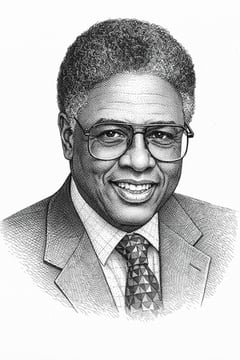
Columnist.
One of the painful realities of our time is that most public schools in most low-income, inner-city neighborhoods produce educational outcomes that are far below the outcomes in other neighborhoods, and especially in more affluent neighborhoods.
In just a matter of days — perhaps next Monday — a decision will be made in Washington affecting the futures of millions of children in low-income communities, and in the very troubled area of race relations in America. An opportunity has arisen — belatedly — that may not come again in this generation. That is an opportunity to greatly expand the kinds of schools that have successfully educated, to a high level, inner-city youngsters whom the great bulk of public schools fail to educate to even minimally adequate levels.
Even the best things come to an end. After enjoying a quarter of a century of writing this column for Creators Syndicate, I have decided to stop. Age 86 is well past the usual retirement age, so the question is not why I am quitting, but why I kept at it so long.
Any honest man, looking back on a very long life, must admit — even if only to himself — being a relic of a bygone era. Having lived long enough to have seen both "the greatest generation" that fought World War II and the gratingest generation that we see all around us today, makes being a relic of the past more of a boast than an admission.
Sometimes someone inadvertently performs a public service by bringing an unbelievably stupid and dangerous idea to the surface, where it can be exposed for what it is. The New York Times can be credited — if that is the word — with performing this public service in a recent editorial against proposals to allow law-abiding citizens to carry concealed guns. They refer to what they call the National Rifle Association's "fantasy that citizens can stand up to gunmen by shooting it out."
Nothing so epitomizes the politically correct gullibility of our times as the magic word "diversity." The wonders of diversity are proclaimed from the media, extolled in the academy and confirmed in the august chambers of the Supreme Court of the United States. But have you ever seen one speck of hard evidence to support the lofty claims?
We are now in a kind of political no-man's-land between an administration on its way out and a new administration taking shape. Predictions are always risky — and nowhere more so than in times like these.
The left has been gambling with other people's livelihoods.
Sometimes life forces us to make decisions, even when we don't have enough information to know how the decision will turn out. The risks may be even greater when people make decisions for other people. Yet there are some who are not only willing, but eager, to take decisions away from those who are directly affected.
This is a football story with both political and legal implications. It was fourth down in a National Football League game, and the punting team came onto the field. The other team went into their formation to defend against the punt. Then somebody noticed that the man set to kick the punt was black.
People who call themselves "progressives" claim to be forward-looking, but a remarkable amount of the things they say and do are based on looking backward.
As the post-election shock of some, and the euphoria of others, both begin to wear off, the country and the new administration will have some very serious problems to face, at home and abroad. How those problems are faced — or evaded — will tell us a lot about the next four years, and about the longer-run future as well.
The good news is that we dodged a bullet in this election. The bad news is that we don't know how many other bullets are coming, or from what direction. A Hillary Clinton victory would have meant a third consecutive administration dedicated to dismantling the institutions that have kept America free, and imposing instead the social vision of the smug elites. That could have been the ultimate catastrophe — not just for our time, but for generations yet unborn.
In most Presidential election years, the most important vote is the vote for President of the United States. This year, the most important vote looks like the vote for control of the Senate. Regardless of who wins the White House, the freedom that Americans have taken for granted — taken too much for granted, for far too long — can be destroyed by whomever the next President puts on the Supreme Court.
Let's talk sense about the election. Nothing is to be gained by refusing to face the hard facts. What are those facts? First of all, neither Hillary Clinton nor Donald Trump has the qualifications, the track record or the personal character to be President of the United States. Most of us could probably think of a number of people who would be better in the White House. But here, as elsewhere in life, we can only make our choices among the alternatives actually available.
It is especially painful for me, as an economist, to see that two small cities in northern California — San Mateo and Burlingame — have rent control proposals on the ballot this election year. There are various other campaigns, in other places around the country, for and against minimum wage laws, which likewise make me wonder if the economics profession has failed to educate the public in the most elementary economic lessons. Neither rent control nor minimum wage laws — nor price control laws in general — are new. Price control laws go back as far as ancient Egypt and Babylon, and they have been imposed at one time or other on every inhabited continent.
The political left keeps announcing, as if it is a new breakthrough discovery of theirs, that life is unfair. Have they never read Thomas Gray's "Elegy Written in a Country Churchyard," more than two and a half centuries ago? What about economic historian David S. Landes' statement: "The world has never been a level playing field"? In the joint autobiography of Milton Friedman and his wife Rose, they say: "Everywhere in the world there are gross inequities of income and wealth. They offend most of us. Few can fail to be moved by the contrast between the luxury enjoyed by some and the grinding poverty suffered by others."
Random thoughts on the passing scene: There seem to be fewer bumper stickers this year than in previous presidential election years. People may decide to vote for one of these candidates, but apparently they are not proud of their choice. It is astonishing that some people think that the answer to the problems of ObamaCare is to go to a "single payer" system. But "single payer" is just another way of saying "government monopoly." Does anyone pay attention to how government monopolies operate — from the local DMV to Veterans Administration hospitals?
Some of us this election year don't even want to say the words "Clinton" or "Trump" — and with good reason. However, there is one word that we should keep in mind: "Turnout." If we sit home in disgust on election day, we forfeit the right — and the duty — to elect a Congress that can keep either of these dangerous people from doing permanent damage to this country and to the future of this generation — and generations yet unborn. Control of Congress has probably never mattered more than in this election, simply because of two out-of-control people, one of whom is going to become President of the United States.