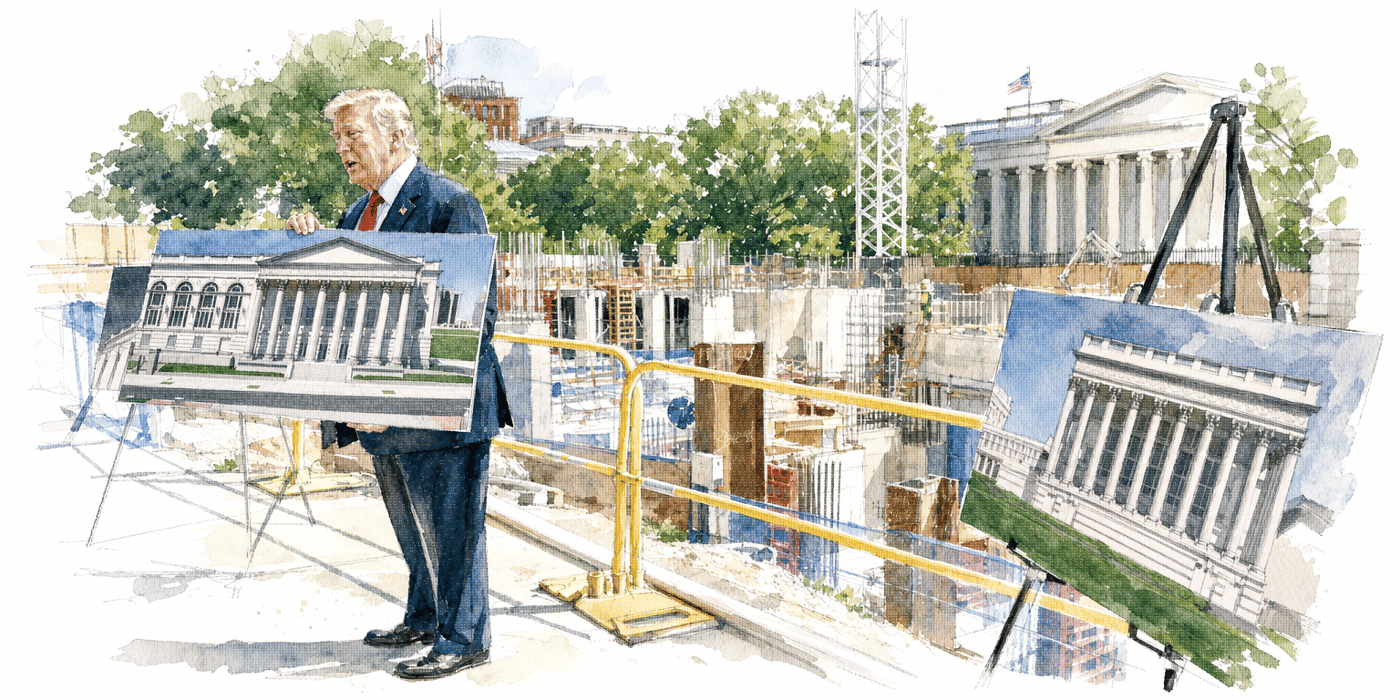

The nation has waited with bated breath to hear what the Supreme Court would say about President Donald Trump’s White House ballroom. Trump is a developer, after all, and the project is eminently sensible. But it’s not exactly the most important issue facing our nation. In an eight-page, unsigned opinion, the Court permitted construction to continue.
The 5-4 ruling hardly settles the fight, though. First, let’s review the timeline.
- June 6, 2025: President Trump teased a “new Ballroom ... at the White House.”
- July 31, 2025: The White House formally announced the project. Then-Press Secretary Karoline Leavitt said, “President Trump and other donors have generously committed to donating the funds necessary to build this approximately $200 million structure.” (The estimate is closer to $600 million now.)
- October 20, 2025: The White House commenced demolition of the East Wing, which took only three days and triggered leftists everywhere.
- December 12, 2025: The National Trust for Historic Preservation filed a lawsuit to stop the project, which was already well underway, arguing that it was an eyesore, lacked requisite congressional authorization, and had failed to secure the appropriate environmental and other reviews.
- March 31, 2026: U.S. District Judge Richard Leon issued an order temporarily blocking construction, though the order never took effect because of continued legal wrangling.
- August 7, 2026: The DC Circuit Court upheld Leon’s injunction, but stayed its ruling for 14 days.
- August 21, 2026: The Supreme Court issued its own order allowing construction to continue after Trump escalated the case.
That brings us to yesterday’s ruling, in which the Court again allowed construction to continue, finding that the plaintiff lacked standing to bring the suit in the first place. That may sound quaint, but it’s actually fairly fundamental to the case. As the DC Circuit Court determined when coming to the opposite conclusion, “Whether or not a massive ballroom should be constructed is for Congress to decide and is not a matter for Executive self-help.”
Thus, while Congress has standing, the National Trust for Historic Preservation does not. The White House legal team argues that Congress authorized the project by way of allowing presidents “to make ‘alteration[s]’ and ‘improvement[s]’ to the White House.”
Trump’s strategy has been simple: Make progress on the project faster than lawyers and judges can act, and then protest that it’s already almost done and should be seen through to completion.
After yesterday’s ruling, he boasted on Truth Social:
I am pleased to report that the United States Supreme Court has just ruled in favor of the Ballroom/Military Complex being built without any further contingency, doubt, or threat. We are living in the Golden Age of America, and this Building will be one of the Greatest ever constructed in Washington, D.C. When completed in the Summer of 2028, the magnificent Ballroom and Military Complex will be something that the entire Country is very proud of. The Project, despite the baseless lawsuit brought by the so-called National Trust for Historic Preservation of the United States, which is not in any way affiliated with the United States Government, is under budget and ahead of schedule. The Ballroom is totally funded by Great Patriots and Corporations and, therefore, is a Gift — At no cost to the American Taxpayer. Thank you for your attention to this matter! President DONALD J. TRUMP
Again, the president did not win over all the justices. Chief Justice John Roberts sided with the three leftists in opposing Trump’s project as “likely illegal,” regardless of its completion rate. “The ballroom is a building or structure being erected on federal park grounds — President’s Park — in the District of Columbia,” Roberts wrote. “Yet Congress has not passed any law resembling ‘express authority’ for the Executive’s construction of it.”
Even the majority couched its decision in standing rather than legality. “Today, we do not pass upon the legality of the government’s East Wing project,” the majority said. “We conclude only that, based on the submissions before us, the government is likely to prevail in showing that the Trust lacks Article III standing to challenge the project in federal court.”
The standing question centers on the plaintiff — Alison Hoagland, a preservationist who serves on the National Trust’s board. She claimed that “having to view the finished ballroom the government is constructing would cause her to suffer injuries to her aesthetic, cultural, and historical interests because she finds the scale, height, and massing of the government’s design distasteful.”
Well then.
The Supreme Court’s majority declined to indulge her aesthetic preferences, though Roberts went out of his way to support her, saying she can indeed be “aesthetically injured in a concrete, particularized way by the transformation of a historic building that she frequently enjoys.”
That is not how courts generally rule. “This Court has not found standing in circumstances like these before,” the majority wrote. “To the contrary, we have repeatedly held that mere offense, disagreement, or distaste does not qualify as a concrete and particularized injury under Article III.”
This leads me to wonder whether Roberts considers himself aesthetically injured by Donald Trump.
On a more serious note, constitutional law professor Josh Blackman believes Roberts was trying to flip Amy Coney Barrett’s vote, which is why his opinion reads more like a majority opinion that he grudgingly converted to a dissent.
On the question of congressional authorization, as I wrote last month, “Though there are good reasons for this construction project, it would certainly be preferable if President Trump did more with Congress and less unilaterally. Article I, Section 8, Clause 17 seems to include the White House within congressional purview.” Then again, Congress has generally abdicated this authority over the White House for the better part of our nation’s history.
“Today’s decision,” groused Roberts, “is no victory for the separation of powers.” Perhaps. But if Congress doesn’t mind the president proceeding as planned, why are the courts involved at all?