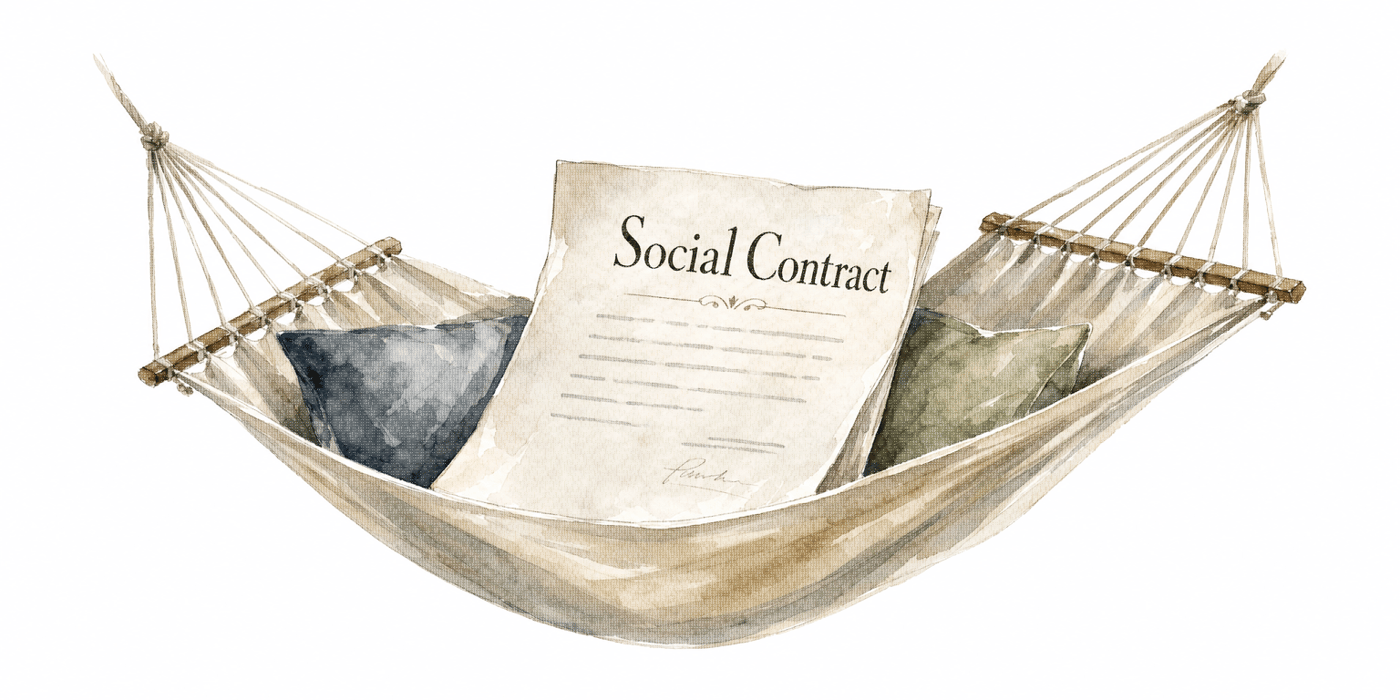

We ought to apply a fairly simple test to every political ideology and every government built upon one. It requires no elaborate economic model, no appeal to Marx, Locke, Rawls, Hayek, or anybody else. It does not even require us to decide in advance what constitutes the proper size of government. It only requires two imaginary groups of people.
Call them Segment Y and Segment X.
Assume that the entire population possesses roughly the same fundamental capacity distributed among them. They can work, make decisions, accept responsibility, plan for the future, and maintain the society in which they live. Obviously, individuals differ enormously, and every decent society makes provisions for children, the elderly, the seriously disabled, and people temporarily overwhelmed by circumstances.
That is not what I am talking about.
I am talking about a political philosophy that divides otherwise capable people into two functional classes: those expected to carry responsibility and those increasingly relieved of it.
Segment Y works, produces, saves, invests, raises families, pays taxes, and accepts responsibility for the consequences of its decisions (William Graham Sumner called them “the Forgotten Man”) even as Segment X is told its responsibilities belong to someone else. Housing, food, education, health care, retirement, childcare, transportation, and an ever-expanding catalog of “necessities” to a decent life become obligations not primarily of the person consuming them, but of society.
But “society” is not a separate, benevolent, munificent entity, and “society” has no bank account. Every promise made in its name eventually lands on Segment Y’s desk.
Here we can establish a surprisingly useful test of political legitimacy. No ideological movement, and no government organized around it, can remain legitimate with this operating principle: one group of capable adults transfers responsibility for maintaining themselves to another group of capable adults, with the government acting as the collection agency.
Civilization has always involved mutual obligations. Today I may need you. Tomorrow you may need me.
Communities care for people who cannot care for themselves, neighbors help neighbors after disasters, families support members who fall on hard times. Governments also provide public goods that individuals cannot efficiently provide on their own. None of this violates the principle because reciprocity remains embedded in the arrangement.
The problem begins when assistance ceases to be reciprocal insurance against misfortune and becomes a permanent assignment of responsibility from one class of citizens to another. At that point, the mathematical reality becomes pretty brutal.
Segment Y’s resources, productive capacity, and willingness to surrender the fruits of its labor are finite. Segment X’s potential wants, by contrast, have no natural ceiling. Human wants are infinite, and once government accepts the proposition that a desire creates an obligation on somebody else, another need will always be just around the corner.
Free food, free housing, free healthcare, free college, free transportation, internet, childcare, paid leave, and retirement — the Democrat Party and its DSA shock troops have transformed these from desirable things into “rights” simply by changing the vocabulary.
Too bad calling something a right doesn’t make it one, especially if it requires somebody else’s labor, property, or money.
That is the beginning of the death spiral.
As benefits increase, the incentive to belong economically to Segment X increases while the incentive to remain in Segment Y declines. People respond rationally to incentives. If working an additional hour produces little additional disposable income because taxes rise and benefits disappear, people will work less. That decision matrix already exists. If government assumes risks previously borne by individuals, individuals have less reason to avoid those risks.
Meanwhile, Segment Y isn’t just sitting idly by. Though X hates it, Y seeks strategies to keep its production — tax shelters, reducing investment, retiring earlier, moving elsewhere, restructuring their businesses. Demand for a productive population increases, incentives to produce decrease, and Y becomes hostile toward the arrangement.
Even worse, our cynical, transactional politics accelerates the process.
Votes are won by promising additional benefits to X, not by announcing that people must assume greater responsibility for themselves. The politician offering another benefit appears compassionate. The politician asking who will pay for it appears cruel. Government therefore develops a structural bias toward expanding obligations faster than the productive economy supporting them.
Eventually, the argument becomes moral rather than mathematical. Segment Y is no longer thanked for carrying the burden. It is condemned for possessing the resources from which the burden is financed. Its productivity becomes evidence of privilege. Its accumulated wealth becomes proof that it has not contributed enough. Success itself becomes the justification for another claim upon it.
It is no shocker that this cannot continue indefinitely.
There is an enormous difference between a society in which capable people accept primary responsibility for themselves while collectively caring for those who genuinely cannot, and a society in which responsibility itself has been collectivized. The first creates a safety net beneath a population expected to stand. The second gradually creates a hammock and then wonders why fewer people are standing.
The question, therefore, isn’t whether the government should help people. Of course it should in certain circumstances. The question is what principle governs that help.
A legitimate social contract must contain reciprocity. Duties must accompany rights, and assistance must preserve responsibility rather than extinguish it. Those capable of contributing must remain expected to contribute because no civilization can permanently divide itself into people entitled to receive and people obligated to provide.
Without that mutual responsibility, Segment Y is eventually drained of one of three things: money, productive capacity, or patience. Usually, it runs out of all three.