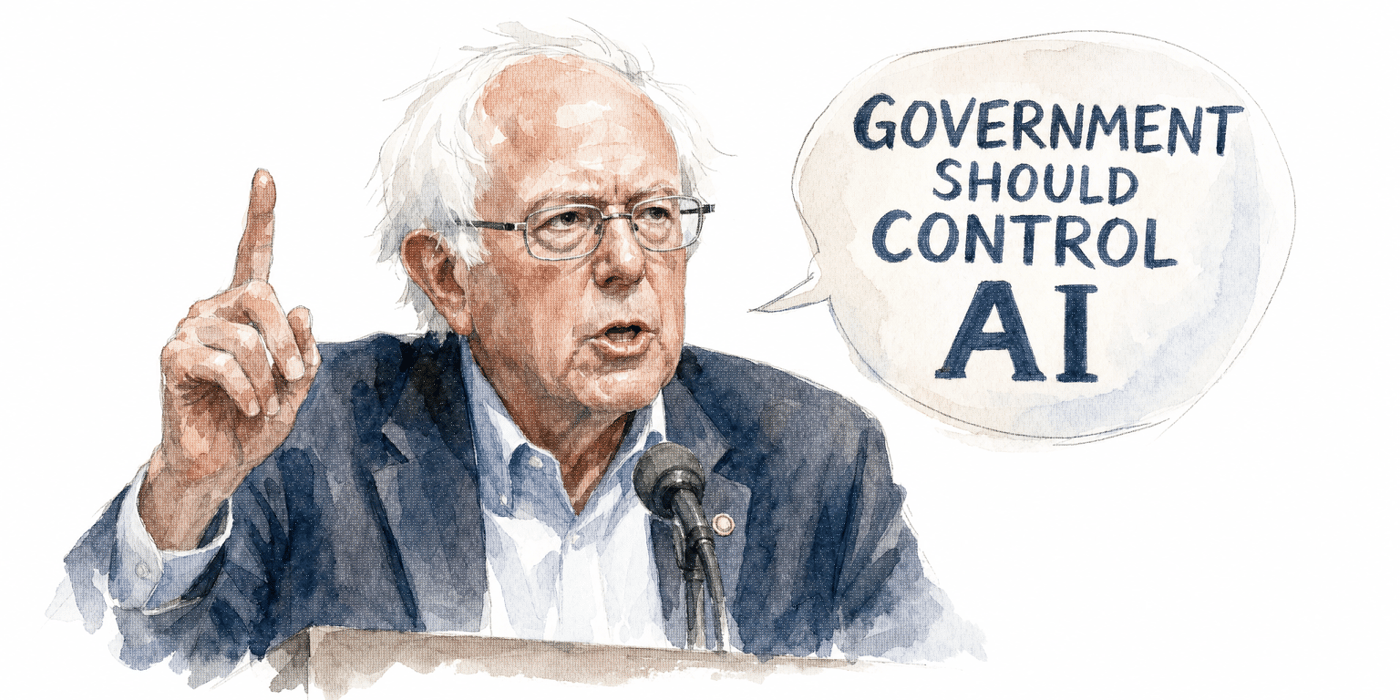

Socialist Vermont Senator Bernie Sanders recently announced his joint effort with Texas Democrat Representative Greg Casar “to stop AI oligarchs from building machines humans cannot control.”
Dubbed the Ban Artificial Superintelligence Act, the legislation would create a “corporate death penalty” against a company caught engaging in “superintelligent” AI development, including up to a 20-year prison sentence for individual violators.
Sanders’s bill would “permanently ban the development and deployment of superintelligent AI and temporarily pause advanced AI development until a federal regulator has established safety rules.”
Effectively, this bill would create a new AI regulatory agency with broad powers to enforce what it deems compliant AI development, but only after a moratorium on all AI development so the agency can set new AI rules. Sanders also envisions this agency having the power to physically destroy “non-compliant tech systems.”
While being broadly anti-AI has become a popular position, this legislation is a recipe for economic and geopolitical disaster. Indeed, it is so bad that one can’t help but wonder if China is funding Sanders’s fearmongering.
And what of China, the wannabe global superpower with which the U.S. is currently in an AI tech development race? Wouldn’t Sanders’s legislation mean that the U.S. is throwing up its hands and throwing in the proverbial towel?
Well, according to Sanders, the U.S. would seek international agreements and concessions from China and other nations to ban AI superintelligence development, too. That model has worked so well with climate change and CO2 emission reductions. Oh, wait...
When has China ever been a good-faith actor when it comes to its own geopolitical aims? In fact, the AI development race is largely because of Beijing’s long practice of intellectual property theft.
Apparently, though, for Sanders and Casar, the bigger threat comes not from humans but from AI. “Nearly every day, there is a frightening new story about how Big Tech companies are losing control of the technology they are developing, with potentially cataclysmic results,” Sanders contends. “The leaders of the major AI companies publicly acknowledge that they do not fully understand the technology and that it is escaping their control.”
He then argues, “It is irresponsible for society to allow them to move forward and make these products even more advanced. ... The future of humanity cannot be left in the hands of a handful of Big Tech oligarchs. The American people and people throughout the world must determine that future.”
On the one hand, Sanders asserts that AI tech is “escaping” Big Tech’s control; on the other, he argues that individual “Big Tech oligarchs” shouldn’t control society.
So is the problem uncontrollable AI tech, or is it wealthy Big Tech companies and individuals using AI development to impact society for their own ends?
Sanders’s true objection to developing AI technology seems more tied to his views on government and economics than to the technology itself. In other words, a socialist like Sanders sees capitalism as the problem with the burgeoning AI industry.
This isn’t to say there aren’t problems with AI technology, seen and unforeseen, but creating a new government agency staffed with “do-gooder” bureaucrats to regulate its development is more of a problem than any realistic threat from the technology itself.
There is little doubt that as the industry develops, certain regulations will be developed to address specific concerns. But broad-brushing the industry so negatively is disingenuous and irresponsible, given that it is already well established and offers many positive tools to advance not just the American economy but also the world economy.
Sanders’s instinctive call for greater government control shows why socialist nations have always struggled to innovate and technologically develop.