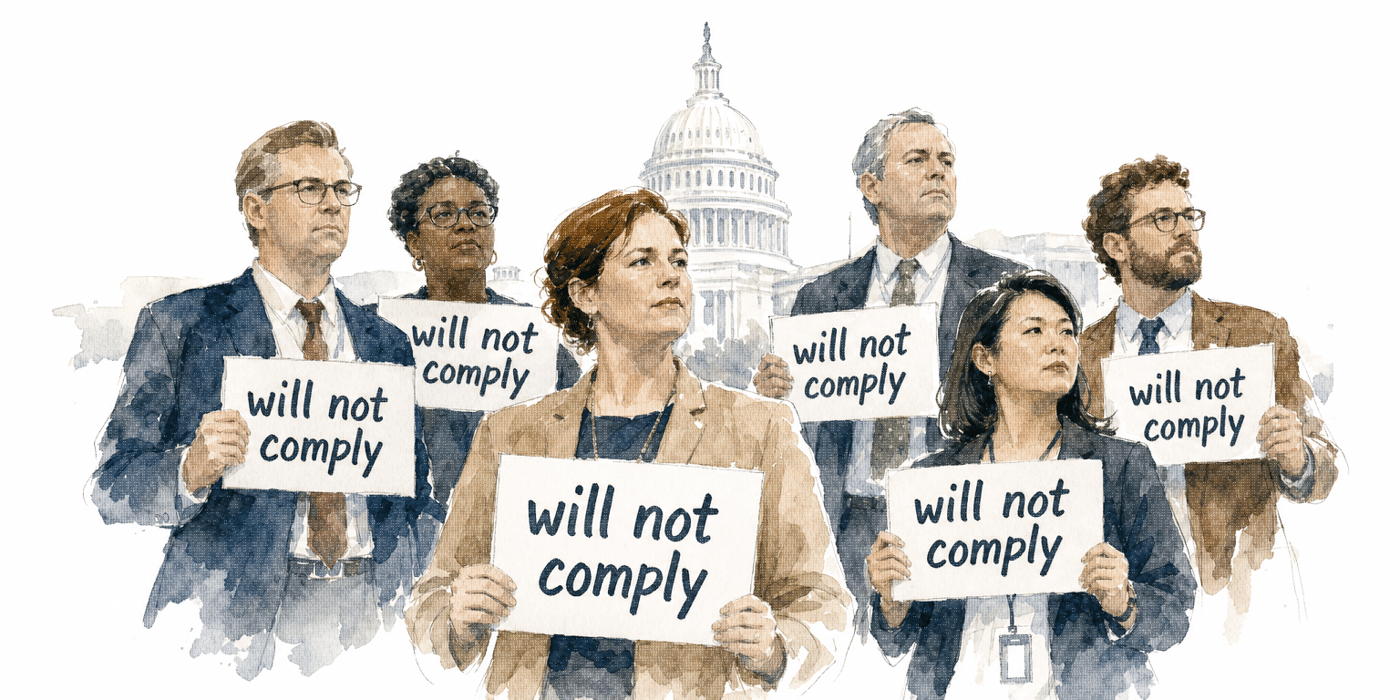

The American government was founded on the principle of shared power because the Founding Fathers understood human nature. As Lord Acton famously observed, “Power tends to corrupt, and absolute power corrupts absolutely.”
Thus, the American governmental system of three coequal branches is intended to both complement and check the accumulation and usurpation of power.
The executive branch, which has long been the largest branch of the federal government, is only so because it has accumulated a massive bureaucracy over our history. This bureaucracy, which mostly resides in Washington, DC, has effectively become a fourth branch of government, contrary to the Founders’ design.
Technically classified under the executive branch, this fourth branch has, with the help of Congress, accumulated significant unelected power to run much of the federal government, and in turn the nation, via a vast regulatory state.
This fourth branch of government numbers about two million people, who are supposed to be answerable to the American people through the election of the head of the executive branch, the president.
Yet this federal workforce has sought to establish a system that is independent of the president’s political agenda. Hence the “fourth branch” identification, also known as the deep state.
In his second term, President Donald Trump has sought to crack down on the deep state within the executive branch, challenging many of these bureaucrats’ “independent” claims.
This has resulted in unelected bureaucrats filing numerous lawsuits, trying to keep their jobs and prevent Trump from pursuing his agenda. Since January 2025, this fourth branch has filed 18 lawsuits, with the latest coming courtesy of the American Federation of Government Employees union, or AFGE.
The AFGE is suing the White House’s Office of Personnel Management (OPM) over new federal employee rules and evaluation standards.
Unsurprisingly, the AFGE is joined in filing lawsuits by various leftist organizations, such as Democracy Forward. Their agenda is clearly to oppose Trump’s efforts to implement new rules, which is why Americans elected him in the first place.
They are resisting Trump’s efforts to reshape the executive branch. Of course, AFGE players deny this is their motivation; however, their own objection to his changes to the bureaucracy belies this reality. As Capital Research Center Director Michael Watson observes, “It should not be surprising that the professional Left and the AFGE are working hand-in-glove.” The AFGE is “the representative organ of the federal civil service attempting to enact its own policy preferences through litigation.”
Meanwhile, the Trump administration “is attempting to weaken the power of unions like AFGE to carry out their own policy preferences against the policies laid out by the people’s elected representatives and the executive officers who have been chosen to carry out the laws made by Congress.”
This latest lawsuit over the OPM’s federal employee rule change demonstrates this reality. These rules give the OPM greater authority to evaluate employees’ performance, making it easier to discipline or fire them. OPM Director Scott Kupor explained that the new rules fix a long-observed problem where “the federal government has had stronger tools to prevent someone with serious misconduct from entering public service than to address the same misconduct once that individual is already employed.”
This view and attitude have long dominated Washington’s work culture. To put it bluntly, if you can land a government job, then you’re in for life because it is almost impossible to get fired. This attitude toward government employment is terrible and desperately needs correcting. Indeed, it explains how the fourth branch came into existence in the first place.
The whole concept of public service needs to return. Those engaged in actual public service should be held to higher standards, not lower ones.