
As a ’90s baby who grew up just outside of Chicago, I was a fan of the Chicago Bulls. More specifically, I was a fan of Michael Jordan, who visited my public school once for a fun assembly.
Michael Jordan was Chicago basketball. He was also Nike, whose brand reached new heights because of their lucrative relationship.
In the ’90s, Nike really understood the sports cultural zeitgeist. It promoted great athletes, who in turn sported its athletic wear. This reciprocal relationship has worked for years. In the last decade, however, Nike strayed from the formula, largely because it forgot what Michael Jordan famously said in the ’90s about why he didn’t get political: “Republicans buy shoes too.”
Nike went full woke in 2018 when it threw its advertising weight behind failed former NFL quarterback Colin Kaepernick. At the time, Kaepernick was an active player who made headlines for his repeated stunts of kneeling and sitting during the national anthem because he said that he wouldn’t stand for a nation that oppresses people of color. He later infamously wore socks that called police “pigs” in a protest against their “oppressive” ways of enforcing the law.
Assuming that all of America was on the “social justice” bandwagon, Nike pulled a Fourth of July-themed shoe the following summer. The company’s logic was that if people thought America was racist, it wouldn’t be able to sell a shoe with the Betsy Ross flag as its design.
Nike’s culture war faux pas continued. During the 2020 Summer of Love Rage, the company was a huge donor to Black Lives Matter. Who knows where that money went. Perhaps Patrisse Cullors knows.
In 2023, after the Bud Light debacle, Nike partnered with Dylan Mulvaney, a gender-confused man who thinks he is a girl. Mulvaney had already sparked the Bud Light boycott, but Nike doubled down and had him advertise and prance around in women’s leggings and sports bras.
Last month, OutKick reported on the final nail in Nike’s culture-war coffin. According to Dan Zaksheske, “Evidence indicated Nike had helped fund a study involving ‘transgender’ youth athletes as young as 12. The proposed research was designed to track athletic and physiological changes among young people undergoing so-called ‘gender-affirming care.’”
After word got out in 2025, the company quickly stopped supporting the study. Since then, the company has been plagued by the woke taint it brought upon itself.
The company has also faced other complications, both internally and internationally.
Nike has suffered internally from the takeover of female middle management, putting all its chips in the China basket while neglecting the home market. It has used China’s cheap labor for over 40 years and banked heavily on its marketability there. How does China reward such neck-showing? By elevating its own athletic wear companies and shivving Nike.
However, Nike just can’t bounce back in the U.S. because it has alienated one particular customer: the suburban mom, who has far better and cheaper options for athletic wear than Nike. Plus, those other brands aren’t promoting a mentally ill man masquerading as a woman as its ambassador for bras and leggings.
Nike also suffers from the same malady as Disney: resting on its name-brand recognition without being innovate or creative. For example, its latest NBA collaboration, the Specter Edition NBA uniforms, is a bland, dark, uninspired design trying to sell to a population that doesn’t exist. There’s no market for what Nike is peddling, but it doesn’t seem to care.
Investors are leery of putting their money behind a brand unwilling to be transparent with its charitable giving and subject to an EEOC investigation into its racially discriminatory hiring practices.
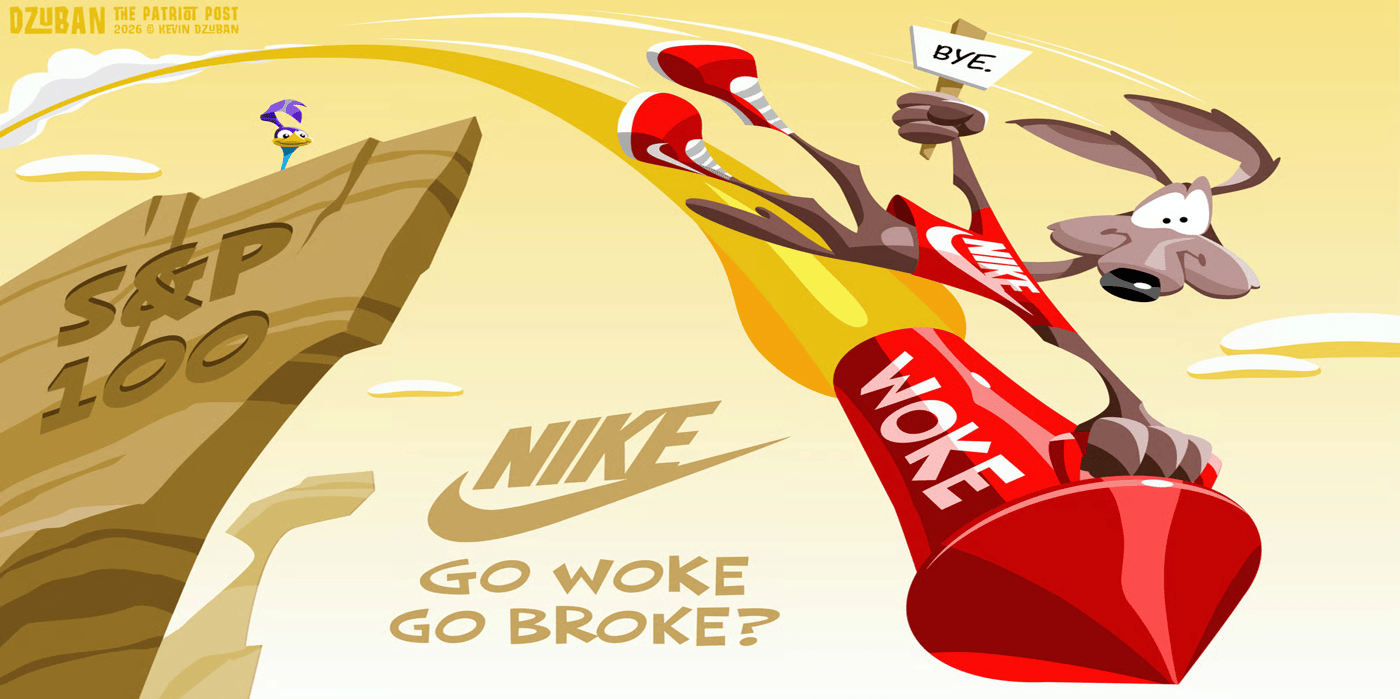
Nike has fallen drastically since its peak in 2021, with its market cap sinking by $200 billion. It is being dropped from the S&P 100, and after 18 years it is losing its blue-chip status.
Ultimately, Nike is guilty of being unwilling to navigate market demands in a way that matches reality. It bet on the wrong country, the wrong people, and the wrong ideology, and its market value has paid the price. It’s a disappointing downfall for a former all-American company.