
Can anyone in this country explain what the law says concerning mail-in ballots? I sure as heck can’t. I suspect you can’t, either. So is it too much to ask, given that former Trump Attorney General William Barr was sounding the alarm about all this some six years ago, that the Supreme Court provide a bit of clarity on the constitutionality of mail-in balloting?
Answer: Yes.
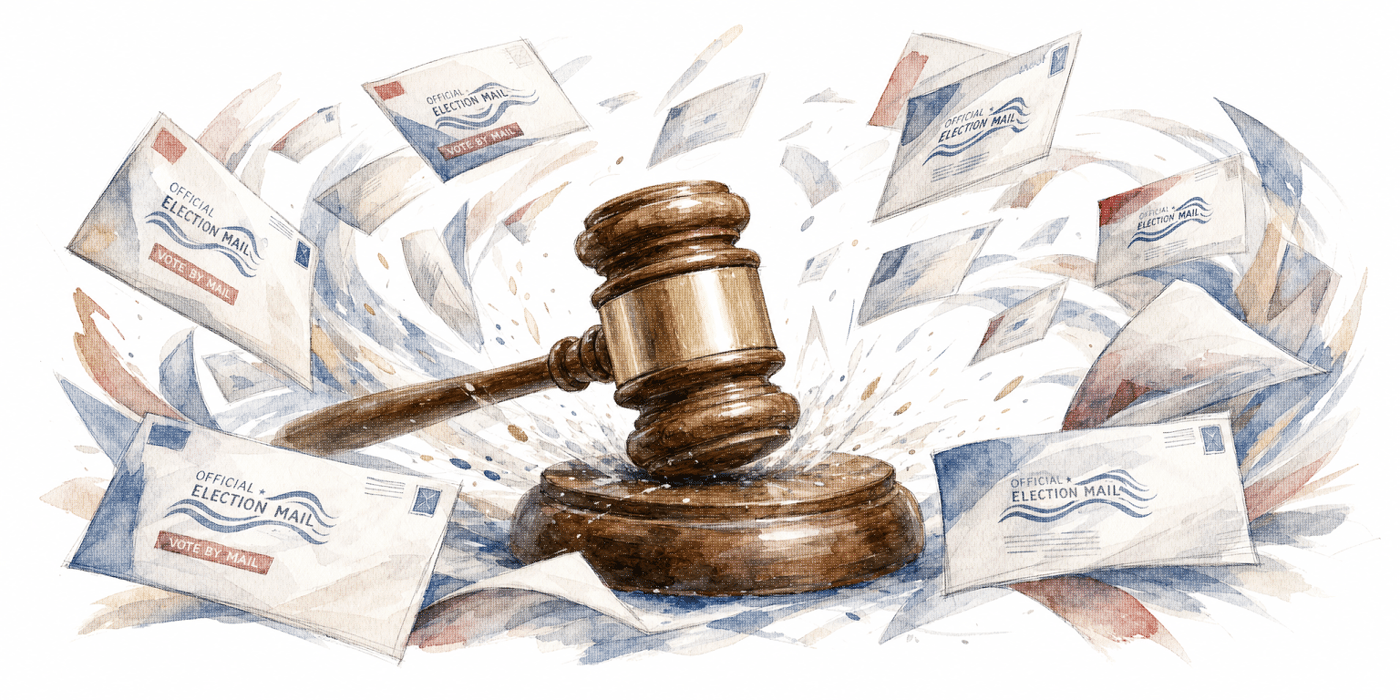
Late yesterday, the High Court opted for electoral chaos and suspicion, rejecting the Trump administration’s last-ditch effort to enforce new U.S. Postal Service restrictions on otherwise fraud-friendly mail-in ballots. As Fox News reports, “In a brief order, the court said the government was ‘unlikely to succeed on the merits’ for purposes of obtaining emergency relief and had not shown that the legal and practical considerations warranted a stay.”
Not surprisingly, rock-ribbed Justice Samuel Alito disagreed. “The Government,” he said, “has made the showings necessary for a stay, so I respectfully dissent.”
So much for a Supreme Court ruling late last month that allowed a Trump administration executive order restricting mail-in voting to remain in place.
Regarding yesterday’s ruling, the Postal Service restrictions would’ve required federal ballots to be contained in envelopes with an electronically scannable election-mail logo — a logo containing a unique barcode for each voter. Such a system would’ve made it immeasurably more difficult for Democrats to find just enough votes in those swing congressional districts that’ll determine which party controls Congress for the final two years of Donald Trump’s presidency.
Instead of ruling on the side of security and confidence, though, the Roberts Court left a lower court’s nationwide block in place, thereby green-lighting yet another electoral cycle of bulk-mail ballot fraud.
I dunno, maybe John Roberts likes presiding over presidential impeachment hearings. Because that’s exactly what he’ll be doing early next year if the Democrats have their way on November 3.
Regarding the scourge of mail-in voting, it’s instructive to revisit AG Barr’s warning to CNN’s Wolf Blitzer and his dozens of viewers back in 2020:
The bipartisan commission chaired by Jimmy Carter and James Baker said back in 2009 that mail-in voting is fraught with the risk of fraud and coercion. … The only time the narrative changed is after this administration came in. ...
We’ve had absentee ballots from people who request them from a specific address. Now what we’re talking about is mailing them to everyone on the voter list, when everyone knows those voter lists are inaccurate. ... Do you think that’s a way to run a vote?
This is playing with fire. We’re a very closely divided country here, and people have to have confidence in results of the election and the legitimacy of the government. And people trying to change the rules to this methodology — which as a matter of logic is very open to fraud and coercion — is reckless and dangerous. And people are playing with fire.
Bill Barr was no Trump toady, no partisan hack. Where electoral fraud is concerned, he was a wise old owl. Republicans have, ever since, tried to heed his warning and improve our election system. And the American people, Republican and Democrat, have shown overwhelming support for the SAVE America Act and its two most fundamental reforms: photo ID and proof of citizenship. But not congressional Democrats. I wonder — don’t wonder — why.
All isn’t lost for free and fair elections, though — at least not just yet. As Fox News reports, congressional Republicans have an end-run plan to pass key portions of the SAVE America Act before year’s end.
House Speaker Mike Johnson is pushing Republicans to pass the SAVE America Act’s main mandates via budget reconciliation — which would bypass the Senate Democrats’ filibuster.
“I’d rather pass the SAVE America Act,” said Wisconsin Congressman Brian Steil, who’s spearheading the effort. “But recognizing that the Senate might not be able to get that done with the 60-vote threshold, let’s leverage the parliamentary procedure, bring that threshold down to 50, and get some really commonsense reforms done.”
Given the intransigence of Senate Majority Leader John Thune and his, er, fellow Democrats, it’s a shame that House Republicans didn’t act on this months ago. The clock is ticking, and I don’t see how any of this happens in time to improve the integrity of the November 3 midterms.
Ultimately, it’s a bad thing when a citizenry has no confidence in its nation’s voting system. But it’s an even worse thing when a citizenry can’t even begin to explain the laws governing its nation’s voting system.
John Roberts and his “conservative” Supreme Court have had years and innumerable opportunities to help bring much-needed clarity to the crisis of confidence that plagues our electoral system and jeopardizes the legitimacy of our Republic.
And they have failed miserably.