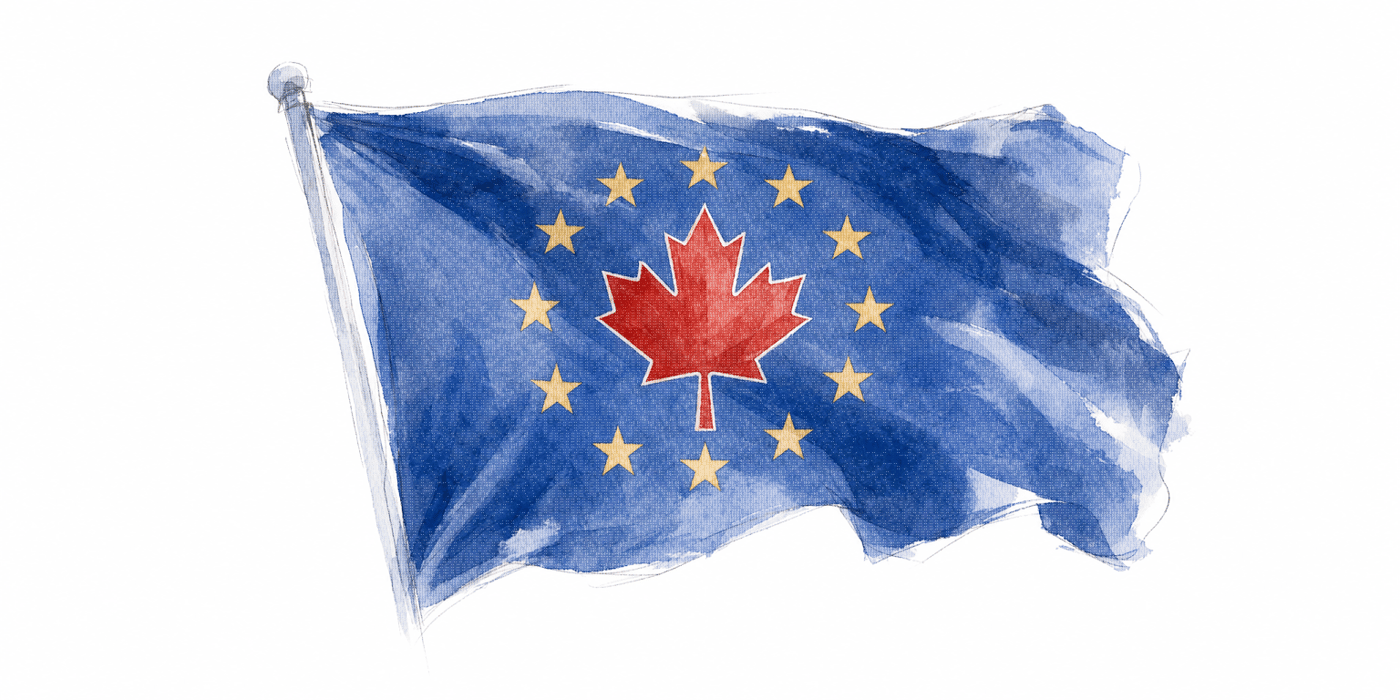

When Canadian Prime Minister Mark Carney decided to pick a trade fight with President Donald Trump, he must have believed his bluff would pressure Trump into capitulating to his demands.
In his typical fashion, Trump instead chose to tweak Carney by renaming Lake Ontario to Lake America. It mocked Carney’s supposed serious trade stance and his claims that he would not let Trump bully Canada.
The glaring problem for Carney is the fact that Trump effectively holds all the cards.
For example, 75% of Canada’s trade is with the U.S., whereas just 10% of U.S. trade is with our northern neighbor. Economically, Canada isn’t really hitting it out of the park right now, as it currently has the lowest GDP of any industrialized nation.
The main point is that Canada depends on America for its own economic survival, whereas the U.S. can get by just fine without Canadian goods.
In its trade negotiations with Ottawa, the Trump administration sought a genuine free trade agreement that wasn’t limited by protectionist policies.
Meanwhile, Canada has long taken advantage of its geographic position with the U.S. as a NATO member, only meeting the agreed-upon 2% of GDP spending on defense for the first time in 2026. In other words, the U.S. has provided security for Canada for years with little economic reciprocity.
When Carney backed out of trade negotiations at the last minute in August, he claimed the U.S. was being unreasonable and threatening Canadian sovereignty. However, his latest gambit in the trade dispute exposes these claims as vacuous. Carney is seeking a first-ever associate membership status with the European Union, an idea proposed this week by European Commission President Ursula von der Leyen.
Canada and the EU already have a free trade agreement, the EU-Canada Comprehensive Economic and Trade Agreement (CETA), signed back in 2017, that eliminated 99% of tariffs between the two economies.
So, how would an as-yet-undefined associate membership with the EU translate into greater trade between them? For Carney, it seems that it’s not really about trade at all; rather, it’s about distancing Canada from the U.S. and bringing it closer to globalist-minded Europe.
“This alliance is a positive process; that’s my response to the American president. A stronger, more resilient, more sovereign Canada will be a more effective partner with the United States,” Carney explained. “Canadians are united that nobody is going to tell us what language we speak; no one is going to dictate our culture or with whom we can strike agreements internationally.”
That last point is ironic, given that pushing Canada into EU membership would undermine Canadian sovereignty, not strengthen it. Inviting Brussels bureaucrats into Ottawa doesn’t smack of independent sovereignty.
Indeed, this move displays that Carney himself, a man who holds British and Irish citizenship, along with his Canadian citizenship, is more globalist and apparently more European than North American.
Trump called Canada’s move “laughable,” and he also warned Europe, “If they do that, if I think it’s at all a hostile act, I will put very serious tariffs or stop trading with Europe on many things.” He added, “If Europe does that with a bad intention — if it’s a good intention, that’s fine — if it’s a bad intention, we’ll put very heavy tariffs on Europe.”
Trump knows that even if Canada should follow through on this EU associate membership nonsense, it will do little to solve the trade dispute with the U.S.
In fact, given von der Leyen’s push for the novel idea, the EU leadership’s primary motivation appears to be countering Trump’s reestablishment of U.S. geopolitical and economic leadership. Europe’s globalists have long sought to shape the global economic future, including that of the U.S. Trump has served as a wrecking ball to their globalist agenda, prompting them to court Canada to align more closely with EU interests rather than U.S. interests.
What will be interesting to see is whether this move by Carney helps build greater public support for his leadership in Canada, especially in provinces like Alberta and Quebec, or whether it does the opposite and spurs secession efforts.